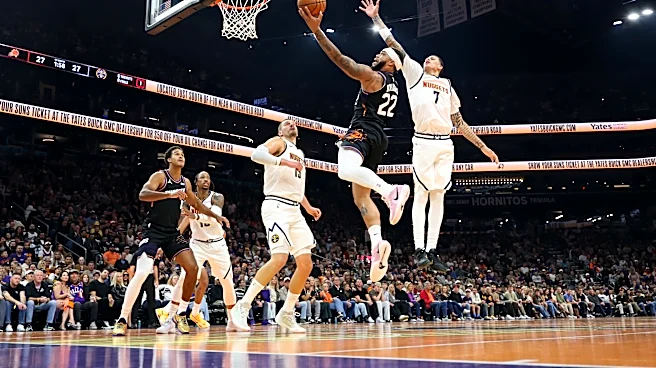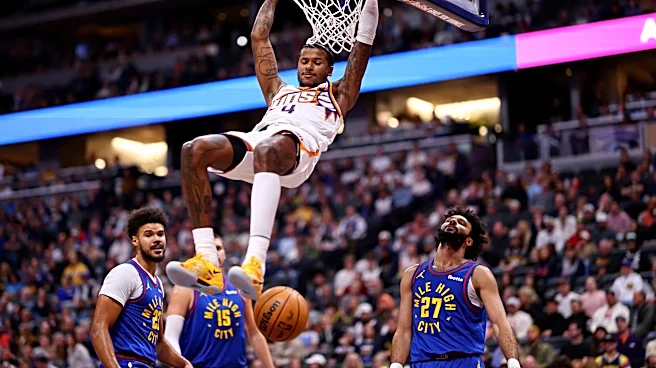



The Phoenix Suns, on the second night of a back -to-back, made the journey to the Mile High City to open up their five-game road trip. The result? A 117-105 win.
It was a solid team victory for the Phoenix Suns, who once again watched their starting unit struggle early before the bench provided a highly effective and efficient first-half performance. In the second half, however, we saw a much more engaged version of the Suns’ starting five, helping Phoenix build a lead that grew as large as 19 points.
The Suns shot 44.4% from beyond the arc, knocking down 16 three-pointers while winning the rebounding battle by a convincing 51-35 margin. And while Denver owned the interior early in the game, scoring 38 points in the paint in the first half, Phoenix surrendered only 12 in the second half. The Suns also converted 18 Denver turnovers into 31 points, reminding us how effective this basketball team can be when it’s playing with defensive aggression and purpose.
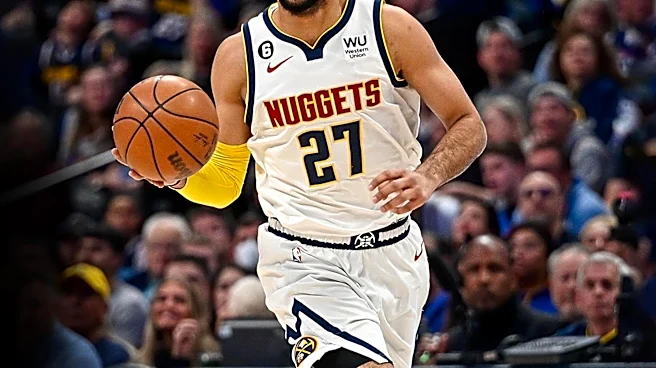
Nikola Jokic and Jamal Murray each finished with 28 points, but Phoenix countered with a balanced offensive attack throughout the evening. Devin Booker led all Suns scorers with 20 points despite shooting 5-of-14 from the field, and seven Phoenix players finished in double figures.
On the second night of a back-to-back, on the road, against a quality opponent, the Suns received meaningful contributions throughout their rotation. They defended, they rebounded, they knocked down their shots, and they looked increasingly connected as the game progressed. That’s the version of Phoenix Suns basketball we’ve been waiting to see with greater consistency.
The win is the Suns’ first on the road and moves the team to 6-7 on the year.
Game Flow
First Half
If you were hoping to see some adjustments to the starting five, prepare to be disappointed. The Phoenix Suns rolled out the same starting lineup they’ve deployed for the majority of the season.
The starting unit played Denver even through the first 5:37 of the game. That said, the Suns were uncharacteristically careless with the ball, committing four early turnovers that led to four easy points for the Nuggets.
Denver was making its living in the paint, scoring 22 of its 24 first-quarter points there. Neither team could find much success from beyond the arc, combining to go 1-of-11 from deep, with the lone triple coming courtesy of Jordan Goodwin.
Nikola Jokic and Cam Johnson each scored six points to lead the Nuggets, while Goodwin paced the Suns with five. It was a relatively uninspiring quarter of offensive basketball, with Phoenix trailing 24-20 heading into the second period.
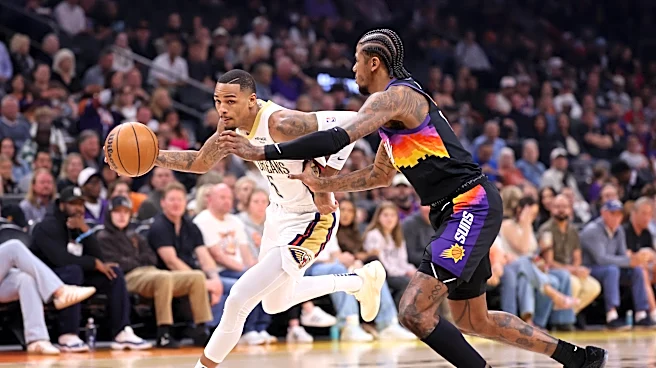
The second quarter began with an interesting adjustment: Dillon Brooks shared the floor with Luke Kennard, Khaman Maluach, Jordan Goodwin, and Collin Gillespie. You could sense that Brooks felt more empowered to be the alpha offensively within that unit, taking the majority of the shots and asserting himself as the primary scoring option. The problem? He wasn’t hitting them, going 1-of-4 from the field through the first three minutes of the quarter.
Khaman Maluach checked out, and in came Koa Peat. You could immediately feel his impact on the group as a whole. There was more physicality, more activity on the glass, and a greater sense of balance.
With Collin Gillespie, Luke Kennard, Dillon Brooks, Miles Bridges, and Peat on the floor, the Suns deployed a small ball lineup despite Denver having Marvin Bagley III out there. It was an effective blend of physicality, rebounding, defense, and perimeter shooting, and Phoenix put together a 13-3 run as a result. Peat was only out there for 1:16, but he was a +5.
Nikola Jokic returned, as did Oso Ighodaro, and the Joker went right back to abusing Phoenix down low. The starting unit eventually returned, with Luke Kennard in place of Dillon Brooks. And with them came the turnovers.
Jordan Ott opted to utilize both of his challenges within a three-second span. He was successful with the first, as the basketball went out of bounds off Nikola Jokic, but unsuccessful with the second, as the foul called on Collin Gillespie was upheld. So with 2:03 remaining in the second quarter and the score tied at 51–51, the Suns were already out of challenges.
It was a miserable shooting half for Devin Booker, who made only one field goal and finished with five points, courtesy of going 3-of-4 from the free-throw line. He did distribute the basketball effectively, recording seven assists, although he also committed two turnovers. But hey, he collected his 3,000th career rebound. There’s something to celebrate.
Nikola Jokić led all scorers with 16 points at the half, shooting 7-of-14 from the field. Denver continued to make its living down low, with 38 of its 53 points coming in the paint. The Suns, however, held a 12-6 advantage in second-chance points and a commanding 28-9 advantage in bench scoring.
Perhaps the most encouraging statistic of the first half? The Suns were winning the battle on the glass, outrebounding the Nuggets 27-19. Given what we’ve witnessed through the first 12 games of the season, that’s a refreshing development. Like a Cherry 7UP.
The Suns’ bench matched the production of the starting five, with both units scoring 28 points in the first half. The difference was in how efficiently they got there. The starters shot 37% from the field and 14.3% from beyond the arc while committing eight turnovers. Meanwhile, the second unit shot a blistering 73.3% from the field, going 11-of-15, while connecting on 60% of its three-point attempts and committing only two turnovers.
Once again, the bench was responsible for keeping Phoenix afloat. And despite Devin Booker’s rough shooting performance in the first half, the Suns entered halftime with a 56-53 advantage.
Second Half
The Denver Nuggets, a team not particularly known for its perimeter shooting, came out of halftime and promptly knocked down three triples. Take Jamal Murray out of the equation, and this is a team that shoots 30% from beyond the arc.
Denver lost its challenge with 9:12 remaining in the third quarter after a foul called on Murray against Jalen Green was upheld. What made the decision more significant was that it was Murray’s fourth personal foul, presumably why Nuggets head coach David Adelman elected to challenge the play.
Green followed it up with an impressive transition dunk that tied the game at 62. On Denver’s ensuing possession, Green came away with another steal and drew a foul while aggressively attacking the basket.
And wouldn’t you know it? Dillon Brooks picked up a technical foul after knocking down a three-pointer. His crime? Yelling at the opposing bench, something we’ve obviously never seen another NBA player do after hitting a three-pointer. But his reputation precedes him, and the officials assessed him his third technical foul of the season.
The starting five looked considerably scrappier to open the third quarter than we’ve grown accustomed to seeing this season. Through the first six minutes of the period, the unit was a +3, forcing five Denver turnovers and converting them into 11 points. There was a welcomed sense of defensive aggression from a group that has struggled to consistently establish it.
The Suns extended their lead to 10 points following Devin Booker’s first three-pointer of the evening. Phoenix allowed Denver to get within five points before putting together a 9-0 run that helped extend its lead to 13. The Nuggets responded with a 5-0 run to close the quarter, trimming the deficit to single digits.
Overall, the Suns outscored the Nuggets 34-29 in the third quarter, including a 31-5 run, surrendering only six points in the paint after allowing 38 in the first half. Their defensive aggression continued to pay dividends as well, converting six Denver turnovers into 14 points.
The Suns carried a 90-82 advantage into the fourth quarter.
Phoenix opened the fourth quarter with a 7-0 run, prompting a David Adelman timeout as Phoenix extended its lead to a game-high 15 points.
With Nikola Jokic on the bench, you knew Jamal Murray was going to take it upon himself to get the Nuggets going offensively, and he scored all six of Denver’s points through the first five minutes of the quarter. But the Suns’ effort on the glass was magnificent early in the fourth.
Meanwhile, the Suns were playing collective basketball and relentlessly attacking the offensive glass. They secured six offensive rebounds through those first five minutes, generating six second-chance points. Those extra possessions were vital in preventing Murray from generating any significant momentum for Denver and allowing Phoenix to maintain control of the game.
The starting unit returned, and Denver promptly knocked down a couple of three-pointers. It also felt as though the whistle tightened up, as Jalen Green continued to aggressively attack the basket without being rewarded with trips to the free-throw line.
With four minutes remaining, Denver deployed the Hack-an-Oso strategy, and Jordan Ott was having none of it. He immediately pulled Oso Ighodaro from the game, opting to deploy a small-ball lineup with Miles Bridges at center and the Suns protecting a 14-point advantage.
Jamal Murray was feeling it, knocking down a three-pointer and following it up with a jumper. He then drew a foul on a three-point attempt, helping the Nuggets pull within eight points with 1:46 remaining. Ighodaro subsequently returned to the floor.
Devin Booker responded by burying a big 17-footer to push the lead back to 10, and that one felt like the dagger. Murray scored again, bringing his fourth-quarter scoring total to 18 points, but with 34 seconds remaining, it essentially became a free-throw shooting contest the rest of the way.
Suns win, 117-105.
Up Next
It’s off to Sac Town for the Suns’ first game against the Kings this season.