



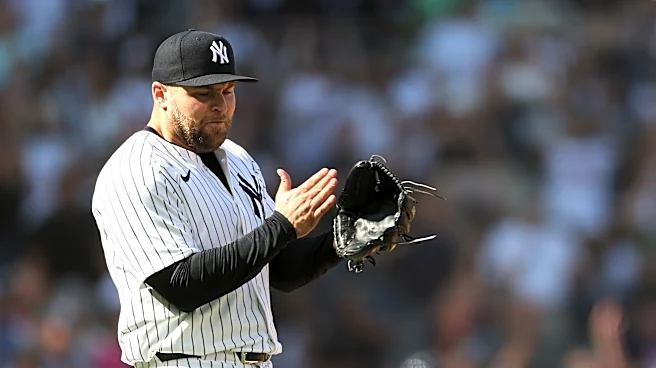
Every year, the Yankees seem to pluck an unknown reliever from another roster and magnify the things he does best, converting another team’s trash into their own treasure. Clay Holmes, Ian Hamilton, Jake Cousins, and Luke Weaver stand out as notable recent examples, and it looks like we can add another name to that list. Claimed off waivers from the Twins prior to the start of last season, Brent Headrick has been a strikeout machine through the first two weeks of the season.
We join Headrick with
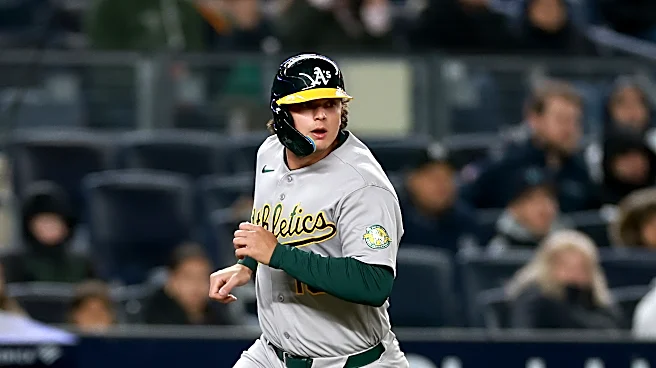
two outs in the top of the sixth, the Yankees trailing the Athletics, 3-1, in the series opener. There are runners on the corners after Jake Bird allowed a leadoff single and was replaced by Headrick, who walked Lawrence Butler with two outs. With the offense stuck in neutral to this point in the game, it became imperative that Headrick strand the two runners to keep the deficit at two.
Headrick starts Max Muncy with an elevated four-seamer — his bread-and-butter pitch.
Even though this pitch comes in at just 93 mph — a tick and a half below league-average velocity for a four-seamer — Muncy isn’t close to catching up with it. It possesses an eye-popping 20 inches of induced vertical break and gets on the hitter faster than expected due to Headrick’s elite extension — the combination of the two leading to a late swing underneath.
Now that he has shown Muncy the high cheese, he attempts to induce a chase on a slider down and in.
Unfortunately, he executes badly, missing his spot outside by more than a plate’s width, making for an automatic take from Muncy.
Rather than panic, Headrick attempts to leverage the poor execution of the previous pitch. After missing so far outside, there is an opportunity to steal a called strike if he can hit his target away with the heater.
The fastball is executed well this time, just off the plate low and away. Muncy is all over the pitch from a timing perspective but can’t quite square it up sending it foul to his right.
Perhaps Headrick senses that Muncy is hunting the fastball based on the prior swing, because he follows it up with a splitter aimed at the same spot, looking to get the chase and strikeout.
Even though this pitch ends a fair bit outside of the strike zone low and away, it’s still an excellent pitch. It tunnels precisely with the four-seamer that immediately preceded it, requiring an outstanding take from Muncy, who somehow barely flinches at the pitch.
Butler stole second on the previous pitch, putting a pair in scoring position, which means Headrick needs the strikeout more than ever. He aims this slider down a similar tunnel as the previous two pitches, remaining confident that he can get Muncy to chase.
That’s just what happens, Muncy unable to check his swing as this slider looks like a fastball on the corner low and away before dropping below the zone. Headrick escapes the jam, giving his offense a chance to eventually secure the come-from-behind victory.
Here’s the full sequence:

Out of 359 MLB pitchers who have thrown a four-seamer this season, Headrick’s four-seamer ranks in the top-40 in induced vertical break (iVB) at 18.6 inches, comfortably above the elite threshold of 18 inches. However, what makes the pitch particularly deadly is the amount of extension Headrick gets on his release, his release point seven feet in front of the rubber placing in the 91st percentile league-wide. This not only gives the hitter less time to react to the pitch — creating deception of increased velocity such that it plays above its 93.6 mph average velo — but also means the pitch enters the hitting zone flatter than your average four-seamer. That combined with the already elite iVB makes it that much harder for hitters to raise their barrel to the pitch as it gives off an even stronger illusion of rising as it approaches home.
In addition to his invisi-ball four-seamer, we also saw Headrick throw a slider and splitter as well as a sinker that didn’t get used in this AB. I’ve always felt that having a third and fourth reliable pitch is almost as important for relievers as it is for starters, and with the slider and splitter inducing whiffs on over 65-percent of swings, I’d say he certainly has a repertoire that will allow him to keep racking up strikeouts. He’s been nothing short of a revelation in his seven appearances, yet to give up a run while placing in the 90th percentile or higher in strikeout, whiff, and chase rates. It looks like the Yankees have unearthed yet another hidden gem of a relief ace, giving them quite a weapon to widen their circle of trust.