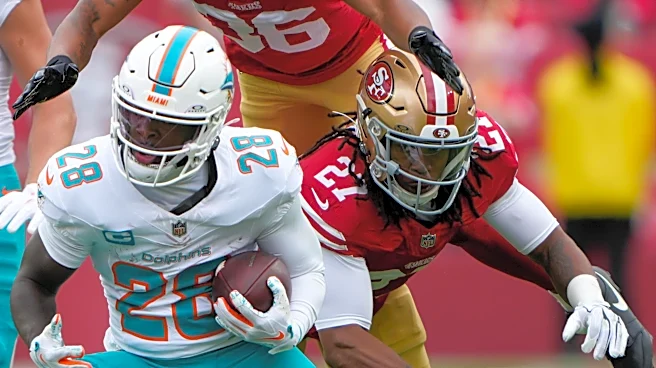


The San Francisco 49ers have outscored their opponents by 42 points through two weeks. That’s at least two touchdowns better than the next team. The Miami Dolphins did their best to play keepaway in the first half, but they couldn’t control the ball in the second half, and that’s when things got out of hand.
How do you have a “loser” in a game that you controlled wire to wire? Dolphins didn’t reach 200 yards passing. They didn’t score a touchdown on either red zone trip. The 49ers scored on all five
red-zone attempts and had only seven third downs across 49 plays. It was a playoff team versus a rebuilding one, and it showed on the field.
Here are the winners and losers from the 49ers’ thrashing of the Dolphins.
Winners
Brock Purdy
Twenty-eight of Purdy’s 30 rush yards came on one drive, and they resulted in a pair of first downs. Purdy’s legs went well beyond the box score, though. He bought time in the pocket for his receivers on numerous plays — most of them resulting in 10+ yard completions.
Purdy’s aggressiveness remains one of his best traits. Credit Kyle Shanahan for calling plays that required Purdy to push the ball downfield.
Purdy converted 83% of his late-down throws into first downs or touchdowns. He had a 24% explosive play rate. The farther the ball was thrown downfield, the better the result. Against the blitz, Purdy was 6-for-8 for 121 yards and two touchdowns.
Purdy had three 20+ yard completions in the third quarter, which added significant EPA to his ledger. He was in the zone all game.
It was Purdy’s eighth career start with a 140+ passer rating. That ties this guy named Joe Montana for the second-most in 49ers history. Purdy needs five more to tie Steve Young. Since Purdy entered the league in 2022, only Lamar Jackson has more games with a 140+ passer rating.
George Kittle
Kittle became the third-fastest tight end in NFL history to reach 600 career receptions. He did it in 126 games, only trailing Travis Kelce (110 games) and Jason Witten (125 games).
On a third-quarter play, the 49ers tried to run “leak,” but the Dolphins sniffed it out. Kittle adjusted on the fly, broke his route inside, and turned it into a 26-yard reception. It was a heady play that could’ve easily resulted in an incompletion.
Kittle had three impact plays. It’s somewhat miraculous to see him run after the catch. Kittle added 30 yards after the catch to his 80 receiving yards. Kittle topped 17 miles per hour on the GPS tracker. He also forced a missed tackle and caught his one contested target.
Raheem Morris
Morris had a completely different defense against the Dolphins than he did against the Rams. As we highlighted in the snap counts, the 5-man fronts used an extra defensive tackle instead of a linebacker.
There’s no arguing with the drastic difference in the quality of the passing attacks and quarterbacks. Still, the 49ers had the fifth-lowest passing success rate allowed in Week 2 and only allowed one rush for 10+ yards.
The 49ers had the highest sack percentage of the week at 14.3%. Morris only blitzed the Rams four times. He blitzed Miami 39.3% of the time. Yet, the 49ers still ran zone coverage 90% of the time. Last week it was primarily a 2-high shell on the back end. This week? Nearly 70% of the time, there was a single-high safety.
Morris showed he’s not married to one scheme, coverage, or personnel usage, despite the injuries. It’s been impressive.
Gracen Halton
Halton is a ball player. He should’ve had a sack on the first play. That play highlighted Halton’s awareness and overall football IQ. Halton’s 21.4% pressure rate was eighth among all defensive tackles this week with at least double-digit pass-rushing snaps. His run defense was more impressive. Halton was fourth among all defensive tackles in run-stop percentage.
On one play, Halton stood up his blocker, peeked one way after steering and locking out the lineman, then peeked the other way, disengaged, and made a play. If the first play of the game doesn’t impress you, this one will grab your attention.
Halton is playing like a first-rounder. He’s beating first-rounders. He will be even better once Mykel Williams returns.
Ji’Ayir Brown and Marques Sigle
Credit where it’s due. Had it not been for Halton, Brown would have given up a touchdown on the first play of the game. But it was forgotten, and there were no issues for the rest of the game. Brown was aggressive against the run.
Brown’s three run stops were the third most of any safety this week. He did so without missing a tackle. He had only four solo tackles compared to nine assists, but Brown did a job well, making plays around the line of scrimmage and playing fearlessly around offensive linemen.
Marques Sigle looked more confident and got into some throwing lanes. There might be something to using Sigle as a blitzer after a sack. That speed around the line of scrimmage could be problematic. Sigle fits the run as aggressively as anybody on the roster.
I think it’s a credit to Morris that the safeties played better in Week 2. Morris will keep fine-tuning their roles as the competition stiffens.
Upton Stout
Stout was a bit confused about the touchdown he gave up, but less than three minutes remained in a 35-6 game at that point. I’m going to forgive the second-year pro for not being focused at that point in the game.
Stout topped 20 miles per hour on the GPS, which was the second-fastest time on the team this week. That speed, paired with his intuition, is how you end up with a tackle for loss and a pass breakup in the same game.
Aside from the touchdown, Stout allowed 39 yards in coverage on six targets. He has a lot on his plate, and it’s not slowing Stout down, literally or figuratively. He’s a keeper who hasn’t come close to reaching his ceiling.
The pass protection
I say this a lot, but Trent Williams gets dozens of reps in a game and looks bored. If you could caption the plays where he’s unchallenged, it comes off as, “Really, this is the best y’all can throw at me?” Williams allowed no pressure on 25 blocking snaps, despite the Dolphins throwing six different players at him.
49ers fans’ favorite pinata Jake Brendel had a clean sheet, as did Dominick Puni. Connor Colby allowed only one pressure, but made up for it with a pair of impact plays. The same is true for Colton McKivitz. When your quarterback throws the ball downfield as often as Purdy did and finishes the game with two incompletions, you’re doing a disservice when you don’t mention the offensive line.
We are a couple of weeks away from this unit being truly tested against the Broncos and Seahawks’ fronts. That’ll tell us more about Colby than anything. But you can only play who is in front of you, and so far, so good for the offensive line.
Parting thoughts
When you’re expected to win by multiple touchdowns, and you exceed those expectations, you are a dominant team. Early season results can be tricky.
This is the fifth time the 49ers have begun the season 2-0 since 2019. They’ve made the playoffs in each of those years (’19, ’21, ’23, and ’25).
The offense produced like a juggernaut. It was the first time they scored five consecutive touchdowns to begin a game since 1981. The 49ers’ 761 total net yards through two weeks are the third-highest since 2019.
Everything feels easy, which is a good sign considering the injuries at the skill positions. The two different game plans on both sides of the ball in each game could foreshadow this season’s potential dominance.
You don’t want to make any grand proclamations after eight quarters of the season. But Mykel’s return should shore up some of the run-defense issues. The offense’s exceptional production feels like an outlier, but it’s really not. They’re loaded with great players at every position.
This is a team that is supposed to play like they’re destined for the NFC Championship. That’s what it looks like after two weeks.