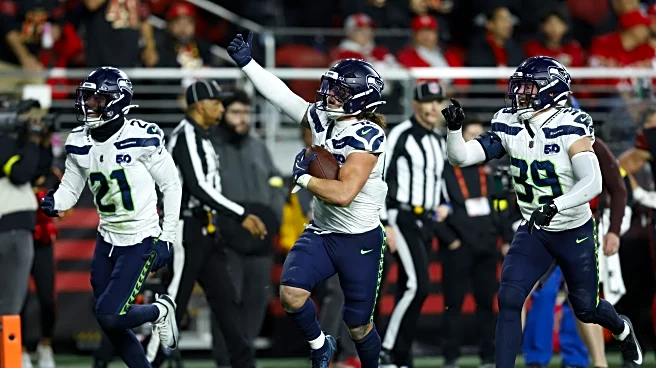

Few players on the Seattle Seahawks roster took a path as unconventional as linebacker Drake Thomas. What began as an undrafted signing who didn’t survive final cuts elsewhere has turned into one of the most intriguing development stories on Seattle’s defense.
By the end of the 2025 season, Thomas had not only carved out a consistent role — he had become a starter on a defense that leaned heavily on versatility, discipline and effort at the second level.
Thomas’ rise wasn’t built on elite size or overwhelming
athletic traits. Instead, it came from quick diagnostic ability, relentless motor, and the type of instincts that fit naturally into Mike Macdonald’s structurally complex defensive system.
Through the lens of the All-22, Thomas’ season reveals a linebacker who thrived in the chaos created by Seattle’s defensive design. He flashed as a blitzer, played downhill against the run and showed just enough range in coverage to remain on the field in key situations.
Let’s take a deeper look at his background, his statistical production in 2025, and what the tape says about his role going forward.
From NC State to Seattle
Before reaching the NFL, Drake Thomas built his reputation at NC State, where he developed into one of the most productive linebackers in the ACC between 2019 and 2022.
His college résumé is difficult to ignore. Over four seasons he piled up nearly 300 tackles while consistently living behind the line of scrimmage, recording 46 tackles for loss and 19.5 sacks. He also showed strong playmaking instincts in coverage, finishing his college career with four interceptions and eight passes defended.
Thomas truly burst onto the national radar during the 2021 season. That year he recorded 100 tackles, six sacks and three interceptions, earning First-Team All-ACC honors and drawing some All-American recognition. He followed it up with another outstanding campaign in 2022, serving as a team captain and finishing with 101 tackles and 7.5 sacks while leading the conference in tackles for loss.
Despite that level of production, Thomas went undrafted in the 2023 NFL Draft. Evaluators questioned whether his size — roughly 5’11” and 228 pounds — and perceived athletic limitations would translate against NFL competition.
Seattle, however, had already done its homework. Thomas had one of his Top-30 pre-draft visits with the Seahawks, giving the team a closer look at his instincts and football IQ.
He initially signed with the Las Vegas Raiders as an undrafted free agent but was released during final roster cuts. Seattle claimed him shortly afterward.
His first season with the Seahawks in 2023 was largely derailed by a knee injury that limited him to just seven games, most of which came on special teams. The following year, in 2024, Thomas remained part of the linebacker rotation but was still searching for a true defensive role. The coaching staff frequently alternated him with Tyrice Knight, and while Thomas saw snaps, he rarely produced standout moments at the time.
At that stage of his career he looked more like a depth player fighting to stay on the roster than a future starter.
That perception would change dramatically in 2025.
Knight dealt with injuries during the offseason and struggled early in the year. As the season progressed, Thomas gradually took over the starting role — and once he entered the lineup, he never really gave it back.
Drake Thomas’ 2025 production
Thomas finished the season as one of the most productive linebackers on Seattle’s defense. He started 14 games and logged 871 defensive snaps while continuing to contribute heavily on special teams with another 165 snaps.
Statistically, his impact was felt across several areas of the defense. He finished the year with 96 total tackles and frequently made plays near the line of scrimmage, adding 10 tackles for loss and 3.5 sacks. Thomas also showed flashes of playmaking ability in the passing game, recording one interception, recovering a fumble and defending six passes — the second-highest total among Seahawks linebackers.
Seattle also used him creatively as a pass rusher. On just 80 pass-rush snaps he generated 18 pressures, which ranked fourth among the team’s linebackers, while his four sacks placed him sixth at the position group.
The main statistical blemish on his season came in the tackling department. Thomas recorded 20 missed tackles, placing him among the linebackers with the highest missed tackle totals during the year. While the aggressive play style that leads to those numbers also contributes to his splash plays, improving tackling consistency will likely be a point of emphasis going forward.
Securing a rising contributor
After his breakout season, Thomas entered the offseason as a restricted free agent, but the Seahawks wasted little time ensuring he would remain part of the defense. Seattle signed him to a two-year contract worth up to $9 million. The deal carries a base value of $8 million with incentives that can push the total to the full $9 million mark.
For a player who entered the league as an undrafted free agent and spent his first seasons fighting for roster spots, the contract represents both a reward for his development and a vote of confidence in his continued growth within the system.
Drake Thomas All-22 Breakdown
Run defense
One of the defining features of Mike Macdonald’s defense is the use of late defensive shifts and moving fronts. Those pre-snap adjustments force offensive lines to process new blocking assignments just moments before the snap.
For a linebacker with Thomas’ explosive profile, that structure is incredibly beneficial.
Instead of regularly engaging offensive linemen head-on, Thomas often attacks newly created run gaps created by those late movements. His burst and diagonal pursuit angles allow him to shoot through creases before blockers can climb to the second level.
On tape, his ability to quickly diagnose blocking schemes stands out. Several plays show Thomas identifying the run concept almost immediately and beating tight ends or pulling linemen to the spot before they can establish leverage.
At the same time, the system also protects him from the situations where his size disadvantage is most noticeable. When Thomas does get stuck in a direct one-on-one with a guard or tackle, the physical mismatch becomes obvious. There are snaps where a misread or incorrect gap fit leaves him exposed to a much larger blocker.
Seattle’s defensive design clearly tries to minimize those situations — and when Thomas is playing downhill with clear reads, his speed becomes a real weapon.
Relentless motor and defensive mentality
If there’s one trait that defines Thomas’ play style, it’s his motor.
He plays every snap as if he were ten pounds heavier and two inches taller, constantly chasing the football and refusing to quit on a play. That energy mirrors the overall mentality of the defense.
One sequence on tape illustrates this perfectly. Thomas is sent on a blitz that initially fails to reach the quarterback. Instead of disengaging from the play, he quickly redirects his pursuit and eventually tracks down the receiver after the catch.
Effort like that shows up repeatedly throughout the season.
However, that aggressive mentality can occasionally work against him. Early in the year there are several examples of Thomas biting too quickly on run action, which opens space behind him for RPO/Play actions concepts.
As the season progressed, though, he showed noticeable improvement in controlling that aggression.
A key example came during the Divisional Round against the San Francisco 49ers. The offense used heavy motion and misdirection before running a speed option with the fullback carrying the ball and Christian McCaffrey positioned for the pitch.
Thomas defeats his block but remains patient instead of overcommitting. By holding his leverage and staying disciplined, he eliminates the pitch lane and forces the play to collapse.
It’s the kind of subtle, intelligent rep that often goes unnoticed but reveals real growth.
Coverage
Coverage is still the area where Thomas has the most room to improve.
There are several plays where his aggressive instincts lead him to abandon his zone too early, opening windows for the quarterback to exploit.
His zone drops improved over the course of the season, but they remain somewhat inconsistent. Opposing offenses occasionally targeted those intermediate areas when he was responsible for the coverage.
Even so, the tape shows flashes of the instincts that made him productive in college.
On one play, he quickly recognizes the route concept developing in front of him and delivers a perfectly timed hit to break up the pass. If Thomas can pair that level of diagnostic ability with more disciplined positioning in zone coverage, it could significantly raise his ceiling as a three-down linebacker.
Pass rush
Thomas is not a traditional edge threat, but his relentless effort makes him a valuable piece of Seattle’s pressure packages.
He doesn’t win with overwhelming strength, yet he compensates with timing, leverage and technique. On one snap he uses a smooth dip-and-rip move to slip past a running back in pass protection, forcing the quarterback into an immediate throw.
One of the most striking plays on tape comes when Thomas — at 5’11” and roughly 228 pounds — lines up against offensive tackle Walker Little, who stands 6’7” and weighs over 320 pounds. Despite the size disparity, Thomas manages to shed the block quickly and collapse the pocket.
Those moments highlight why Seattle trusts him as a situational blitzer.
Final thoughts
Drake Thomas’ journey is a reminder that player development rarely follows a straight line in the NFL.
In just three seasons he has gone from an undrafted free agent who didn’t make his original team’s roster to a key contributor on a championship defense.
His instincts, motor and blitzing ability make him a natural fit for the modern defensive structure Seattle runs. Just as important, his football intelligence allows him to anticipate plays and avoid situations where his size disadvantage could become a liability.
If Thomas continues refining his tackling consistency and improving his ability to shed blocks, there’s a real possibility that his 2025 breakout season will be remembered not as a one-year surprise — but as the beginning of a much longer run as an important piece of Seattle’s defense.