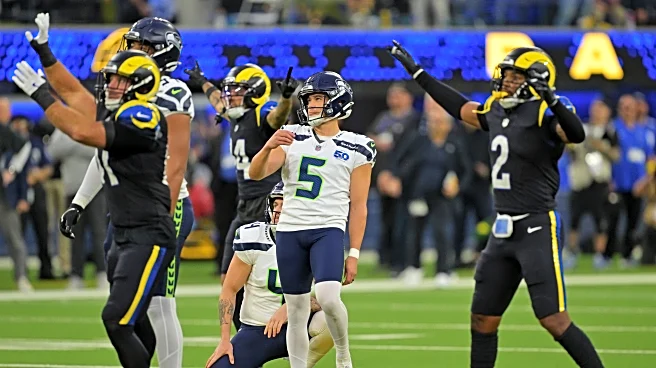



If there’s a divisional matchup that consistently comes down to the margins, it’s the Seattle Seahawks and Los Angeles Rams. The standings matter, the history matters, but what usually decides these games shows up on the All-22: spacing, leverage, timing, and who is forced to abandon their original structure first. Awesome matchup between Sean McVay and Mike Macdonald.
From Seattle’s side, the equation is straightforward but unforgiving: limit negative plays, avoid turnovers, and keep the offense
on schedule. From Los Angeles’ perspective, the question is more complex: how does McVay stress a defense that is explicitly built to survive stress?
Seahawks offense vs. Rams defense
Simulated looks, late safety rotation, and edge alignments force quarterbacks to speed up even when the rush doesn’t immediately win. That matters against a Seahawks offense that has been far more efficient when it can dictate tempo.
On early downs, Seattle’s offense has shown its best stretches when:
- The quick game is emphasized (slants, sticks, speed outs).
- Motion is used to clarify coverage and simplify the post-snap picture.
- Play-action is tied directly to downhill run looks, not window dressing.
When those elements are present, the offense stays on schedule and avoids the obvious passing situations where the Rams’ disguise package becomes far more effective.
When they aren’t:
- Reads get late.
- The middle of the field closes quickly.
- And turnovers tend to follow.
The All-22 from the first meeting tells a consistent story: most of the damage came from hesitation, not reckless decision-making. The Rams don’t need to dominate snaps — they just need one late throw, one extra hitch, one quarterback forced off his first read.
Seattle’s path on offense:
- Screens and checkdowns to punish aggressive fronts.
- Play-action from under center to hold linebackers.
- Attacking intermediate zones before safeties can gain full depth.
Rams’ advantage:
- Forcing third-and-long.
- Masking coverage just long enough to disrupt timing.
- Turning hesitation into game-changing plays.
- Pressure with light packages;
Rams offense vs. Seahawks defense
Conflict by design vs. discipline by construction
This is where the tape gets interesting.
Sean McVay remains elite at manufacturing conflict for defenders — stressing linebackers and safeties with motion, condensed splits, and layered route concepts. The goal is to force a single defender to be wrong, even if only for a beat.
Mike Macdonald’s defense is built to remove that beat.
On film, Seattle consistently:
- Maintains leverage rather than chasing plays.
- Keeps safeties patient in two-high shells.
- Asks linebackers to close throwing windows instead of attacking the mesh point.
The statistical result is a defense that may concede short gains but limits explosives — especially off play-action.
For the Rams, that means execution has to be clean:
- Routes must be precise.
- Timing has to be exact.
- And the run game must do enough to keep linebackers honest.
When Kyren Williams is consistently generating efficient early-down runs, the offense opens up. Play-action regains its teeth, and intermediate crossers become viable.
When that efficiency disappears:
- Stafford holds the ball longer.
- The coverage structure stays intact.
- And the offense becomes more predictable than McVay wants.
Rams’ offensive keys:
- Isolating linebackers in coverage with layered concepts.
- Using motion to force late communication.
- Capitalizing on the rare coverage bust.
Seattle’s defensive edge:
- Red-zone execution.
- Obvious passing downs.
- Discipline against misdirection and eye candy.
What the numbers and the film agree on
This matchup is rarely decided by yardage totals or time of possession. It’s decided by:
- Turnovers
- Field position
- Which quarterback is forced off-script first
Seattle doesn’t need offensive fireworks — it needs efficiency and ball security.
The Rams don’t need to dominate physically — they need one mistake at the right time.
On tape, these games almost always look even until they suddenly aren’t. And when the balance shifts, it’s usually because one side is no longer playing the game it planned to play.
Final Thoughts
This game is crucial. A loss doesn’t result in elimination from the playoffs, but it basically takes the Seahawks out of contention for the NFC West and the number 1 seed. It’s also a chance to show we can beat a strong opponent and qualify for the playoffs. It’s a day to cheer! It’s a day to cheer a lot!