
Throughout the 1910s and 1920s, the Yankees swindled the Red Sox on a couple different deals, mostly famously the one for Babe Ruth, a trade that’s had its own lore for decades. The Yankees’ acquisition
of Les Nunamaker from Boston a couple years prior is not remotely on the level of Ruth, just because you might not have heard of Nunamaker, while Ruth is still one of the most famous names in baseball.
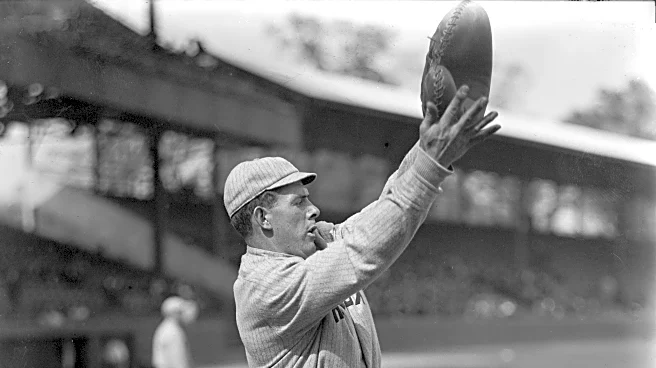
However, Nunamaker was another trade the Yankees made with the Red Sox where they made out very well, and the Red Sox made out with not much. And if medical science was somehow way more advanced than it already is, today would be his 137th birthday. With that in mind, let’s look back on Mr. Nunamaker.
Name: Leslie Grant Nunamaker
Born: January 25, 1889 (Malcolm, NE)
Died: November 14, 1938 (Hastings, NE)
Yankees Tenure: 1914-17
Nunamaker was born and raised in Nebraska, and playing semi-pro baseball there was what got him on the radar. At 20-years-old, he first caught on with the Lincoln Railsplitters of the Western League in 1909. Slotted in at catcher, his early career was often a struggle defensively. However, he apparently still impressed enough to get picked up by the Cubs, who farmed him out to the Bloomington Bloomers of the inartfully named Illinois-Indiana-Iowa League.
Despite another defensive struggle and a suspension for insubordination, Nunamaker’s talent apparently shone through enough for the then Cleveland Naps to select him in the Rule 5 Draft, although they very soon after traded his rights to the Red Sox. With Boston coming off a middle-of-the-pack finish in 1910, they took a chance on the young catcher and put him on their big-league roster for 1911.
Nunamaker spent 1911 mostly as the Red Sox backup catcher and missed some time with injury during the year. The next season, he was part of the 1912 Boston team that won the World Series, although he was again hampered by injury, and had his playing time cut into after a good season from replacement Forest Cady.
After again recieving sparse playing time in 1913 and ‘14, the Red Sox eventually sold him to the Yankees in May 1914. The Yankees’ manager at the time was Frank Chance, who had been the Cubs’ boss when Chicago originally picked Nunamaker up back in 1910. The stretch run in 1914 saw Nunamaker get regular playing time and finally have some success, especially at the plate. In his third game as a Yankee, he hit his first career MLB home run. Over the course of 87 games with the Yankees in 1914, he hit .265/.327/.350, which may not sound great, but actually grades out as an above average OBP for the era. Not to mention in one game, he achieved the rare feat of throwing out three runners in one inning.

After regressing in 1915, Nunamaker had probably his best year in 1916. He hit .296/.380/.404, which was good for a 134 OPS+. In addition, he had also come around 360 from the poor defense from early in his career. In that season, the Yankees contended much of the year and led the AL as late as July 29th, although they struggled throughout August and September and ended up double-digit games out of first.
Throughout his career, Nunamaker could also be a bit of an ornery figure. He got into numerous spats with opposing players and umpires over the years. One incident after leaving the Yankees saw him apparently tell a fan that he would “change the fan’s map as the kaiser is trying to alter the topographical face of Europe.” That line probably hit harder in the World War I era than it does now.
After one more year with the Yankees in 1917, Nunamaker was traded to the St. Louis Browns. The Yankees’ return in the deal included previous birthday boy Del Pratt. Under new manager Miller Huggins, the Yankees were trying to become a regular contender after years of ups and downs, and Pratt was a legitimate star of the time. While Pratt didn’t end up leading the Yankees to glory, he was part of a package that brought pitcher Waite Hoyt to New York, so we can include Nunamaker as part of that trade tree.
Nunamaker spent one year with the Browns and a couple with Cleveland to end his major league career. While he once again wasn’t a regular starter or anything, he was part of another World Series winning team with Cleveland in 1920. He only got two at-bats in the Fall Classic, but singled off future Hall of Famer Burleigh Grimes in Game 2. He continued to play on in the minors for several years after that, managing off and on as well. After his time in baseball was up, he returned to his native Nebraska, where he passed away in 1938.
See more of the “Yankees Birthday of the Day” series here.