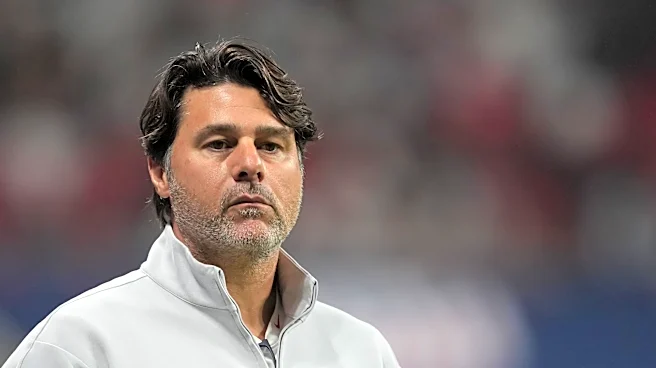









After four long years of waiting, the 2026 World Cup is here; there is no more time for potential or development, only to perform and produce results on the big stage. As one of the co-hosting programs, the United States Men’s National Team is expected to put in a strong showing, lest the preparations should be for naught. Then there is Mauricio Pochettino: a well-regarded outsider (or hired gun, depending on the person being asked) who was hired with the intent of raising the level at international
competitions and is expected to leave after the tournament, yet whose results in the lead-up have appeared somewhat unconvincing. Judgment awaits as an entire cycle is boiled down into a few weeks of tournament play.
But that raises the question of what a good or disappointing finish would be. Obviously, the hope for every fan is that the USMNT wins the World Cup, which seems to be a bit unrealistic as things currently stand. Dropping out following the group stage or even being removed from contention after two fixtures would force the program to reassess the culture and reevaluate the hiring process.
Based on previous history, the easy hope is to at least reach the quarterfinals. This would match the level of the 2002 team that continues to be unequaled in the modern era. Is that a realistic expectation for this team?
The shallowest of methodologies is to look at worldwide rankings. FIFA has the USMNT currently at 16th, sandwiched between Mexico and Uruguay, which could indicate that a Round of 16 finish is adequate. The Elo rating of 41st presents an even more superable goal of merely escaping the group stage. However, the sophistry of mapping a hierarchy of largely atomized teams onto a tournament bracket and their ensuing finishes feels unsatisfying at best.
Under the previous tournament structure, a reasonable expectation for a finish was slightly easier to decipher. Home-field advantage is expected to carry programs beyond their typical level, with escaping the group stage being the bare minimum for success. Comparing the potential performance to that of other host nations in the modern, 32-team era of the World Cup (excluding power players or favorites) provides a metric and also coincidentally began just after the United States previously held the competition.
Omitting perennial power players France (1998 – champion), Germany (2006 – third), and Brazil (2014 – fourth) leaves South Korea (2002 – fourth), Japan (2002 – Round of 16 [averaged out at 12.5]), South Africa (2010 – first round [averaged out at 24.5]), Russia (2018 – quarterfinal [averaged out at 6.5]), and Qatar (2022 – first round [averaged out at 24.5]), which roughly equaled out to a finish in the Round of 16 for hosts. Removing the outliers of South Africa and Qatar due to the relatively higher status of the USMNT’s place in the global footballing hierarchy, the average for host nations in the modern era is reaching the quarterfinal round.
However, the new 48-team competition throws a wrench into any assessment. The inability to advance out of the group stage is still, in no uncertain terms and regardless of the strength of the other sides, a failure. The expanded knockout stage bracket presents a greater challenge and one more hurdle to overcome.
What if the USMNT were to meet Germany (Group E), the Netherlands (Group F), Belgium (Group G), France (Group I), Argentina (Group J), or Portugal (Group K) in the Round of 32? That list of power programs only gets bigger in the Round of 16 and makes the task of a deep run all the more arduous. Would a valiant effort from the star players and a tight loss be considered commendable?
Like most things in life, the answer to what qualifies a successful World Cup is relative and cannot be determined until after the competition concludes. An abysmally poor finish should be pretty easy to judge, as would a standout performance that surpasses previous history. However, the line between “mediocre” and “adequate” could be a question of the knockout-phase opponent and their ensuing journey.
As Supreme Court Justice Potter Stewart wrote in Jacobellis v. Ohio, “I know it when I see it.” While a universal opinion is unlikely to be formed, a general consensus will be reached based on intuition. What constitutes success is difficult to claim before the tournament kicks off but will be obvious to discern once the final whistle blows.
Will this generation of the USMNT enter the history books? How will Pochettino be remembered based on the strength of one tournament finish? These questions and many more will be answered in June… and perhaps July.