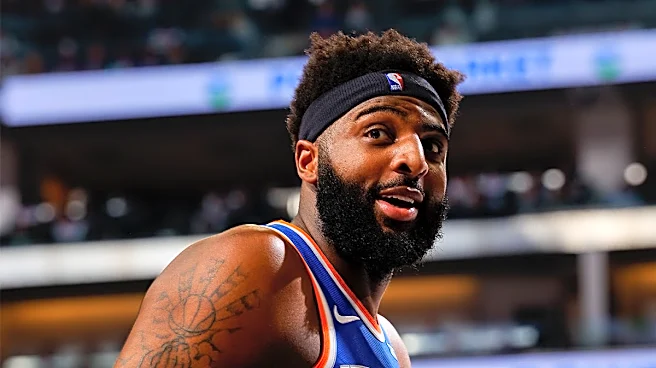


When the Boston Celtics signed former Knick Mitchell Robinson to a three-year, $47.4 million deal this offseason, it didn’t take long for one part of his game to dominate the conversation: offensive rebounding.
And for great reason.
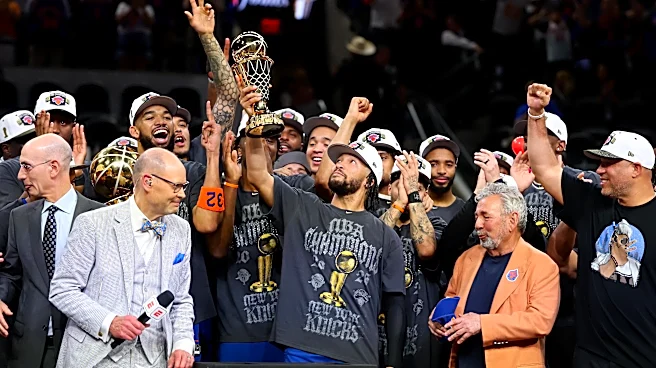
Robinson has established himself as one of, if not, the best offensive rebounders in the NBA, giving Boston exactly the type of interior presence they needed. The seven-footer averaged 8.8 total rebounds per game in just 19.6 minutes a night for the Finals-winning New York
Knicks. His impact on the offensive glass was even more impressive, as he pulled down 4.2 offensive rebounds per game, good for second in the league, despite playing at least six fewer minutes per game than every other player in the top-five.

I made a video going into great detail about all the ways the big man gets his boards on that end and how it translates to the green guys.
Offensive rebounding is his best skill, but there is another part of Robinson’s game that deserves far more attention and if you read the title, I assume you know where this is going: His three-point shooting.
A man can dream, but for real this time: His defense.
I went back through Robinson’s entire playoff run to recall what the impact on that end looks like.
Robinson’s ability to protect the rim, use his length as a deterrent and provide a legitimate defensive presence behind Boston’s perimeter defenders could ultimately be 1A/1B situation in terms of importance with his rebounding.
When it comes to pure shot-blocking, Robinson averaged 2.2 blocks per 75 possessions, placing him in the 95th percentile. According to Bball-Index, he recorded a block on 27% of his shot contests, a figure that ranked in the 96th percentile and further underscored his ability to protect the rim.
Furthermore, Robinson is simply a high-impact defender. When he isn’t blocking shots at the rim, he is deterring attempts altogether, forcing rushed kick-outs, using his size to hold his own in the post and displaying excellent timing as a help defender. His +2.7 Defensive DPM last season ranked in the 99th percentile, while his 23.2% defensive rebound rate allowed him to consistently finish possessions on the glass.

He is more than a big body who just stands in the paint. When healthy, Robinson gives the Celtics an athletic, mobile center capable of erasing mistakes at the rim and making life difficult for opposing offenses on the perimeter. He brings much needed potential coverage versatility with major size to a team that absolutely could’ve used it last season.
He regularly demonstrated the ability to cut off driving lanes, slide his feet in aggressive pick-and-roll coverages while recovering to his assignment, and stay in front of smaller offensive players long enough to force a pass or contest the ensuing shot.
Speaking of contesting shots, Robinson’s 7-foot-4 wingspan and quick leaping ability make him a genuine problem for opposing offenses.
Robinson also possesses impressive off-ball instincts for a big man, which become particularly valuable against some of the league’s more unique frontcourt players. He leans into his physicality when he sees a screen coming and somehow gets skinny enough to get through the screen and blow up the play.
Maybe the most unique part of his defense is his hands.
Last season, Robinson averaged 4.1 deflections and 1.8 steals per 75 possessions, placing him in the 96th and 98th percentiles, respectively, among players at his position.

It is a level of activity that has remained remarkably consistent for the Western Kentucky product, who has ranked in at least the 96th percentile in both categories in each of the past three seasons and when you watch him play, it’s easy to see why.
In possessions where he’s the screen defender, he often puts his hand in the passing lane so the ball handler can’t attempt or complete the needle threading pass.
Other times, he uses great anticipatory skills to diagnose passes and sometimes pluck the rock loose on ball.
And once in a while, Robinson will put everything together and completely shut down some of the league’s best in isolation. While I wouldn’t rely on switching or red-coverage schemes for extended stretches given the demands on his endurance and the sheer difference in foot speed, Robinson is a willing switcher that forces turnovers shown by his 4.3 STOP percentage.
The easiest way to describe Mitchell Robinson is as an elite offensive rebounder.
The more accurate way may be to describe him as an elite possession-changer.
He changes possessions when he grabs a miss that should have belonged to the defense. He changes them when he deters a drive at the rim. He changes them when his length smacks a shot attempt into the hands of a teammate. He changes them when he turns a clean look into a rushed pass, or when he blows up a play before it ever develops.
Robinson has the size to protect the rim, the athleticism to cover ground, the instincts to disrupt actions away from the ball and the physicality to make opponents uncomfortable. Very few centers can check all of those boxes.
He just needs to be the defender he has already shown himself to be.