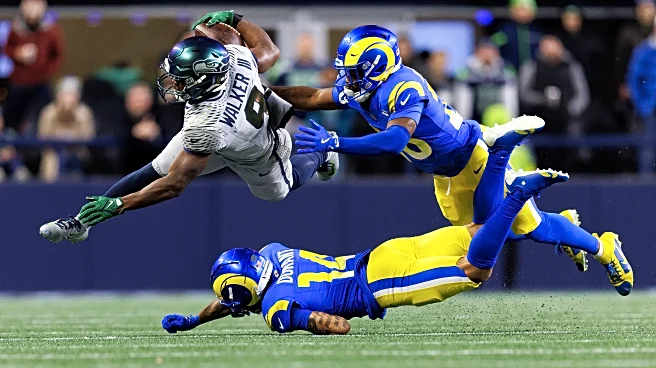

Following a 2024 season in which the run game of the Seattle Seahawks was non-existent for the majority of the year, head coach Mike Macdonald immediately moved on from offensive coordinator Ryan Grubb.
Along with firing Grubb, the Seahawks allowed several other members of the offensive coaching staff to move on to other opportunities elsewhere, including offensive line coach Scott Huff.
To fill the openings that had been created, the team turned to Klint Kubiak and a cadre of coaches with a long history of coaching run-heavy offensive systems. The additions included adding John Benton as offensive line coach and Rick Dennison as run game coordinator.
Benton’s resume included long stints as the o-line coach for the Houston Texans during the tenure of Kubiak’s father, Gary, as the head coach, along with a four year stint in the same role with the San Francisco 49ers. In both stops Benton coached offensive linemen to block in wide-zone heavy schemes handed down from Mike Shanahan and Alex Gibbs with the Denver Broncos.
Likewise, Dennison’s history included taking over as the offensive line coach of the Broncos under Shanahan when Alex Gibbs opted to depart for the Atlanta Falcons, before spending time with Gary Kubiak in both Houston and a return to Denver in 2015 that saw the Broncos hoist the Lombardi trophy in 2015.
In short, the coaching staff came in with a track record of success coaching teams with a ground-heavy attack, and in particular a long history of coaching rushing attacks that relied heavily on outside zone. That combination of experience and the raw youth and inexperience of the Seattle offensive line had many fans expecting, or at least hoping for, a breakout season for the ground game in 2025.
That, however, has not developed.
That then raises the question about what has been holding the run game back. Is it once again the inexperience of the offensive line? Is it the coaching staff? Is it the running backs?
The answer is that it’s a combination of several factors, and one that is sufficiently complicated to warrant its own post at a later time and date. Before getting to that post, though, it’s necessary to have a foundational understanding of some key background data. Specifically, if the coaching staff has a long history of implementing and deploying rushing attacks designed around zone blocking, in particular outside zone, then it would make sense for the current usage of zone blocking to be similar to usage at past stops as well.
Thus, the first step is to look back at the two stops where Klint Kubiak was offensive coordinator and had play calling duties with the 2021 Minnesota Vikings and the 2024 New Orleans Saints. Here is how often those two teams ran behind zone blocking versus man blocking.
Moving on to the 2024 New Orleans Saints, here is what the breakdown looks like.
Not only does the total percentage come out very similar to the numbers from the 2021 Vikings, seven of the nine individual running backs are at or above 74.8%,
Turning to the 2025 Seahawks, here is how the numbers play out through the first 16 weeks of the season.
What instantly jumps out from those numbers is how low the percentage of zone rushing attempts is relative to Kubiak’s two prior stops as an offensive coordinator. What also jumps out is the fact that both Walker and Charbonnet are well under what one would have expected based on Kubiak’s play calling history. To dig a little more into that, here’s a look at their percentages by week, with a reminder that Charbonnet missed the Week 3 win over the New Orleans Saints, which is why that part of the chart is empty.

Looking at that chart, it’s readily apparent that the Seahawks used Charbonnet a significantly higher percentage of zone attempts early in the season relative to Walker, and then around Week 6 tweaked things.
The question that raises multiple questions, the first of which is, of course, why the team would make such adjustments on the fly in the middle of the season? In addition, it brings the discussion back to Walker’s usage, inviting questions about why Walker’s usage differs so greatly from nearly every single listed back.
Of the eleven backs listed with double digit rushing attempts who is lower than Walker is Jordan Mims. Even Charbonnet, who checks in more than seven percentage points higher in zone attempts than Walker saw his usage drastically change starting in Week 6.
Is Walker’s usage so different from the others because of a conscious decision by the coaching staff? And if that’s the case, what is driving that decision? Why would an offensive coaching staff with decades of experience deploying zone blocking schemes for different teams suddenly change up their approach when a specific running back is on the field?
Of course, looking back at the 2024 Saints, it’s easy to hypothesize that this appears to be the second straight season in which the coaching staff has deployed a specific running back in a unique way that bucked historical trends, just as they did with Mims in 2024.
Obviously, there could be any of a number of factors at play, but below an interesting portion of Mims’ draft profile from 2023 is highlighted that may or may not be relevant.

In any case, further analysis will come in another post on another day, as for now it’s on to the final injury report ahead of the Seahawks Week 17 matchup against the Carolina Panthers.