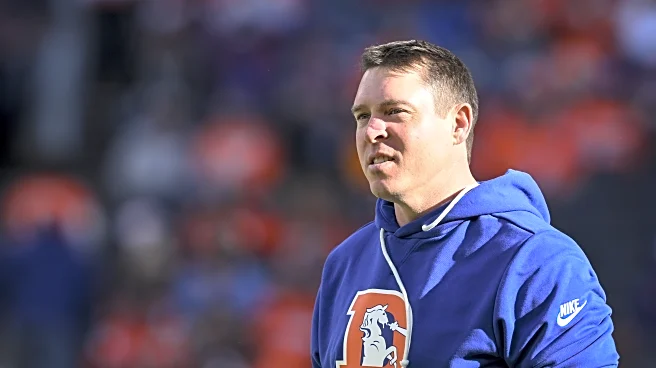

The Cowboys are moving on to the second round of interviews for their defensive coordinator vacancy, and Broncos pass game coordinator Jim Leonhard has emerged as a top target. Here is a deep dive on Leonhard,
his background as a coach, and what he would bring to the Dallas defense.
Background
Born and raised in Wisconsin, Leonhard played both quarterback and safety in high school before walking on at Wisconsin. Quickly becoming a starting safety, Leonhard was twice named to the First Team All-Big Ten team before his senior year, at which point he was finally put on scholarship.
After a stellar final year with the Badgers, Leonhard went undrafted in 2005 and landed with the Bills. There, he was the only undrafted rookie to make Buffalo’s roster. Injuries helped him start a handful of games towards the end of his third season, which preceded his signing in Baltimore.
There, Leonhard started 13 games and became acquainted with defensive coordinator Rex Ryan. A year later, when Ryan was named head coach of the Jets, he brought Leonhard with him as a free agent. Leonhard was a starter in that defense, which reached consecutive AFC Championship games, before injuries began to creep in.
Leonhard hung around a bit longer after his Jets stint, retiring after the 2014 season, and began his coaching career two years later as the defensive backs coach for his alma mater. After just one year in that role, Leonhard was promoted to defensive coordinator, a role he held for six seasons.
In 2022, when Wisconsin shocked the world by firing Paul Chryst after a 2-3 start, Leonhard was named the interim head coach. He went 4-3 the rest of the way, with two of those losses coming by one score, and seemed to have the inside track for the full-time gig. Then Wisconsin lured Luke Fickell away from Cincinnati, which prompted Leonhard’s departure.
After one season as an analyst at Illinois, Leonhard made the jump to the NFL, joining the Broncos as their pass game coordinator and defensive backs coach. Ahead of this season, he was also named assistant head coach.
Scheme
Leonhard has only ever called plays at the college level, so it’s not exactly a guarantee he’d run the exact same defense he ran at Wisconsin. Still, the basic philosophy behind his defense remains the same. And the reality is his Badgers defense was built on flexibility anyway.
There are a few central tenets Leonhard believes in. He prioritizes multiplicity in the way his defense aligns themselves and wants to attack at all times. Whereas Eberflus wanted to be fairly passive and just prevent big plays, Leonhard strives to dictate the game to the offense.
On the front end of the defense, he does this primarily with stunts and simulated pressures. Leonhard is certainly no stranger to blitzes – the Broncos have been a fairly blitz-heavy team during his time there – but his time in Wisconsin was built on winning with four pass rushers by tricking the quarterback on who those four will be.
The most common concept Leonhard used in that aspect was the creeper look. A creeper involves a blitzing defender waiting until the last moment to show a blitz – or, creeping up to the line of scrimmage – thereby presenting what looks like a traditional four-man rush when in reality it’s three of those rushers – with one of them dropping into coverage – and a fourth coming from an unexpected player.
Creepers can work wonderfully when executed properly. It has the same impact as sending extra rushers without sacrificing any numbers in coverage. Leonhard saw great success with a varied package of creepers at Wisconsin, but he also used other forms of pressure looks, including the double mug looks that both Mike Zimmer and Brian Flores have terrorized quarterbacks with.
As with those two coaches, Leonhard’s system also requires EDGE and linebacker players who can play multiple roles. He won’t always drop edge rushers into coverage, but they need to be capable of doing it with some consistency; similarly, his overhang linebackers need to be able to rush the passer to some degree.
One consistent feature of Leonhard’s Wisconsin defenses was his use of five-man fronts, which should set off the good kind of alarm bells for Cowboys fans. While he used more rotations at Wisconsin due to the much larger roster caps in college, Leonhard’s scheme would be ideal for getting Osa Odighizuwa, Quinnen Williams, and Kenny Clark on the field at the same time frequently.
On the back end, Leonhard dictates to the offense with heavily disguised coverages and pattern matching techniques, things he’s directly implemented in Denver as the pass-game coordinator.
Pattern matching refers to a coverage technique that, in simplest terms, allows defenses to pick and choose between man and zone based on the routes the offense is run. It’s something Nick Saban built into his defenses a long time ago, and other coaches like Zimmer and Flores have incorporated it into their schemes as well. It takes longer to install than typical spot drop coverage, but it helps defenses have more effective options in coverage.
In terms of coverage types, Leonhard lives in the MOFC (middle of field closed) world. Philosophically speaking, Leonhard clogs up the middle of the field with linebackers and safeties and has his cornerbacks funnel outside receiver inside. This typically manifests itself with lots of Cover 1 and Cover 3, but between coverage disguises and pattern matching technique, Leonhard keeps it from being too predictable.
Much of his scheme is inherited from Justin Wilcox and Dave Aranda, Wisconsin’s previous two defensive coordinators before Leonhard, both of whom are widely regarded for their defensive prowess at the college level. Leonhard has also infused a bit of the principles he learned playing for Rex Ryan, which helped elevate the scheme a bit. Now, with his time spent alongside Vance Joseph (himself a Wade Phillips disciple), Leonhard has the tools to build a truly unique and dangerous defense wherever he goes next.
Roster Fit
As mentioned before, the most obvious roster fit for Leonhard is those three big-name defensive tackles. Leonhard built a lot of his simulated pressure looks at Wisconsin off of a five-man front, and lining up that trio inside with two others on the edge would cause myriad problems for protection schemes.
At linebacker, Leonhard would have a few options. DeMarvion Overshown has flashed potential as a blitzer before, and his background as a one-time college safety creates intriguing potential as a deep-drop coverage option. Logan Wilson’s high IQ play style should make him a reliable run stopper. Marist Liufau may have the build and tenacity to become a valuable overhang defender, lining up on the edge and threatening to blitz with the potential to drop into coverage.
The secondary is where the bigger questions lie. Leonhard prefers his cornerbacks to be physical off the line, which plays well into Shavon Revel’s strengths. He was at his best this year when playing press, but sometimes struggled in off-coverage. Outside of Revel, though, the Cowboys need new blood, especially with DaRon Bland undergoing another foot surgery.
The safety position could be due for a makeover, too. Donovan Wilson would be a much better fit playing down in the box in Leonhard’s system, especially as a creeper option, but he’s set to be a free agent. Malik Hooker could be a cap casualty too, and his fit in this system is less obvious. Leonhard may prefer to press the reset button entirely with this secondary, and Jerry Jones seemed to hint as much was likely in his press conference last week.
Potential Staff
Many of Leonhard’s connections come at the college level, which isn’t to say he has no rolodex to build from, but it does create fewer obvious ties for a potential staff.
One name that could get in the mix is Bobby April III. Recently hired to coach the defensive line at the University of Minnesota, April spent the past three years as the defensive coordinator for Stanford. The longtime linebackers coach spent four seasons under Rex Ryan between the Jets and Bills before coaching linebackers for five years at Wisconsin for Leonhard. His father was also the special teams coordinator in Buffalo when Leonhard signed as a rookie, and Leonhard primarily played on special teams before rising to a starer.
One potential name to watch in the secondary is Gerald Alexander, who just wrapped up his first season coaching defensive backs for the Steelers. Alexander backed up Leonhard at safety in his final season with the Jets, and later spent three seasons as the defensive backs coach at Cal, whose head coach – Justin Wilcox – preceded Leonhard as the Badgers defensive coordinator. Alexander later left Cal to coach defensive backs under Brian Flores with the Dolphins, and later reunited with Flores in the latter’s lone year with the Steelers.
A more seasoned name for the secondary could be Jim O’Neil. He assisted with the defensive backs with the Jets, giving him a direct link to Leonhard, and later followed defensive coordinator Mike Pettine first to Buffalo and then to Cleveland. He was also Northwestern’s defensive coordinator for two seasons, directly competing against Leonhard’s Badgers. He’s spent the past two seasons as a defensive assistant for the Lions.
On the defensive line, there seems to be some indications that Aaron Whitecotton might be retained. Quinnen Williams raved about him when he first got to Dallas, and Whitecotton’s recent interview for the coordinator job suggests he’s highly thought of inside the building.
If Whitecotton doesn’t stick around, though, look for Sione Po’uha to get in the mix. A hulking nose tackle who played eight seasons with the Jets, Po’uha overlapped with both Leonhard and Schottenheimer. He’s since made a name for himself at the college level, first with Utah and now BYU. He’s seen quite a few of his defensive linemen make it to the NFL, and he may be next in line.
It’s always possible Leonhard fills his staff with other guys he has no real connection to. Current pass game coordinator Andre Curtis has ties to Schottenheimer from the Seahawks and could be retained. The other names on the Cowboys’ interview list may also be options, namely former Ravens defensive coordinator Zachary Orr and former Colts head coach Chuck Pagano.