


Recently, I went to a basketball coaching clinic led by Canada Basketball. Mike MacKay, director of technical development – who is behind the quote at the top – and Ron Yeung, vice president of domestic programs and strategy, led a practical and a theoretical session for around 60 people in Copenhagen. There was more than one thing that stood out, but in light of the Dallas Mavericks coaching change and cultural shift, this topic stayed with me.
Mike MacKay emphasized that soft skills and soft leadership
is much harder than X’s and O’s. One can be quantified, but the other is harder to both execute and teach.
“There is nothing soft about coaching people. We often call communication, relationship building, empathy, self-awareness, and emotional regulation, the soft skills of coaching. I’m not so sure there’s anything soft about them.”
“Drawing up a play is relatively easy. Talking to a disappointed athlete, who has just lost their starting position, is harder. Holding an athlete accountable when you’re angry, frustrated, and under pressure is a lot harder,” he said in a recent episode of his podcast “On Point” following the clinic.
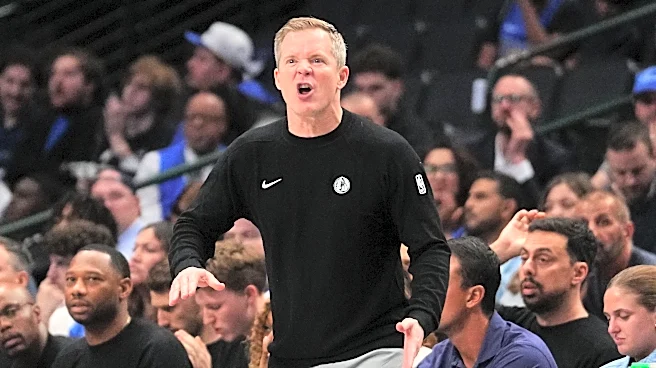
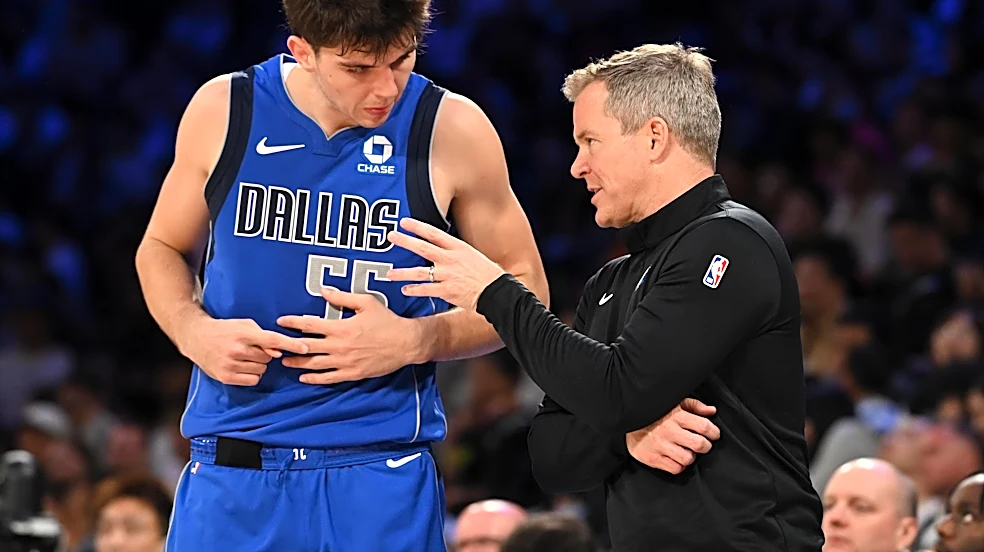
As new Mavericks head coach Dusty May takes the reins in Dallas, we’re getting to witness this up close. May seemed to have close relationships with each player on the Michigan team, which he coached until this summer. Watching and studying clips and film from last season, that much becomes clear. And this also helped the team thrive and accomplish great things (like win the NCAA Championship last season, 2026).
In order to get a better understanding of how Dusty May builds relationships and trust with his players, I picked a few clips that show how he works – and how it affects his team.
In the first one, May highlights a bench player at Michigan, who was ready when his number was called, talking to the team in the locker room during March Madness 2026:
“The game rewards the guys that have a great attitude and show up and work when it’s not about them. He probably didn’t expect to play, I’ve been telling him three or four games, stay ready, stay ready.”
Then May reminds the players that they’re a collective, a team, teaching and guiding them on how to win by working together:
“Let’s take care of each other. And just be happy for each other’s success. I’m so happy for the guys that stayed the course and came in and won that freaking game. It’s unbelievable to see that, because that’s actually what equates to the real world stuff.”
Speaking of working as a team and that being more impactful than playing for yourself, May has repeatedly said how he wants the Dallas Mavs to be a passing team first. He managed to make that happen with Michigan.
Next is a great example of how he leads the team and sets the tone in a time out during a particular high-pressure March Madness game. Red faced and almost with no voice left, he makes his message clear:
“Guys, we have one possession. Where can I try to generate offense? Instead of f-ing scoring. And we got whatever we want. Everybody can’t f-ing score. We gotta do something to win! F-ing win!”
“You five need to score. Not you! Not you! Not you! Not you! Not you!” (Pointing to each player)
“Use his leverage! For good shots! Come on, man. We gotta be thinking: how do I create offense for my teammates?”
“Alright. Take a deep breath. (He breathes with them). Let it out, let it out. Let’s regroup and play good ball for four minutes.”
What we’re seeing here is leadership through the storm, as Mike MacKay calls it. Dusty May directing his players, reminding them that they can only win as a team, not as individuals. He finishes by helping them to regulate their emotions (breathe in), and calm their nerves. This is a masterclass in relational coaching and leadership through the storm.
Relationship-based coaching, coaching based on soft skills and understanding your players to help them fulfill their potential – simply equates to wins.
When you have a good relationship with your coach, you also have trust. You trust that they play you in the right way, that they like you and push you when needed. That the coach has your best interests at heart. And the power of that is real.
Mike MacKay, Canada Basketball:
“We work on offense, defense, spacing, transition, advantage, decision-making, and all of this matters and is important,” he said on his podcast. “But eventually, every one of these ideas has to travel through a relationship.”
“A brilliant observation communicated with contempt may never be heard. A corrected adjustment delivered as a character attack may create defensiveness instead of learning.”
Soft skills are hard, and it takes more than barking orders at players. It takes more than yelling at a teammate to work harder. And yet soft skills are what makes a team go from good to great. It’s the glue in relationships, which in turn is the foundation for a winning culture.
“Culture is what people do everyday, right? It is the only thing that’s important,” Dusty May told his Michigan team in another clip.
“When you walk into this gym, this should be the highlight of the day. You guys are playing ball! For a living!,” he reminded his Michigan team in a speech putting things in perspective a little bit – and encouraging them to be joyful.
This kind of soft leadership is hard to teach, it’s intangible and relies on knowing a player and building a relationship over time.
“Connection allows accountability to land. Without connection, accountability can feel like rejection,” Mike MacKay noted on his podcast.
“Perhaps these have been called soft skills, because they are difficult to measure. That does not make them less important. It may make them more important to notice.”
“A practice plan can be written down. A defensive coverage can be diagrammed. A set play can be installed. But the way we communicate, regulate, listen, challenge and repair often determines whether people can actually use what we are trying to teach. Coaching people is not softer than coaching basketball. It may be the hardest part,” Mike MacKay concluded.
Coach May is that coach who seems to be able to do both. But his approach is people-oriented, relationship-based. You see that in how the players trusted him at Michigan, how he was able to bring out the best in his team. How it looks like he was loved by everyone. And he has the potential to do the same in Dallas. A new era of coaching has arrived.
Find more Beyond basketball pieces here.