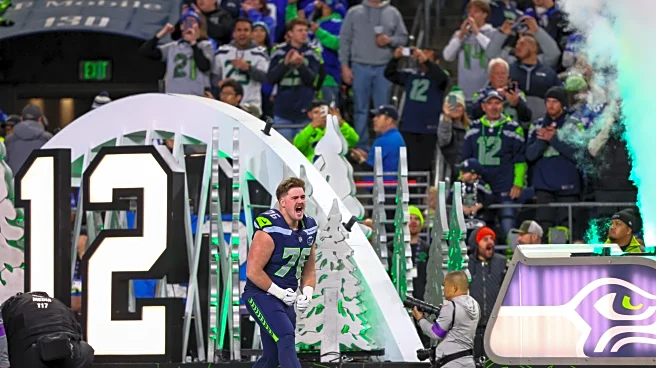

The Seattle Seahawks’ rookie class combined for 166 snaps in the Super Bowl win over the New England Patriots. That number was slightly inflated by Elijah Arroyo’s presence, but once again, the workload
was overwhelmingly concentrated on two players: Grey Zabel and Nick Emmanwori accounted for 142 of those snaps by themselves. Jalen Milroe, Robbie Ouzts, Mason Richman, and Nick Kallerup were all inactive, not even counting Tory Horton and Bryce Cabeldue, both of whom remain on Injured Reserve.
With that context in mind, let’s dive into the film and break down some of the most important rookie contributions from this game.
All data referenced in this article comes from PFF.
Grey Zabel – Offensive Guard (72 snaps)
Zabel finished the game as Seattle’s second-highest graded run blocker, posting a 76.5 mark, trailing only Abe Lucas (90.2). Pass protection was more uneven. He allowed five pressures, all of them hurries, and earned a sub-50 pass-blocking grade. Still, that was enough to outperform both Anthony Bradford and Jalen Sundell on the night.
One of the biggest issues for Seattle’s offensive line throughout the season — and again in this game — has been handling stunts. Against the Rams, this was a recurring problem. Against New England, however, the Patriots’ creative blitz packages and games up front were largely handled well by the unit as a whole.
On one key snap, the Patriots dial up a tackle-end stunt clearly designed to stress Zabel. The gap that opens between the center and left tackle is massive, forcing Zabel to cover a ton of ground. His footwork is excellent here, allowing him to stay balanced, square up, and close the space before the stunt can fully materialize.
Another snap looks like something you’d expect from a ten-year veteran. Zabel immediately processes the EDGE defender dropping into coverage, transitions to engage #97, keeps his eyes active, then helps the center who was starting to lose leverage. All the while, he maintains a hand on #97 to prevent inside leakage and help Charles Cross on the outside. That level of awareness and multitasking is rare for a rookie interior lineman.
There were still ups and downs. On one rep, Zabel uses a jump set, but Milton Williams counters with a quick swim move that leaves Zabel momentarily stuck at a bad angle. Once again, though, his footwork saves the play, allowing him to recover and finish the rep without catastrophic loss.
Hand usage remains a concern and has shown up on tape in multiple games. When his hands miss, he can lose early control. The encouraging part is that even when he loses cleanly, he finds ways to slow the defender down just enough to keep the quarterback upright long enough to attempt the throw.
On a run play, Zabel starts the snap well inside and ends up driving his defender several yards laterally, effectively escorting him out of the play. He disengages slightly too early, allowing the defender to recover and make the tackle, but the displacement itself is impressive.
In a concept similar to pin-and-pull, Zabel shows strong lateral movement to seal the edge defender. Anthony Bradford struggles at the point of attack, forcing Ken Walker to bounce the run wider than designed. Zabel holds his block just long enough for the cutback lane to develop, turning a potentially dead play into a positive gain.
Not every rep was clean. On a protection call where three threats align to the left side, the protection slides and hands off the initial defender to the center. Zabel is left with a poor angle and can’t prevent pressure from arriving quickly. Sam Darnold’s pocket awareness and escapability save the play from ending in a sack.
Nick Emmanwori – Defensive Back (70 snaps)
Emmanwori didn’t have the same splash impact he showed in the NFC Championship Game, but he also wasn’t asked to play the same role. His usage leaned more toward pressure and box responsibilities, logging six blitz snaps. Only twice all season — against Tampa Bay and Atlanta — did he record more pass-rush snaps than in this game.
His alignment distribution tells the story of his versatility: 10 snaps on the defensive line, 30 in the box, 29 in the slot, one snap as an outside corner, none as a free safety.
Statistically, Emmanwori finished with one pressure, five tackles, and four stops — leading the team. In coverage, he allowed five receptions on seven targets for 46 yards. There were no glaring breakdowns, though on one snap he briefly lost contact at the top of the route and nearly gave up a chunk gain.
The ongoing, somewhat contradictory narrative continues with Emmanwori. He looks fluid and comfortable matching slot receivers in space, but still struggles at times against tight ends who lean into physicality at the top of routes. That was unexpected coming out of college, where the assumption was that his size and strength would translate more naturally to those matchups. On this play, the tight end uses his frame to create separation, and Emmanwori has difficulty staying connected through the route stem.
Against a quicker, more agile receiver, however, Emmanwori shows excellent patience and hip fluidity. He mirrors the route cleanly, staying in phase the entire way. Drake Maye nearly threads the throw, but the coverage is tight enough to discourage the attempt.
Where Emmanwori consistently shines is in the run game. He plays with linebacker-level physicality, willingly taking on offensive linemen, tight ends, and fullbacks to preserve gap integrity. On one rep, he squares up Jack Westover — a former Seahawks UDFA — and holds his ground, preventing the run from cutting back inside.
While PFF credits him with just one pressure — which came on a blitz — his overall impact as a blitzer was more significant than the box score suggests. The attention he drew opened lanes for multiple free rushers, making him a key piece in the Patriots’ pressure packages.
Elijah Arroyo – Tight End (19 snaps)
Arroyo didn’t record a single statistic, but the tape was more encouraging than the box score suggests. Seeing him log nearly 20 snaps was somewhat surprising, and while the production wasn’t there, the usage alone creates optimism heading into Year 2.
On one run play, Eric Saubert executes a strong block, allowing Arroyo to climb to the second level and engage a cornerback in space. Yes, blocking a defensive back is far different from dealing with a defensive lineman or linebacker, but Arroyo takes a good angle and successfully removes Carlton Davis from the run lane.
There are still limitations. On another snap, he loses badly when asked to reach an interior defensive tackle. The alignment puts him at a severe disadvantage, especially for a player whose blocking is not his calling card.
On a split-zone concept, Arroyo initially misses and even ends up on the ground. To his credit, he keeps fighting, recovers just enough, and that persistence allows Ken Walker to bounce the run outside for a solid gain.
As a receiver, Arroyo’s speed is clearly part of the offensive vision. On one route, he uses a subtle stutter step to slip past the underneath defenders and push vertically. The throw never comes, and the route itself isn’t flawless, but the intent is clear: the staff understands how he can stress defenses down the seam.
On another rep, the defensive back anticipates a corner or dig route. Arroyo accelerates sharply at the top of the stem, creating clean vertical separation. Unfortunately, it appears he was the final progression on the play, and the ball never comes his way.
Rylie Mills – Defensive Lineman (5 snaps)
Mills only played five snaps, but he made the most of every single one. He recorded two pressures, one sack, and one run stop, impacting nearly every play he was on the field.
The rookie spending most of the season sidelined was a major anticlimax, but his final appearance provided legitimate hope that he can carve out a rotational role on the defensive line moving forward.
His quick swim move remains his best path to consistent success. His get-off is excellent, and his game is built far more on speed and first-step quickness than raw power. On one snap, he doesn’t finish the play, but the burst off the line is impossible to miss.
On another rep, he opens with a solid bull rush. As the double-team arrives, he times a swim move perfectly to disengage and redirect toward the quarterback. It’s an impressive sequence, though it appears he may have injured his hamstring on the play.
Then comes one of the prettiest sacks of the season. Mills’ hand placement is textbook, giving him immediate leverage to walk fellow rookie Jared Wilson straight back into the pocket. The finish is clean, controlled, and technically sound — an outstanding rep by any standard.
Other Rookies
Jalen Milroe (QB) was inactive.
Tory Horton (WR) remains on Injured Reserve.
Robbie Ouzts (FB) was inactive, and his absence was noticeable in the interior run game.
Bryce Cabeldue (OL) is on Injured Reserve.
Mason Richman (OL) and Nick Kallerup (TE) were both inactive.
Final Thoughts
It’s always disappointing to see so many rookies either inactive or on Injured Reserve, especially when players like Horton and Ouzts had already shown flashes of real impact earlier in the season. Still, even in limited opportunities, this class continued to provide reasons for optimism.
Rylie Mills’ five snaps were incredibly efficient, Zabel looked far more advanced than his experience level would suggest, Emmanwori continues to prove his value as a versatile chess piece, and Arroyo showed enough to believe his role can grow.
The 2025 draft class may not have dominated the Super Bowl box score, but the class offers plenty of hope heading into the 2026 season.