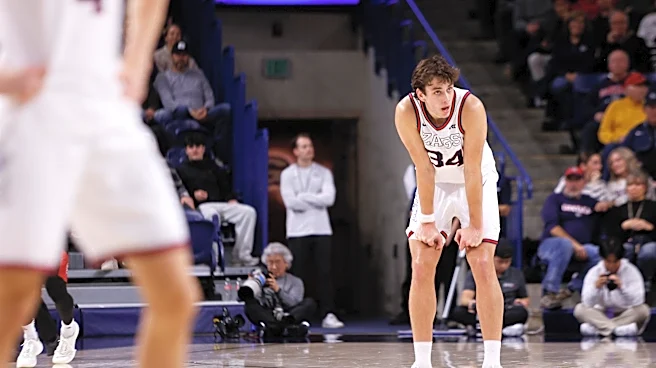





Gonzaga men’s basketball has prided itself on its frontcourt over the past decade. From towering giants like Przemek Karnowski to fluid, athletic bigs like Jonathan Williams, Zach Collins, Killian Tillie, and Brandon Clarke to game-breaking scorers and playmakers like Domantas Sabonis, Drew Timme, Chet Holmgren, and Graham Ike, Zags fans have been blessed to see a myriad of bigs operate in different but successful ways over the past 10-plus years. Now enter the 2026-27 starting frontcourt — Braden
Huff and Massamba Diop. Huff perfectly exemplifies a Gonzaga big man, a homegrown 6-10 senior forward who’s blossomed within the system for a couple of years before his big breakout last season (17.8 points in 18 games). And Diop, the hyper-athletic sophomore Arizona State transfer who looms at 7-1, swallows up feeble attempts at the rim on defense, and doesn’t get enough credit for what he did on the offensive end as a freshman last year (13.6 points, 5.8 rebounds). While Huff has become a favorite for the new Pac-12’s first Player of the Year award in the dawn of its second era, Diop has become a fascination in the Lilac City for his potential as an athletic lob threat for a heavy pick-and-roll offense while being a constant shadow on defense. Having the conference POTY candidate and a potential lottery pick in the 2027 NBA Draft in the same frontcourt should be as exciting as it sounds. While the regular season still hangs in the balance with the Nov. 2 date approaching against Purdue, here’s how Gonzaga’s frontcourt ranks amongst the best in college basketball (and will be updated throughout the season). To me, seven frontcourts around the country stand out from the rest prior to the season. Some are harder to rank at this point because of transfers, injuries, or incoming freshmen. Surely these rankings will hold up against the test of time during the year! Note: Didn’t include Chauncey Wiggins and Izan Almansa for Gonzaga because of eligibility issues. No. 7 – Texas (David Punch Jr., Matas Vokietaitis, Marcus Spears Jr.) Sorry, Zags fans, but I have to give props to a reloaded Texas team that knocked Gonzaga out of the tournament in the Round of 32 last year. I covered the game, and that Camden Heide shot will never leave my mind. I know. However, the Longhorns and coach Sean Miller went crazy in the transfer portal in the offseason, adding talented guards along with Punch (14.1 points, 6.8 boards), an undersized 6-7 big who plays much bigger than his frame, especially defensively (1.9 blocks, 1.3 steals). Vokietaitis (15.6 points, 7.1 rebounds), a 7-0, 255-pound big from Lithuania, flew under the radar for much of last season during his sophomore campaign for a Texas team that slouched through SEC play, then exploded onto the national scene with a 23-point, 16-rebound performance in the upset over BYU, followed by 17 and 9 in the upset over the Zags the following game. Then add in Spears Jr., the son of former Dallas Cowboys defensive end Marcus Spears, who re-classed as the No. 1 prospect in next year’s class and joined the Longhorns early. The 6-10 dynamic forward is another piece in the debate of re-classification (Emoni Bates bad, Cooper Flagg good!), but nonetheless, the frontcourt talent is unmistakable in Austin, and paired with a lot of depth from the portal in the backcourt, Texas is going to be an interesting team to monitor this year. No. 6 – Texas Tech (JT Toppin and Darrion Williams) The frontcourt duo for Texas Tech during their Elite Eight run in 2025 is back, and what a weird 2026 season it was for Toppin and Williams. Toppin was averaging 21.8 points and 10.8 rebounds through 25 games before he tore his ACL against Arizona State in February, ending his season along with any Final Four aspirations for the Red Raiders and Grant McCasland. Still, Toppin was tabbed as a First-Team All-American, showcasing a third straight year of paint dominance with a smooth lefty touch that’s been unguardable since his freshman year as a New Mexico Lobo. Williams was Toppin’s right-hand man during that run in March Madness in 2025, as the 6-6 forward averaged north of 15 points and 5 rebounds per game. Williams then transferred to play for Will Wade and NC State last year, which was a dumpster fire of a year compared to preseason expectations for the Wolfpack. Williams himself had a part to play, averaging 14 a game on just 41% from the field and looked all out of sorts. But this duo of Toppin/Williams wreaked havoc the last time they were together, but there’s a lot of ifs, depending on whether Toppin will return (might return in January, well into league play), and if Williams can slide himself back into the Texas Tech system. But both are all-conference level players, and if history has anything to say, this frontcourt duo can take the Red Raiders to the promised land. No. 5 – Illinois (David Mirkovic, Tomislav Ivisic, Zvonimir Ivisic) Illinois coach Brad Underwood lays claim to the best nickname in college basketball with Balkan Brad. I will not be hearing anyone out on this. Why? Because A) Underwood himself has claimed it and B) Balkan Brad’s strategy of loading with Eastern European players worked to perfection last season, elevating an Illinois team that was stuck in the March mud for years to a Final Four run last season. Mirkovic (13.3 points, 8 rebounds) and twin brothers Tomislav (10.4 points, 5.6 rebounds) and Zvonomir (6.4 points, 1.9 blocks) make up a burly and skilled frontcourt trio that shined with No. 5 overall pick Keaton Wagler last year. Together, the trio creates an offensive explosion with floor-stretching ability, rebounding, and physicality that vaulted Illinois to the No. 2 offense in the country according to KenPom, and just completely overwhelmed defensive stalwart Houston in the Sweet 16. This is a fun trio that will revamp with Providence transfer Stefan Vaaks to replicate that magic. No. 4 – Gonzaga (Braden Huff and Massamba Diop) Preseason, this is where the Gonzaga duo of Huff and Diop lands. With the possibility of Wiggins and Almansa in the mix depending on eligibility, this frontcourt could be No. 1 on any given night. No. 3 – Arizona (Mo Krivas, Ivan Kharchenkov, RJ Godfrey) This was a tough call for me in the preseason between the Wildcats and Gonzaga, but Arizona gets the slight nod for now. Krivas (10.4 points, 8.2 points, 1.9 blocks), a 7-2 rugged center who’s one of the best defenders in the country, will be in the running for Big 12 POTY this year. Kharchenkov (10.4 points, 1.4 steals), a 6-7 downhill slashing forward, is on a short list of the best perimeter defenders in college basketball. That duo will be picked in the first round of the NBA draft this year and will anchor (likely) the best defense in the country this season. Add in Clemson transfer RJ Godfrey (12 points, 5.3 rebounds), a 6-8, 240-pound bowling ball around the rim into the mix, and this trio will be a doozy for opposing offenses to handle under former Gonzaga assistant coach Tommy Lloyd. What’s hanging in the balance is this trio’s offensive ceiling, which for Krivas and Kharchenkov, was somewhat limited by the offensive production of Brayden Burries, Koa Peat, and Jaden Bradley. The Wildcats ran into Michigan in the Final Four and put up a rough performance by their standards, but that game undeniably was the matchup of the two best teams during all of last season. Lloyd is no doubt delighted that he returns Krivas and Kharchenkov, who could have easily been first-round picks in this year’s draft. No. 2 – Duke (Pat Ngongba, Joaquim Boumtje-Boumtje, Cameron Williams, Drew Scharnowski) One of the talks of the offseason has been this bunch for Duke this season. Ngongba (10.1 points, 5.8 rebounds, 1.1 blocks) returns as one of college basketball’s most feared defenders. But that’s the only returning frontcourt member from last year’s team. Joaquim Boumtje-Boumtje is the most intriguing player coming into this season for me. The future No. 1 overall pick, listed at 7-2 250, comes over from Barcelona as someone who can score, defend, and shoot. He won the MVP of the U-17 FIBA World Cup for Team USA, averaging 19.6 points, 10.9 rebounds, 2.1 blocks, and 1.7 steals per game. He also won’t turn 18 years old until next May (!!!). Think about that for a second. He was born in May of 2009. There’s a legitimate possibility that he wins NPOY this year, and he should be struggling in junior year Algebra II in high school somewhere instead. To assist, Duke will debut five-star seven-footer Cameron Williams, the No. 5 prospect in this year’s class, along with Belmont transfer Drew Scharnowski, a 6-10 forward who averaged 11 points and six rebounds last year for the Bruins. The intrigue for this uber-talented frontcourt also lies with the decisions at the hands of coach Jon Scheyer, who has a lot of bigs to choose from for limited spots in the starting lineup. No. 1 – Florida (Thomas Haugh, Alex Condon, Rueben Chinyelu) This is the only spot that was easy to pick. Two years removed from a national championship, the Gators still roster Haugh, Condon, and Chinyelu, a monumental achievement considering that Haugh was a projected lottery pick while both Condon and Chinyelu were projected first-to-early second-round picks as well. The 6-9 do-it-all Haugh is seen by many as the preseason SEC player of the year following a breakout 2026 where he averaged 17.1 points and 6.1 rebounds. Condon, a 6-11 post-oriented big, supplemented 15.1 points, 7.5 boards, and 1.4 blocks per game, while the 6-11, 265-pound Chinyelu is a defensive monster who averaged a double-double last year and was third in the nation in rebounding. This frontcourt is giant, anchored the best rebounding team in the country last year, and can protect the basket. These three have helped bring a championship back to Gainesville before, and will likely be the reason that Florida will be a top choice to do it again this season.