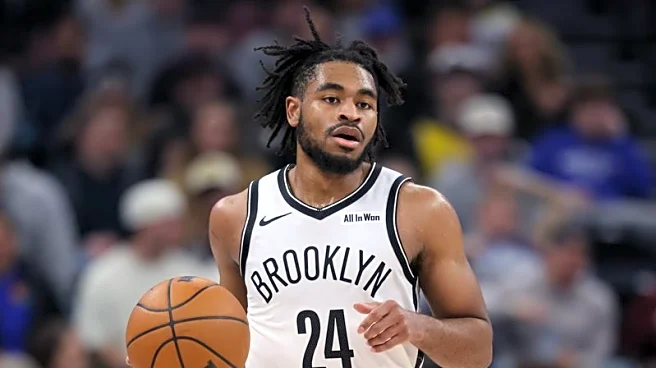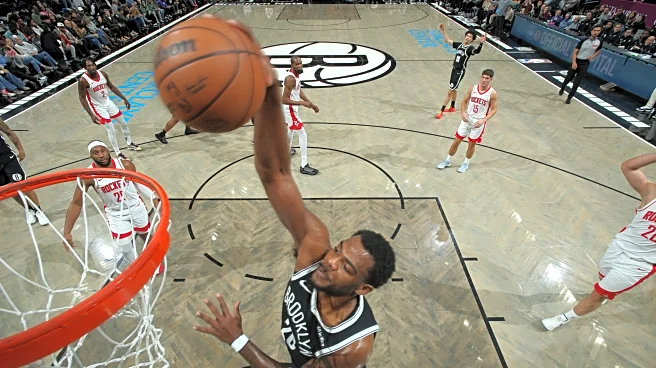




On Monday, the eternal cycle of life continued. The Sun rose in the east; it set in the west. Across the globe, people were born and people passed away. Day’Ron Sharpe was a +2 in an eight-point Brooklyn Nets loss.
Here are Sharpe’s last five games:
- +2 in an eight-point Nets loss
- +5 in a five-point Nets loss
- -1 in a sixteen-point Nets loss
- +7 in a one-point Nets loss
- +17 in a twelve-point Nets win
This season, Brooklyn has a net rating of -8.18 with Sharpe on the bench, but just -0.43 with him on the floor, per PBP Stats. That amounts to a +7.75 net swing. Last season, Sharpe had a preposterous +12.2 net swing, though he only played 50 games due
to injury/tanking. Two seasons ago, Sharpe had a +9.61 net swing, though he only averaged 15 minutes per game.
But how much context do we need to explain away a trend? When does that trend become reality?
Three seasons ago, in the playoffs, Day’Ron Sharpe made the play that still sticks in my mind when I think about his career…
Day’Ron had never moved like that, quick on the ground and explosive in the air. Prior to this play, I thought he might become just another center lost in the shuffle, generously listed at 6’10” without the eye-popping explosion, length, or skill to overcome unremarkable size for the position. It was just his sophomore season, but he was an iffy rotation bet on a team in desperate need of a backup center.
But then, in a close playoff game, Day’Ron shuffled over to double-team James Harden only to re-route and deny the future Hall of Famer off the glass. It was the culmination of an eye-opening physical transformation from the 2021 NBA Draft to the end of his sophomore season. It occurred to me then: if Day’Ron was capable of such rapid progress, if he was suddenly capable of a defensive play like that, he might be capable of much more.
Indeed, the man they call “DayDay” has become — actually, let Michael Porter Jr. tell it: “DayDay is a beast. He’s a starting five in the NBA.”
Day’Ron walked into the NBA as one of the league’s best offensive rebounders (a skill I clearly undervalued at first). But since 2021, he has become a better, slimmer athlete without losing any of the strength he plays with underneath. He has done tremendous work on his defensive positioning and technique since the early days…
So, under Jordi Fernández, the 24-year-old has done it all: trapping ball-screens, hedging and recovering, playing some drop, even outright switching.
Since the end of last season, Day’Ron has spoken of his desire to improve his subpar finishing at the rim, always the most worrisome part of his offensive game. Well, in 2025-26, he’s shooting 75% at the rim, not just average but great for a big man, and his 43% from floater-range is also a career-high, per Cleaning the Glass. The Nets are not yet halfway through the season, but it’s currently a remarkable, vital improvement.
“If you want to be great at anything, you got to have routine,” says Sharpe. “So just during the summertime, attacking every day. Fve days a week, six days a week, whatever, how many days it gotta take, how much time you gotta take, just attack every day. Me and Juwan [Howard], we work on finishes around the basket every day, even during the season.”
Day’Ron Sharpe is merely telling us what the film, what the story of his career would suggest. When a player makes this many improvements — this many drastic improvements — over less than five full seasons in the league, 10,000 hours of work lie below the surface.
Rookie Egor Dëmin has seen it up close: “He’s a great guy to be around, not just on the court, but off the court, right? He’s really funny, he’s really talkative, sometimes even a little too much. But he’s been really, really helpful … Anybody you ask, ‘Who’s the best person, the best human being?‘ it’s DayDay. I think that’s what translates on the court, and obviously because of his hard work and his dedication to it.”
But Sharpe is not just a feel-good story, a hard-worker that’s easy to root for because he responds to every question about his belligerent rebounding with a smile and some version of I don’t know, I just want the ball more, for real. He is an impact king.
Advanced metrics (a 77th percentile EPM this season, top-60 marks in DARKO, LEBRON, multi-year RAPM) are screaming out that Day’Ron Sharpe is, like MPJ stated, an impact starter hiding in plain sight. This is largely because Sharpe helps the Nets dominate the possession game: We know he is one of the league’s very best offensive rebounders, but with career-best defensive rebounding numbers and an absurd 3% steal rate, Sharpe’s defensive impact has skyrocketed.
Per David Lee, an excellent data-heavy hoops analyst, there has not been an NBA player better than Sharpe at securing extra possessions on the defensive end this season…
In simpler terms: Sharpe is a dominant offensive rebounder and a great defensive rebounder. While playing multiple defensive coverages, he racks up deflections, blocks, and steals. And, for now, he is a strong finisher at the basket. (His scoring efficiency would leap off the page too, if he dropped the stretch-big charade and started shooting 76% on free throws again, as he did last season.)
There is one hole to poke in DayDay’s statistical profile: For three straight seasons, opponents have been shooting much better at the rim with him on the court, but much worse from three. Big men can often provide rim protection, but have minuscule control over their opponent’s 3-point looks. Is Day’Ron merely benefitting from a long run of good luck that is set to regress at any moment?
Well yes, at least a little bit. But not all of Day’Ron’s impact can be explained away so simply. In fact: I think it’s time for a change of the guard at Brooklyn’s center position. With the Nets signaling that they’d like to make improvements to the roster this summer, beginning to compete in earnest next season when they don’t own their pick, Day’Ron Sharpe becomes a tantalizing asset.
Say the Nets decline their team option on Sharpe’s two-year contract this upcoming summer and ink him to a long-term deal in free agency. This is pure speculation, but say the deal looks something like $60 million over four years, or $15 million annually. At a flat rate, without the front-loading GM Sean Marks has been so fond of, that contract would run through Day’Ron’s age-25 to age-28 seasons at under 10% of the cap! Hell, even $20 million a year starts at 12% of the cap and decreases from there.
Tweak the exact numbers if you want, you get the idea: If Brooklyn believes in Day’Ron for the long haul — and he’s given them plenty of reason to — this could be their chance to lock in a productive starter while maximizing cap flexibility.
Of course, this would mean trading Nic Claxton at the trade deadline for assets, or using his $23 million salary to upgrade another position this summer. This isn’t necessarily about preferring Day’Ron Sharpe to Nic Claxton outright (though Claxton, despite the playmaking growth, is quietly back to shooting under 60% from two with a career-low block-rate and mediocre rebounding numbers). Rather, the Nets could invest in the ascendant Day’Ron Sharpe. And while it’s great to have two capable centers, Brooklyn is too far away from contention to start handing out significant money to two players who can’t share the floor.
This would surely be a risk. Despite bright playmaking flashes, Day’Ron still turns it over a ton. He is not the league’s most dynamic shot-blocker or lob threat, certainly not compared to Claxton. And of course, Day’Ron Sharpe has never averaged over 20 minutes per game in a season, including this one. His epic 25/15/5/2/3 performance in a start against the Oklahoma City Thunder last February was awesome, but still just a single data point.
But if you’re looking for reasons to be optimistic, aside from his excellent play as a backup, Day’Ron Sharpe has made 17 career starts, playing 24 minutes per game. He has averaged 11/9/2, including four offensive boards a contest.
And in those games, the Brooklyn Nets have won his minutes by a total of 27 points.