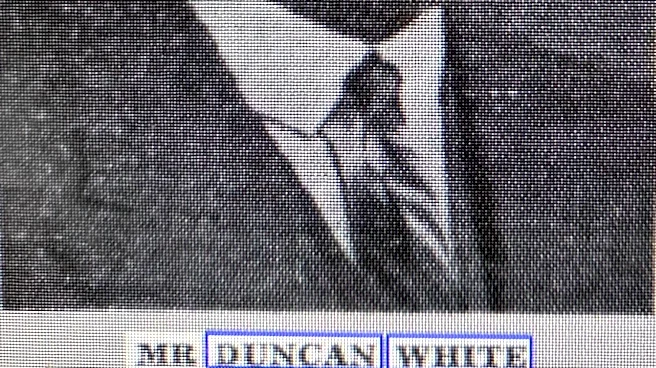

Duncan White passed away on this day nearly 90 years ago, and whilst his time as chairman was relatively short-lived, he had still managed to give Sunderland AFC a lifetime of support.
White was an eminent figure in the town, having joined the board at Roker Park in 1919, the same year that his father, the former Councillor JW White CBE, had died and passed on the running of their family construction firm to him. As a contractor involved in several large infrastructure projects in the area, such as schools,
housing schemes and new roads, Duncan White was named chairman of the Sunderland Master Builders’ Association in 1923.
Football was always a passion and, having been a talented amateur player himself, the Schools Football Cup in Sunderland was named after White in the 1920s. At SAFC, he provided a lot of the expertise and, crucially, funding for several stadium upgrades, and as he was already vice-chairman, became the natural selection to replace chairman Sir Walter Raine when he died in late 1938.
Raine, too, was a much-respected member of the community, the former Mayor and MP aiding many local groups and causes over the years, and his death came following a brave battle against illness. He passed away at his residence of 5 The Esplanade and, in keeping with his reputation as a beloved citizen, many mourners opted to donate in his memory to Sunderland Royal Infirmary, The Eye Infirmary and Monkwearmouth & Southwick Hospital in lieu of wreaths. The funeral then took place on the 22nd of December, starting with a service at St. John’s Methodist Church in Ashbrooke before interment at Sunderland Cemetery. Sunderland players Raich Carter, Len Duns, Bobby Gurney, Alex Hall, Bert Johnston and Charlie Thomson acted as underbearers, with the Police Band heading the cortege.
Other club representatives at Raine’s funeral included White and his fellow directors Ald. FW Taylor, George Purvis, Dr. Modlin and Col. JM Prior, plus secretary Johnny Cochrane, his assistant George Crow, trainer Andy Reid and assistant trainer Billy Dunlop. Former player and now coach/scout Tommy Urwin was also there alongside other members of the playing staff, although what is perhaps more notable was the fine tributes paid by some of Raine’s political and business rivals, who, despite being on opposing sides, still recognised his character.
During Raine’s final weeks, White was being referred to by some sources as the club’s ‘acting chairman’ and was heavily involved in the day-to-day running of Sunderland, overseeing meetings and dealing with contract and transfer negotiations personally. It was not a happy period, though, as in November the board had just lost another valued member when Lionel Wolfe died suddenly, and the remaining directors were working hard to keep things steady despite the absence of two hugely popular and well-trusted sages.
A highly regarded solicitor who had advised and helped countless Wearsiders, Wolfe had lived a short distance from Raine at 7 Esplanade West, and his funeral had been another emotional occasion. As was the case with Raine, scores of local dignitaries and figureheads attended alongside the various Sunderland representatives, although Col. Prior sent his apologies as it was also his brother’s funeral that day. The wreath sent by the club was in the form of a football pitch, with white heather ‘goals’ at either end.
Once everybody had been allowed to mourn, it wasn’t until the 3rd of January 1939 that White was officially elected chairman of the Sunderland Board of Directors, with Col. Prior taking over as vice-chairman (incidentally, both White and Prior had first joined the board on the same day in April 1919, following the resignations of Major R Norman Thompson and Major J Lynn Marr owing to pressure of business). When reporting the news, the Sunderland Daily Echo and Shipping Gazette referred to White as an unassuming character who had preferred to put the club’s interests before his own during his almost 20-year involvement and as one of the larger financial backers, too.
There was seemingly no appetite to bring new faces onto the board just yet, but on the 7th the Football Echo made it clear that the new set-up was expected to be more than adequate. It did, though, in the same piece refer to White’s own health, for he had apparently suffered serious illness himself in previous years, and whilst it was claimed that he was now looking to be in better fettle than ever, this somewhat throwaway line would prove rather prescient less than two years later. His poor health was to return sadly, and when he passed, he was suffering from what was described as another long battle with illness. In the intervening period, White had had just as much to deal with during some testing circumstances at Roker Park.

Just two months after becoming chairman, and with the secretary thought to still be troubled by Raine’s passing, Cochrane offered his resignation. The duo had been in charge for the 1936 Football League win and when the FA Cup was lifted in 1937, but now it was time for a fresh direction, and White and co. soon decided upon a ‘departure from past practice’ whereby secretarial and footballing duties were to be split. Crow was to take full responsibility for the administrative tasks, with a manager assuming the more team-focused functions, and until this new role could be filled, White would take on much of the responsibility.
White also announced in March his decision that the club would be looking to enter a third team into some sort of competitive action the following season – a suggestion that had previously gained traction among the fan base. He threw himself into first-team affairs for the time being, too, helping out during a hectic run of fixtures ahead of the arrival of Bill Murray. A former Sunderland player, Murray was interviewed on the 24th by White and Prior, and it was confirmed later that day that he would be taking over as manager on the 1st of April.
Talking about the decision in the Echo, reporter Argus spoke favourably about the thorough way in which White had conducted matters and pointed out that he had ‘practically deserted’ his own interests so that he could dedicate himself to the club. The homage continued thusly: ‘With him football is something of an obsession, and if he does not say a great deal, perhaps he thinks a great deal more than most people and keeps what he thinks to himself until the appropriate moment. Mr White is very popular with the players. In him they have a club chairman they can trust to give them a fair deal.’
Just as things seemed to be settling down under the new leadership model, though, there was to be further complication. In May 1939, White accounted for a loss on the balance sheet that was sent out to shareholders, mainly through a reduction in income from the FA Cup (the club’s defence of the trophy saw them reach the semi-finals in 1937-38, but they only had two home ties and no replays). On the final day of the month, the annual meeting was largely positive, yet the outbreak of war was on the horizon and events elsewhere would soon rock not only Sunderland AFC, but the whole world.
Proceedings had begun with White remembering Raine and Wolfe, before confirming that there would still be no nominations to replace them. He then said that the positions of Murray and Crow had been found to be ‘very satisfactory’, following that with news of ‘Sunderland III’, who were preparing to apply to the Wearside League and had made arrangements to play home fixtures at Herrington Welfare Ground, which had ‘good stripping accommodation’. On the motion of Mr R Freedman, the directors were re-elected en bloc, and The Marquess of Londonderry, Lord Greenwood and Mr JSG Pemberton were re-elected patrons of the club. Mr RA Brown was reappointed as auditor.
Once the players were returning from their summer break, though, tensions had increased and it was unclear whether football would continue. White was there to welcome the squad on their first day back and gave a short talk before they got stuck into things, but by September the focus had changed, and within a day of war being declared he had confirmed that the board had unanimously agreed to convert parts of the ground into air raid shelters. The club was believed to be the first to make such an announcement, with the Roker End itself thought to offer some protection, and sectional housings accommodating between 2,000 and 3,000 people, plus an 8ft wall of sandbags, were due to go underneath, with work commencing almost immediately.
White then had to guide the club through a time of uncertainty. There was little money coming in and the possibility of a return to regular competition was often a thorny subject, particularly in a part of the country where football could be a morale booster, but the industrial nature of the town, and the ground’s location close to the seafront, could have potentially put people at serious risk.
The Lads played in a handful of away games and White was regularly quizzed about the extent to which the team would compete, yet the conflict took priority and in July 1940 an agreement was reached with the directors that would see the ground being utilised by the Government for physical training schemes – limiting the chances of Roker staging large-scale matches for the time being, yet contributing greatly to the war effort. The decision was rubber-stamped at a shareholders’ meeting, but unfortunately it had to be chaired by Col. Prior, for White was struggling with his health again. His condition deteriorated and, four months later, came the sad news of his death aged 54.
Argus, under the subheading ‘HE DID MUCH FOR THE CLUB’, explained that White had been under treatment for a long period and, as a result of his illness, had been confined to his bed prior to his passing. Remembering White’s ‘cheery and generous disposition’, the piece highlighted his work developing Roker Park both before and after he had joined the board (prior to the Great War, a contractual dispute with a different building firm had jeopardised the completion of the new Roker End, and it was only finished when White stepped in) and praised the way White always shunned the limelight.
Argus then lamented ‘his invaluable quiet counsel’ and revealed that when funds were needed to overhaul the Fulwell End and replace the Clock Stand, White handed the money over readily, insisting that he would only be paid back should the club ever make adequate profits.
It was clear from the article that Argus had an immense fondness for White, who he stated was equally respected in the building trade and by his employees, and he wrote that he had travelled many thousands of miles with him following the team. ‘I knew his straightforward character, his love of fair play, his readiness to admit that the better team won and his love of football and cricket,’ he continued, pointing out also that he ‘knew too that when he spoke, he had weighed his words before he opened his lips’.
Although White was living at Melrose, Thornholme Road when he passed, his wife Gertrude’s address was listed as St Petersburgh Place in London. The now-widow held onto some of his shares, purchased from Ald. Taylor and a Mr Young in 1933, until 1947, but because his brother had predeceased him, his mother was expected to either sell or wind up the building firm, which operated out of High Barnes Works, General Graham Street. William Bell & Sons of Sunniside Chambers, the family company of William Henry Bell, who had preceded Raine as chairman, handled White’s estate, and the funeral took place on the 2nd of December.

This time, the interment was at Bishopwearmouth Cemetery after a service at Christ Church, Ryhope Road, where the organist had been asked to play Londonderry Air and a piece by Frédéric Chopin. Again, the attendance was huge and included a varied mix of senior local figures and community representatives, plus workmen from White’s firm. The board were joined by fellow director Ald. EW Ditchburn, who had not been listed as attending Raine or Wolfe’s memorials, with members of the first team, past and present, once more acting as underbearers, namely Carter, Gurney and Urwin, plus Alex Hastings, Matt Middleton and Harry Thompson. Donations in lieu of flowers in ‘affectionate remembrance’ of White were made to Sunderland Missions to Seamen and Monkwearmouth & Southwick Hospital.
Col. Prior, another important, albeit more gregarious, individual, moved up to replace White as chairman when he was elected at a special meeting on Christmas Eve. Dr Modlin was named vice-chairman, but despite the lifting of a ban preventing gatherings of a certain size, the board felt it was right to continue holding back on a decision to enter any regional leagues until what would be considered the following season (it was agreed, however, that in order to continue developing junior footballers, a young side should be put into the Durham County War Cup).
During Prior’s spell, football did slowly return to its previous state, but he too would pass away whilst heading up the club, a heart attack in 1949 killing him and making him the third chairman in a row to die whilst in post. Raine, White and Prior all have a huge place in SAFC history and rightfully so, and on the anniversary of Duncan White’s death, we mark their remarkable contributions.
Prior’s funeral took place on the 13th of October 1949, with a service at St Peter’s Church in Monkwearmouth. He had been a choir boy there before becoming a successful haulage operator, and rather fittingly for somebody who was a director when Sunderland first won the FA Cup, Abide With Me was one of the hymns that was sung. He had been discovered at his home, Tunstall Lodge, shortly after full time when Sunderland drew against Blackpool on the 8th, having taken a phone call from one of the other directors at half time informing him that The Lads were at that stage 1-0 up.