
In August of 1972, Bobby Fisher became the first (and to this day, only) American to win the World Chess Championship.
It was a remarkable feat that catapulted Fisher into the company of near mythos, combining
his legacy of transcendent skill with a Cold War backdrop, and has been written about almost incessantly since it occurred. Numerous films, biographies, and even a thinly veiled Broadway musical have recycled the tale for generations, aided by Fisher’s descent into reclusive retreat and (arguably) some degree of madness.
But what Fisher’s most heralded moment of genius and eventual seclusion overshadows is a feat that was perhaps even more remarkable.
Almost exactly one year earlier, Fisher had dominated the Candidates Tournament in a manner never before seen. The Candidates Tournament is a collection of the highest-ranked contenders vying for an opportunity to play in the World Championship.
In 1971, this included the eight best players in chess, outside of the reigning world champion, Boris Spassky. At the time, Russian chess players dominated the landscape of the game, aided by both their unusual degree of cooperation and communal strategizing, and a previously unheard-of amount of national funding.
The USSR took opportunities to showcase its self-proclaimed superiority very seriously. Other nations, not so much.
The United States was not particularly interested in funding chess exploits. It seemed like an expensive investment in what many saw as a hobbyist competition. Chess (and especially American chess) had long been viewed as an otherwise unserious preoccupation. Bobby Fisher’s rise had occurred within a vacuum of interest, and perhaps also because of it.
In modern terms, the Russians were an equivalent to the free-spending Los Angeles Dodgers, and Fisher — the Moneyball Oakland A’s.
Four of the eight players in the 1971 Candidates Tournament were Russian. One of them, Tigran Petrosian, was a former world champion who had beaten Spassky previously.
What happened next, no one could have reasonably predicted. Bobby Fisher absolutely dominated the competition, scoring 18 ½ wins against just 2 ½ defeats. Two of his opponents went 0-6 against him. To hold one world-grade contender to zero wins is incredible; to do it to two world-caliber players is herculean.
Fisher didn’t lose a match until the final. It took a former chess champion to finally tally a win against him. Fisher still took him down 6 ½ wins to 2 ½.
What most didn’t understand about Petrosian’s first win in the match was its significance in ending the greatest unbeaten streak in chess history. Going back to his previous matches, Fisher had won 20 consecutive games against the best players in the world, without tallying a single draw. No one has come close to matching it.
To properly express how insane that number is, you have to consider that Magnus Carlsen, chess genius of the current era (and considered by many to be the best chess player of all time), has never managed to win more than 6 consecutive games against top competition without a draw or loss. He’s never even gotten halfway there.
You can argue about era, and technology, and the popularity of chess since, but the streak remains. Most consider it a tribute to singular genius.
I think it exists as one of the most positive expressions of paranoia in competitive history.
To be a great winner in any form of competition, talent is requisite. This much is known. To dominate the opposition, though? This requires a degree of fear and paranoia surrounding loss that can only be generational.
We often hear the term ‘appropriate fear’ thrown around in the realm of sports. Coaches use it to admonish a team for not taking an opponent seriously, and I’ve known those who consider the term to be a bit dramatic. I, on the other hand, consider it to be more sensible sporting phrases in existence.
Any team can go on a winning streak. Probability argues for it. Eventually, even in mediocrity, everything eventually lines up mathematically so that it becomes a forgone conclusion.
Players all get on the same page at the same time. Shooting streaks combine. Effort is high, and health allows for a unified roster. The coaching stumbles into previously unconsidered strategies. Everything just works, for whatever reason.
For a winning streak to endure, though, one must be afraid. One must fear losing in a formative way, like a Michael Jordan who never got over being cut from his high school basketball team.
There’s nothing shocking about those Bulls going 72-10 – Jordan took every opponent seriously. There was nothing mathematical about it. Jordan knew lesser win-loss records would still allow his team to enter the postseason as the top seed. He wanted to dominate, to crush the hopes of every other team in the league before even reaching the postseason.
Why? Fear and paranoia that hope might allow another team to overtake his; to deprive him of a championship. It’s something I’ve termed ‘inappropriate fear’.
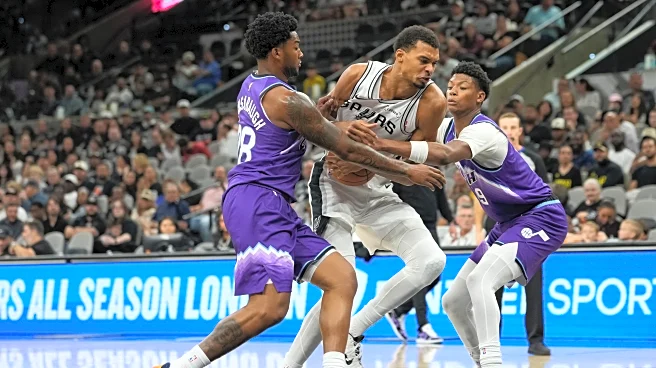
To say that the Spurs did not fear the Utah Jazz last night would not be an exaggeration. The first half felt lackadaisical. Mitch Johnson tried lineups that echoed the sentiment. Many of the players didn’t seem to lock in until the 2nd half.
Never mind that the Jazz had just upset the Eastern Conference-leading Pistons, and had come just shy of upsetting both the Lakers and the Magic.
Never mind that the Jazz were shooting almost 50% from three, and that San Antonio’s offense was visibly stalling in the absence of De’Aaron Fox.
The Spurs had just beaten the reigning champs three times in just two weeks. They’re contenders now, haven’t you heard?
And don’t get me wrong, this Spurs team is talented. They deserve acclaim for those very impressive victories, absolutely. But if they want to become champions, they’ll need to show appropriate fear regardless of the opponent. And if they want to become truly great, they’ll need to tap into something bordering on mania.
Bobby Fisher’s remarkable feats have become inseparable from the paranoia that fueled them. He assumed that everyone was against him, that his rooms were bugged, that the soviets were following him.
It was an obsessiveness that kept him from underestimating any of his Russian opponents, that spurred him to study their matches and styles more than ever, that forced him to improvise so creatively as to be almost unpredictable. An obsessiveness that allowed him to dominate them, absent anything resembling their budgets and government labs, teammates of equal talent, and the computer-driven analytics that dominate the game today.
In the end, he was vindicated. The KGB was observing him. The Russians had built a lab dedicated to studying both his strategies and psychology. Even the FBI joined in, trying to determine if he had been turned into a Russian asset. His chair at the 1972 World Championship was found to have been bugged.
I’m not saying that I think that Victor and company need to descend to the depths of the very real (relative) madness that eventually found Bobby Fischer in his later years. But they do need to begin to see all opposition equally. No match-up can be seen as so advantageous as to play less than full bore. No lead can ever, ever be safe.
The Spurs need to play with appropriate fear, at the very least. Perhaps even inappropriate fear, if Wembanyama wants to ascend to the mythos of a Jordan or Fischer.
Last night they played with neither.
Takeaways
- Something important that had much less to do with effort was the shooting of Stephon Castle, particularly from downtown. Castle was 1-8 from three, showcasing exactly how vital De’Aaron Fox’s success in this area has been for spacing and in aiding his teammates’ drives. I’ve written at least once this year that the Spurs are likely to struggle in games where both Harrison Barnes and Julian Champagnie aren’t hitting their shots, but I had failed to add Fox to the equation. Both Barnes and Champagnie have been streaky in the stretch of the season, and Fox has clearly been an important cog in forcing opponents to stick to the perimeter. Without any of them hitting shots, the Jazz’s defense was able to collapse on Victor much more easily, and stick to him around the arc in the absence of other long-distance threats. It honestly made me wonder if Mitch should have switched out one of the players in the starting lineup for the suddenly Curry-esque Keldon Johnson, who was one of the only players (other than Victor) who came into the game looking for a fight. (If Keldon doesn’t win 6th man of the year, we riot!)
- The lineup featuring both Jeremy Sochan and Lindy Waters was a bust, and I sincerely hope that we do not see it again this season. Regardless of intentions, that lineup immediately fumbled the lead and just did not look cohesive in any way. Spacing was bad, players looked out of sync, and while I understand that it’s partly because they haven’t played together much, it absolutely sucked San Antonio’s momentum into a basketball black hole. Things are starting to look grim for Sochan, I’m afraid. If Mitch can’t find at least one lineup that fits in, it might be over in San Antonio, which would be a huge bummer.
- Carter Bryant and Luke Kornet were the other two players who were really looking to make the most of their playing time, and insofar as they were allowed, they did. There’s an argument to be made that the Spurs should have given a double-big lineup some run, but the Jazz were so hot in their shooting that it honestly may not have mattered. Bryant’s shooting is still a work in progress, and he’ll need more time to really get into rhythm, but this was the first time that he didn’t really look lost even once in his time on the court. The rookie curve is always tough to overcome, but Bryant looks like he belongs on the defensive end, which may be exactly what the Spurs need come the off-season, as their forward rotation looks to experience some flux.
- It was definitely one of those rough rookie games for Dylan Harper. We’re starting to get to the part of the season where rookies have to adjust to the length of the schedule, and Harper definitely looked tired to me. It was an unfortunate outing, but those are just going to happen with rookies. Kudos to him for saving it for the Jazz rather than the Thunder. I will say, he certainly deserves to be the one running the point in the unlikely event that Fox misses more time. That kid has got vision you just can’t teach. I love watching him drive into the trees, don’t get me wrong, but his passing is a delight not seen on the roster since Manu’s retirement.
Playing You Out – The Theme Song of the Evening:
An Honest Mistake by The Bravery