
Luke Raley’s alma mater is Lake Erie College in Painesville, Ohio. Founded in 1856 as a female seminary, the school initially aimed to educate the gentler sex in the domestic arts and etiquette, but gradually
became a cradle of the suffragist movement, hosting speakers like Jane Addams and Susan B. Anthony and educating the women’s rights activist Frances Jennings Casement; today, it’s a stop on the National Trail of Votes for Women. As part of the emphasis on gentility, the arts play a large role on campus: a limestone Neoclassical music building with Art Deco flourishes, featuring a grand Skinner pipe organ, opened in 1927 for small concerts; the Royce Arts Center, a Brutalist riff on a those same Neoclassical columns and proportions, opened in the 1970s with a keynote speech delivered by Buckminster Fuller.
It’s not the most likely place to imagine the gargantuan figure of Luke Raley undergoing the Bildungs part of his roman, although the image of Raley noodling away on the pipe organ or scrutinizing a de Kooning has brought me much warmth over this cold, baseball-less period. But it was athletics that brought Raley an hour northeast from his hometown in Hinckley, OH, from one side of the Cleveland suburbs to the other, a drive that hugs the outline of the lake the college is named for. Raley didn’t receive interest from Division I schools despite being named to the All-Ohio baseball team as a senior at Highland High School, so he followed his older brother to become part of the Division II Lake Erie Storm (whose mascot “Stormy,” an anthropomorphized muscular cyclone, was needed to replace the former school mascot, The Unicorns, when the school went coed in the 80s).
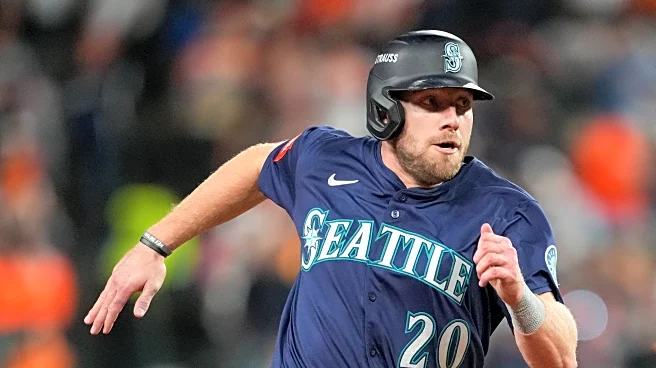
Raley’s broad-chested physique and cordwood-sized forearms might look more like the pugnacious Stormy, but he’s got a fair amount of Unicorn in him, as well. He’s capable of hitting a baseball as far and as hard as anyone on the team, like this Statcast-estimated 459-footer. The Raley family runs a Christmas tree farm in Ohio, and if this home run was a tree on the lot, it’d be one that took two handlers to wrangle, destined for a grand hotel lobby:
But Raley the Unicorn is just as likely to get on base like a slap-hitting infielder. He’ll drop a bunt down and use his surprising speed to leg out an infield base hit. He’s even likelier to wear a pitch, in the vein of the player the Mariners traded to the Rays for Raley, utilityman José Caballero. Here he makes no effort to get out of the way of 99 mph from the Rockies’ Angel Mejia. Raley walks away unscathed; the catcher is not so lucky.

“I don’t give a f***,” Raley said postgame about wearing 99 on his knee. “Just get on base, however you can.”
That’s an important skill for Raley to keep in his toolkit, because in order to get to that big power, Raley is going to have to take big swings, which means he’s always going to have a certain amount of whiff in his profile. But if he can balance those big K rates with a solid on base between big hits and small ball, there’s consistent above-average player in that profile: he posted a wRC+ of just under 130 in both 2023 and 2024 before injuries robbed Raley of the chance to repeat his efforts in 2025.
After being the feel-good story so often on a 2024 team that was otherwise frustrating, the tables turned on Raley in 2025 and he was stuck with the bummer year while the rest of the team soared to the postseason. It was clear immediately to those watching batting practice on that late April afternoon that something terrible had just happened to Raley, who took a swing in the cages and immediately grabbed his side, his formidable figure crumpling into the infield dirt. That oblique strain would keep him off the field until late June, and likely contributed to the back spasms that knocked him out again later in the season, sidelining Raley during the club’s postseason run.
It’s always hard to see a player get injured, but there’s something especially affecting about Raley, who exercises the kind of carelessness about his personal safety as the silver-sprayed War Boys or ancient Roman Hastati. Raley has said his style of play came from his dad, who told him if his uniform wasn’t dirty at the end of the day, he hadn’t tried hard enough. But baseball was still a dream for Raley at D2 Lake Erie, where he took education classes with an eye towards teaching special education; a dream that slowly sharpened into focus as he set school records and caught the attention of the Dodgers, who drafted him in the seventh round in 2016—just the second player to ever be drafted from the former women’s college, following Ryan Rua in 2011. Fighting for his dream against odds even more stacked than usual has resulted in a style of play for Raley that’s usually described as “scrappy” but is more accurately “Bruce Lee fighting the entire dojo in Fist of Fury.”
Unsurprisingly, this at-all-costs mentality has endeared Raley to fans. His small-ball skills are relatable, even as he’s hitting feat-of-strength Herculean home runs; plus, fans notice when you put your body on the line as much as Raley has. There’s also something joyfully incoherent about how Raley gets where he’s going. At 6’4”, he stands as tall as teammate Julio Rodríguez, but without his teammate’s leonine, loping gait. To borrow from some art history lessons undoubtedly taught at Raley’s alma mater, if Julio is Art Nouveau, all organic flow and natural elegance, Raley is Brutalism: raw, massive, blocky, utilitarian. While not strictly classified as a Brutalist building, Raley puts me in mind of Minoru Yamasaki’s Rainier Tower, although if you’re a Seattleite you might better know it as “the golf tee,” the “sharpened pencil,” or “the Beaver building”:

Yamasaki’s inverted pyramid design allows office space atop but for greenery and civic life to continue at the base of his tower. The design of Luke Raley allows for power-hitting at the top, with a base built for speed. Like the Rainier Tower, it looks precarious, but is surprisingly sturdy—optimized, even, for Seattle’s specific topography.
It wasn’t Raley’s legs that let him down in 2025, but in order to maintain his hold on a roster spot he’ll need every floor of his particular skyscraper working in concert in 2026. Raley’s long absence allowed for significant playing time of fellow Ohioan Dominic Canzone, who provides just half of Raley’s power-speed combo but took a step forward at the plate in 2025, making better, harder contact more consistently. The emergence of the fellow lefty has caused trade rumors to swirl around Raley this off-season, but the Mariners would be trading him at the nadir of his value, and losing out on Raley’s superior defense in the field to boot. There’s a role for both on the club, although a narrower path now.
But Raley is no stranger to having to fight for his position. He’s been doing it his whole life. He’s come out of unlikely places and gone even unlikelier ones, all the while packing the lunch-pail mentality that quarried the limestone for the buildings that would house great musical concerts, art shows, and more. The brutal and the beautiful, all at once in Luke Raley.