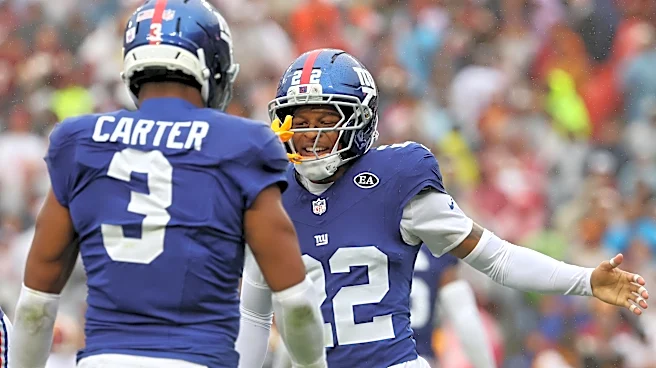


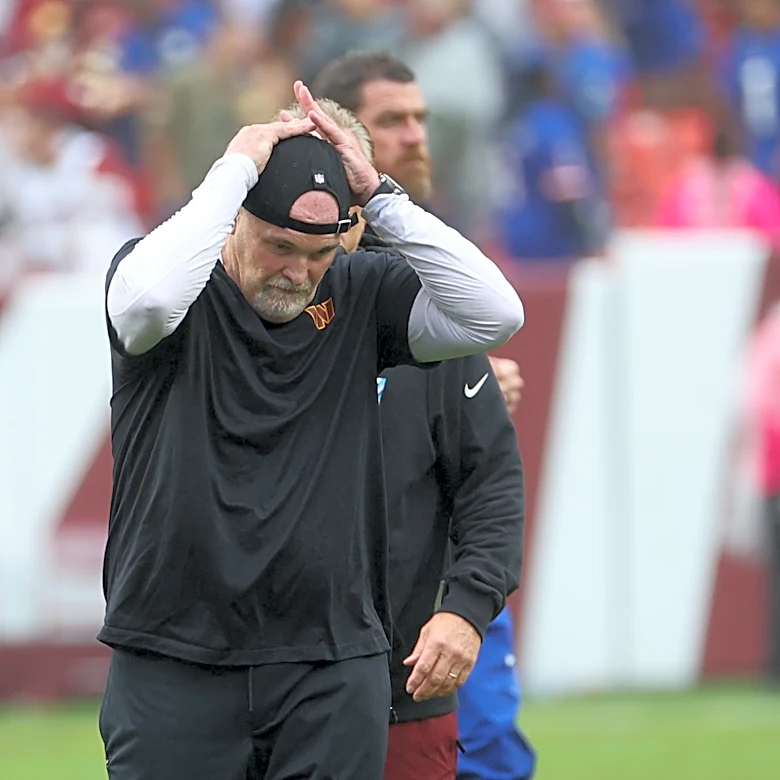

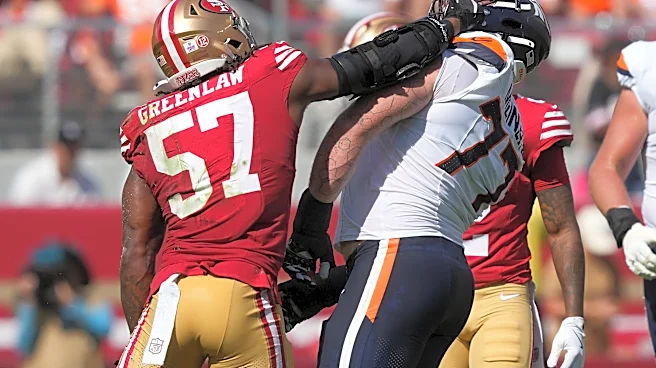

On a Sunday of wild endings in the NFL, the Giants-Commanders game ending may have been the wildest. The Giants should have won the game after they finally started moving the ball in the second half, but they probably feel better about Cam Skattebo’s physical error than Washington does about Jayden Daniels’ mental error. Let’s a take a look at what Pro Football Focus thought of the performances of individual players and what other interesting information has popped up on X.
PFF grades: Offense

No one on offense was judged
to have played an excellent game for the Giants except Isaiah Likely. Malik Nabers did grade above average, though. Likely would probably have graded even higher had he not incurred two penalties.
The character of this Giants offensive line has started to come into focus. In general it is an excellent pass-blocking offensive line, led Sunday by Jon Runyan, Jermaine Eluemunor (whose calf will be MRIed Monday), Andrew Thomas (still effective but a notch less dominant due to his groin injury) and center Bryan Hudson, who will remain the starting center, per what John harbaugh said on Monday. Sisi Mauigoa was average vs. the Commanbders, though he did surrender 3 hurries. The problem was a lot of mediocre run blocking (average or below average run block grades). Unsurprisingly, the Giants’ running backs are also grading mediocre to below average, although it’s hard to say that any of them have looked explosive even when they get a little space.
Jameis Winston also graded in the average range yesterday, pretty much like he has in every game he’s started this season. You may think that 326 passing yards, 3 TD passes, and no INTs (he did have one but it was nullified by defensive pass interference) would lead to an excellent passing grade. Remember, though, that PFF grades process, not just results. Winston’s 326 yards came on 54 attempts and only 33 completions for a measly 6.1 yards per attempt. More importantly, PFF, which emphasizes balls that should have been turnovers, gave Jameis two “turnover-worthy plays” (the nullified INT probably being one of them) and only one “big-time throw.” He also had a fumble. So as is always the case, with Jameis you take the good with the bad. It’s worth noting, though, that the Commanders blitzed Jameis on about half his dropbacks, and he performed as well on those as when not blitzed in addition to having 2 of his 3 TDs on plays he was blitzed, one of them on a play when the blitz resulted in a pressure.
Isaiah Likely had an excellent day catching the ball, with Malik Nabers not far behind (and only because of his first drop of the season). The other receivers were slightly below average, the worst being Darnell Mooney, who only caught 2 of 7 targets. The running backs were a different story, with all three backs grading slightly below average.
PFF grades: Defense

Things looked better for the Giants defense. Abdul Carter is really starting to realize his potential. He had 6 pressures, the second week in a row he has done that, and also his second sack of the season. Inside, D.J. Reader has been every bit what the Giants hoped for, solidifying the run defense (fourth game in five with an above average overall and run defense grade) and giving them a little push in the pass rush too. Likewise, Shelby Harris has picked it up too, grading above average for the second week in a row. Kayvon Thibodeaux had three pressures and was the Giants’ second-best run defender. Darius Alexander was a bit below average overall but did get two pressures (plus an award for taking his time standing around and nudging the ball a bit on his way back across the line of scrimmage on the last play of the game, preventing Jayden Daniels from picking it up and spiking it before time ran out).
At linebacker, Arvell Reese didn’t have the other-worldly performance he gave last week, but he still graded elite in run defense. His overall grade was low because he gave up 3 receptions and missed one tackle (perhaps the ill-fated attempt to spy on Daniels, who went right by him). Tremaine Edmunds was slightly below average but did sack Daniels once.
In the secondary, Dru Phillips got his third consecutive Very Good grade from PFF, but for a completely different reason than in the past two weeks. Phillips rushed the passer seven times yesterday and got five pressures, including two sacks and two QB hits. He also had 3 tackles, all three of them “stops” (unsuccessful running plays), though he did miss one tackle. His draft class mate Tyler Nubin wasn’t as fortunate, grading below average. Nubin had three tackles and an assist and wasn’t given any missed tackles, but his overall low grade was due to a 48.4 run defense grade. Apparently, when you take such a poor angle that you can’t even get into the same zip code as a running back who has burst into the second level they don’t call it a missed tackle.
Elsewhere in the secondary, keep an eye on Ar’Darius Washington, whose 29 snaps were his highest of the season. He had a missed tackle but also two stops and allowed one reception in two targets for only one yard and an overall Very Good defense grade. Those came at the expense of Nubin. Let’s see whether Washington starts next week. At the other safety, Jevon Holland graded slightly below average, even though he had a sack, because he missed three tackles and gave up a 16-yard reception. Greg Newsome and Deonte Banks each gave up two receptions for 23 and 36 yards, respectively.
Advanced stats
Here’s an amusing note. I’ll take ESPN’s word for it:
And that does speak to something about this Giants team under Winston: He’s nothing if not confident in his ability. More about that in a moment, but first…
Here are two different metrics of Winston’s play against Washington relative to other quarterbacks in Week 5, one (PFF grade) subjective based on an analyst’s assessment of his performance on each passing play and the other (EPA/play) based on objective statistics related to how well he advanced the offense toward points:
As we’ve noted before, PFF grades and EPA/play do not agree completely but are significantly positively correlated. In this case, both metrics agree strongly that Winston’s play was…average, barely. The reason, despite his 326 yards and 3 TDs, is that it took him 54 passes (33 completed) to do it, i.e., he had a lot of passes that accomplished nothing. Daniels graded higher, but solely because of his running (even though he ultimately cost his team a win by not spiking the ball – there is apparently no objective metric for bonehead decisions).
Now, about that Winston confidence: An interesting perspective by Kevin Cole is to take the above EPA/play numbers, but for the entire season to date, and separate them by early vs. late downs:
If you’re an optimist, you say that Jameis is “clutch,” making things happen when his back is against the wall (top four EPA/play on third and fourth down, trailing only Brock Purdy, Trevor Lawrence, and Joe Burrow). If you’re a pessimist, as Cole seems to be, you attribute it to luck and suggest he could regress over time. There’s a third interpretation I can imagine, that Matt Nagy is playing it too safe on first and second downs and only gets into his bag when his back is to the wall.
I have no idea which of these interpretations, if any, is correct, but here is a completely different take that in effect reaches the same conclusion about Jameis’ late-down proficiency:
In keeping with that, Winston had a great 77.2 QBR (EPA-related but taking into account quality of opposing defense, down and distance, garbage time, QB vs. receiver responsibility) yesterday, seventh-highest in the NFL:
One thing to say about Jameis is that he knows how to keep Malik Nabers happy. Nabers was targeted 20 times yesterday, catching 11. Here is his route spray chart:
Winston threw deep to Nabers three times Sunday on go routes but didn’t connect on any of them. The Giants continue to be among the NFL’s worst in deep explosive plays this season. What Winston and Nabers did do well yesterday was to hook up on the intermediate routes, which are the bread and butter of explosive pass offenses. They connected on a dig for 16 yards, an out for 20, a 17-yard TD on an over route, and another that went for 28 yards with lots of YAC. Many of the routes were short; Nabers can certainly do damage on those plays, as we saw in the Indianapolis game a couple of years ago, but to me he is best used deeper downfield to stretch things.
One reason to use Nabers more on intermediate/deep patterns is to clear things out for Isaiah Likely, Jameis’ other favorite receiver. Here’s his spray chart from yesterday, when he caught 11 balls in 13 targets for 94 yards and 2 TDs, most of them inside 10 yards at the catch point:

The bad news from the QBR ranking is that Daniels’ 80.6 QBR on Sunday was fourth-highest in the NFL…which brings us to the Giants’ defense.
On defense, if it seems to you as if Dennard Wilson has gotten more aggressive lately, you’re not imagining it:
To quantify that even more, here are the pressure percentages and time to pressure around the league through Week 5:
For the season, Abdul Carter has been the fourth-quickest in the league in time to pressure, despite being middling in pressure percentage. Kayvon Thibodeaux is about average in time to pressure but has gotten pressure less often than most other edge defenders.
Here are some of the pressure stats from Sunday, via NFL Next Gen Stats. First, sorting by “get-off” (time to cross the line of scrimmage):

Three, yes three, Giants edge defenders made the top 12 in pass rush get-off time: The much-maligned Kayvon Thibodeaux was fourth at 0.57 s, Trace Ford (in only 7 pass rush snaps) was seventh at 0.64 s, and Abdul Carter was 12th at 0.69 s. If we sort by time to pressure, Thibodeaux was 12th at 2.10 s while Carter was only 29th at 2.33 s. Part of Thibodeaux’s problem, then, may be more his closing speed than anything else.