

#1 – What Embiid changed in offense
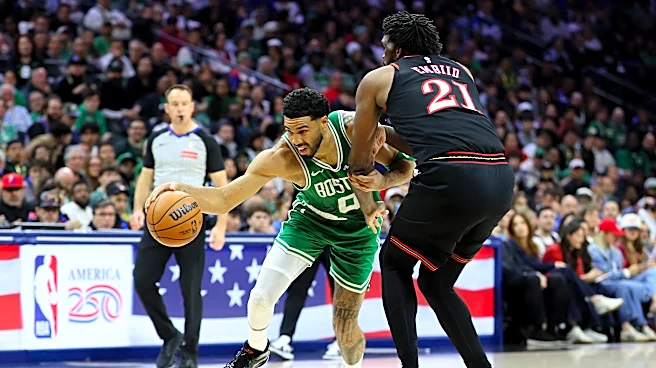
With Joel Embiid back for the Sixers, the way Boston attacked was a little bit different, as the big man is the anchor of the defense. To start the game, they tried to stick to the hedge coverage they had used with Andre Drummond, but the lack of mobility (and conditioning?) from Joel turned this coverage into a problem for Philly.
The big man isn’t as quick as before, but the rim protection remains very efficient. That’s why Nurse tried to keep him in the paint as much as possible when the Celtics
had the ball. Drop coverage was one way of doing it, but it opens pull-up opportunities. High risk, and sometimes high reward, like here with Jaylen Brown’s miss.
To keep Joel Embiid in a rim-protector position, the Sixers tried to reproduce what the Celtics do with a “roaming” role. They matched the big man with the least efficient shooter (here Jordan Walsh) so Embiid could roam in the paint and take away the rim from the Celtics.
However, Walsh’s shooting has improved enough that the Celtics trust him to punish that defensive game plan.
#2 – What Embiid changed in defense
On the other side of the floor, Embiid being back brought something that was lacking in the Sixers offense: gravity.

His presence created more gaps in the Celtics defense, but the Sixers didn’t really take advantage of it, with only 30 attempts from deep and not many catch-and-shoot opportunities created from post-up situations with Embiid.
His presence also created a lot more pressure at the rim for the Sixers, and they generated far more free throws than usual. Before that game, they were generating 14 free throws per 100 shots attempted; that number rose to 26 last night, largely due to Embiid’s skills.
Yet, that wasn’t enough to break the Celtics’ defensive shell, which allowed only 0.97 points per possession when the former MVP was on the floor.
#3 – Tatum passing
While the 2023 MVP didn’t have the impact his team expected, Jayson Tatum played like one, with 30 points, 11 assists, 75% true shooting, and 1.46 points per possession when he was on the floor.
What stood out was his passing, showing great patience and accurate reads to break the Sixers’ pressure. Here, for example, he doesn’t get caught despite having two big bodies on him, remains patient, and finds Nikola Vucevic on the short roll for a little hook.
There are little details that say a lot about a player’s ability to manipulate a defense and create offense. Here, he attacks the mismatch and spins, anticipating that Tyrese Maxey will help from his right. He gathers and recognizes that Baylor Scheierman is open. But when he passes the ball, his eyes are on Walsh, so Kelly Oubre freezes for a second—and when he realizes the pass went to number 55, it’s already too late.
Another impressive night as a creator and offensive engine from Jayson Tatum in these playoffs.
#4 – Payton eruption
While Tatum built the offense for the team, Payton Pritchard just went crazy and took away all hope from the Sixers with another eruption. After a slow start in the series with 31 points in the first three games, the former Sixth Man of the Year scored 32 points and carried the offense when Tatum needed a rest.
He took advantage of less aggressive coverage to drop a bomb against Philly when he recognized that the big man was in drop coverage.
When they switched, he used the spacing to let his speed, handle, and footwork speak for themselves, allowing him to find his spots in the paint with a soft touch.
He was very smart in identifying when the defense made mistakes and making the most of them. Here, the Sixers were supposed to switch, but George is late, allowing PP to drive, use his shoulder to dislodge his matchup, and finish at the rim in a crowded paint. Lethal.
And of course, as always, he knocked down a triple at the buzzer. The best in the business when it comes to closing a quarter.
#5 – Dominating the glass on both ends
The Celtics committed four more turnovers than the Sixers, and yet they attempted seven more shots and four more free throws. How?
Well, they absolutely dominated the glass on both ends. The Sixers were only able to grab six offensive rebounds from their 47 missed shots, while the Celtics generated 14 extra chances from their 45 misses.
The Celtics aren’t just dominating because they are more efficient—they are also winning the possession battle, leaving no chance for the Sixers to compete.
#6 – Finding the corners
The Celtics were a little better than usual at finding great looks in the corner last night, with more than 11% of their shots coming from those spots. That came from very smart floor spacing and great reads from the Celtics. Look at that gorgeous pass from Jaylen Brown to find Scheierman open in the corner—amazing timing, vision, and understanding from JB.
The high volume of corner shots also came from the Sixers’ willingness to stunt at the ball from the strong side. So the Celtics made sure to exploit that to create better shot quality.
They didn’t fall at their usual rate, but it was nice to see the Celtics using three-pointers as catch-and-shoot opportunities rather than forcing pull-ups from deep.
#7 – Creating open looks at the rim
The Sixers tried drop coverage, tested the hedge over and over, and even went to a couple of zone possessions—yet the Celtics’ efficiency at the rim was still outstanding.
With 80% efficiency at the rim and 25 free throws attempted per 100 shot attempts, Joe Mazzulla’s team delivered one of their best rim-attacking performances of the season.
#8 – The bench delivered
At halftime, the Celtics bench had scored 32 points, while the entire Sixers team was stuck at 38. Led by Payton Pritchard, the reserves stayed solid and provided exactly what the Celtics needed in those first 24 minutes to put the Sixers away.
Following the lead of the starters, they took care of the ball and were extremely aggressive on the offensive glass, leading to a lot of extra chances when they (rarely) missed.
The center rotation was impressive, with none of them playing more than 20 minutes, yet all showing different skill sets to help the Celtics build a diverse but solid game plan on both ends of the floor.
#9 – 124 to 86 in first quarters
We often say that games are won in the final minutes—and while that can be true, a point remains just a point, regardless of when it is scored. The Celtics had struggled a bit this season in the clutch, so they decided that the most important quarter wouldn’t be the last, but the first.
Through the first four games of the series, the Celtics are creating a gap of 9.5 points on average. Efficient from the jump, avoiding being caught off guard. Because in the playoffs, a win is a win, regardless of the margin. So they might as well remove any suspense early and take control from the start.
#10 – Triple screen
A little bit of fun to finish things out with a triple-drag action from the Celtics to attack Maxey’s screen navigation and Embiid’s lack of mobility.
On this play, Hauser sets the first screen and the Sixers switch. Then the second screen comes from Tatum, and he knows the Sixers don’t want to switch to protect Maxey from him. So George and Maxey stay matched up with their assignments. Then comes the third screen, where Queta rolls to the rim behind Embiid’s drop coverage.
Maxey is late on the play, Embiid is stuck between protecting the drive or the pass, and that leads to yet another open shot at the rim for the Celtics.