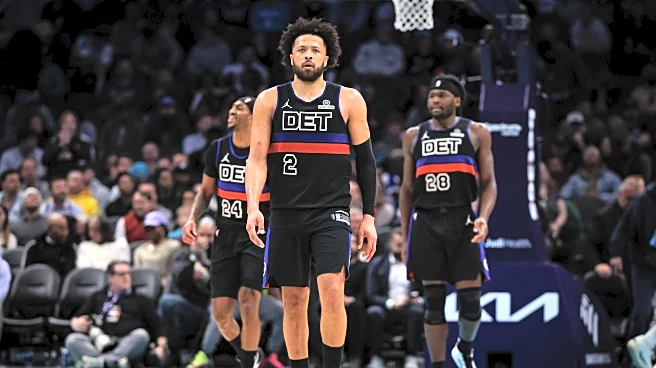




The Detroit Pistons have the best record in the league through the All-Star break, and there is a lot to like. In this Zach Lowe “10 Things” inspired piece, we’ll go over 10 things about the team that could represent the Eastern Conference in the NBA Finals.
Finish em’ Cade
Cade has always been streaky at the rim. He’d make a triple-contested scoop lay, then miss a one-on-one lay attempt against a not-so-big player. That’s why he’s hovered around 56% finishing at the rim throughout his career. The angles he took
or the decision to go up against multiple players tanked his rim field goal percentage in the past.
The Pistons MVP candidate has been more stable at the rim this season, shooting a career high 65% (58th %tile amongst point guards). His versatility in getting to the rim keeps defenses honest. Drives, transition takes, curls, hand-offs, and post-ups are all play types that allow Cade to get his finishes off. His shot-creating has led to finishes and jump shots, and the film is filthy.
Cade is a big guard, and he’s abusing smalls like always. He is an ambidextrous finisher who can sprinkle in tough, skilled layups or power through your chest with strength-based layups.
This finishing uptick will aid the Pistons halfcourt offense quite a bit. They will need every bit of finishing come playoff time. If their offense can remain average or just above it, that dogged defense can carry Detroit to early 2000s heights.
Duncan Robinson is more than a shooter
Duncan Robinson helps the halfcourt offense in many ways. The spacing he provides is second to none. How he weaponizes his shot is the bigger story.
Running Robinson off the 3-point line means you want the 6-foot-7 wing who’s a great finisher to get a lane to the basket. Robinson’s rim volume is low compared to his position, but he gets there plenty for his sharpshooter archetype. He’s not the unconscious get-it-up-at-all costs shooter Detroit has had in the past, but Robinson is an impactful driver, screener, and a plus passer.
Those three skills work in unison in dribble hand-off actions. Robinson takes advantage of defenses glued to his hip. After he runs off screens with shoulder-to-shoulder precision, the defense is at his mercy. Robinson can fire from deep, drive all the way to the cup, where he finishes 74 percent, or deliver pinpoint passes.
Bigs eat off Robinson’s gravity and movement. He makes defenses pay for playing him like he’s only a shooter. Wings eat off his gravity, too. Robinson is going to be a crucial piece in the postseason. Detroit needs him to play like the 2023 playoffs version of himself, not whatever these last few years have been.
How good can Jalen Duren be?
Jalen Duren is one of the bigs who eats the most while playing next to Robinson. Detroit is +10.1 when those two share the floor. That’s a theme for Duren. He has a positive two-man Net Rating with every player on the roster.
Duren’s getting assistance from all over, but nobody makes him. Duren is super impactful in his own right. From competing as a defender to his individual growth as a self-creator, the sky is literally the limit for him.
Young bigs who are poor defenders usually stay that way for a long time, but Duren has shaken off that narrative. Bball-Index’s rim protection grade, which factors in rim deterrence, activity, and disruption in on-ball and help rim defensive situations, grades Duren an A. His value is 10 points better than it was last year.
Duren still has meat on the bone as an offensive player. He’s creating for himself more and more. Duren has self-created 194 field goal attempts compared to 162 last year (PBP Stats). He’s always been a decent passer, and he’s taking boards off the glass and pushing the break more this year.
Not here to say he’ll ever be a point center, but he’s shown some of those skills that those who are that archetype have. With Cade excelling coming off curls and Iverson cuts, maybe Duren can be a hub at his peak.
Peak Duren is so far from now as he’s only 22. This All-Star breakout is encouraging, and his future is limitless. He’s always been an elite lob catcher, that hasn’t changed. But now there’s more than one guy on the squad who constantly wants to throw it up to JD.
Tricky passer
Those are the types of dimes Daniss Jenkins drops when sharing the floor with Duren.
Jenkins is willing to try any pass, and his handle makes life easier for him. Jenkins keeps his dribble alive while running through the paint. This gets defenders off balance, and Jenkins is throwing pinpoint accurate passes before they can blink.
This “nashing” move is a staple in Jenkins game. The fact that he’s a threat to score gets defenses to react favorably. If he were just nashing always to pass and never score, defenders wouldn’t help off their man because they know he’s not a threat to get a bucket. You can’t do that with Jenkins.
He’s eager to throw lobs, and it’s clear bigs loves playing with guards that spoonfeed guaranteed two points. Whether it’s off-hand passes to the corner man or right-on-target dump-offs in PnR play types, Jenkins is going to find the open man.
The alley oop to Isaiah Stewart involved Jenkins using a Shammgod move to create space before giving Stew an easy one. That goes back to his handle. Detroit has two strong ball handlers.
Jenkins has several tricks up his sleeve in addition to taking care of the ball. Jenkins’ 11.8 TO percentage is a solid mark for someone who handles the ball as often as he does. Jenkins isn’t careless with the rock and is willing to try any pass. Chances make champions.
Insane depth
Jenkins has helped establish the next man up culture in Detroit. The Pistons have won with their All-Stars out of the lineup, and JB Bickerstaff is getting the most from his guys. The Pistons’ turnaround isn’t getting enough shouts.
While tanking and All-Star Weekend fixes dominate headlines, remember the actual game. Remember that Detroit won 14 games a few years ago and now has the best record as we start the back end of the season. This isn’t normal, and Bickerstaff and the deep roster are news.
The Pistons were underdogs in the matchup with the Toronto Raptors before the break. Odd makers or the public thought it made sense that Detroit would struggle without Duren and Stew. There’s sound logic in that thought process.
Paul Reed had other thoughts, though. He was the best big on the floor in Detroit’s dominant win against the playoff-bound Raptors — not the first time he’s been impactful this year. Reed has stepped up all season when needed. He stays ready. Reed plays every game like it’s his last and is looking to shake up every game with endless effort and thunderous slams.
Javonte Green was an afterthought signing, but he’s contributing to the insane depth Detroit has — he’s a handsy nuisance and another candidate to put anyone on a poster.
Jenkins has developed into a late-game closer right before our eyes. Marcus Sasser can make big shots. Caris LeVert provides solid play on his best days. Everywhere you look, Detroit has a player who can step in when needed. We’re yet to see what Kevin Huerter can provide as well. There are options.
The Pistons are 8th in bench points. Their backups have been game changers in the regular season. Ron Holland is a part of the rabid bench attack, but unlike the rest of these names, he was expected to do so. Holland’s second year has been positive so far, and his hustle remains his game-changing trait.
Hustlers don’t stop
Holland, alongside Green, check in every game as must-see firecrackers. If nothing else, something is going to happen when those two touch the floor. Holland is susceptible to missing a steal, falling face-first into the hardwood, and recovering to get his hands on the ball in seemingly one motion. That’s the type of motor he has — Holland’s STL percentage remains in the 98th percentile amongst forwards.
Those brilliant hands allow him to turn defense into offense. Detroit is one of the best teams scoring in transition off steals, and Holland has a hand in that.
Green zig zags on the floor, tagging everyone in sight. Offensively, Green is always on poster watch and has made timely 3s. He is shooting 36 percent from deep, but it feels even better. Green has active hands — he is top 20 in deflections and has not played 1,000 minutes this season. Only he and the Miami Heat’s Dru Smith are in that club. Green doesn’t need a significant amount of minutes to show his value.
These two Tazmaynian devils will bring energy and pop on the Pistons’ postseason run. A lot of their value is defensively slanted. The Pistons have more defensive monsters who should be locks for league honors.
All-Defense
Ausar Thompson and Isaiah Stewart bring effort and best-at-what-they-do technique defensively. Ausar is the best perimeter defender in basketball. If you told me “pick one player to defend a random superstar,” I’m going with Ausar every time. You’re comfortable with him guarding smalls, big wings, forwards, and the occasional switch on a big is in his repertoire.
Surprisingly to some, Ausar hounds point guards better than those other positions. That’s insane considering his height, but his lateral quickness and instincts are second to none.
Ausar is the best Pistons defender in the passing lanes. He’s third in deflections league-wide, and his film has some “what was that?” in there.
There’s no way anybody thought Ausar would get back into this play. The way he patiently baits Memphis is beautiful. He blew that thing up and turned offense to defense. That’s a Deion Sanders-level lurk job, and he’s just as good on the ball as he is playing the lanes.
The league honored Ausar with Eastern Conference Defensive Player of the Month in January. If that’s a sign of things to come, the third-year play-destroyer should be in line for his first All-Defense first team selection.
Chet Holmgren, Victor Wembanyama (65-game rule), Scottie Barnes, Rudy Gobert, and Bam Adebayo are in the mix for first-team, but Stew should be too if these awards are a snapshot of the season.
The story of this season wouldn’t be whole if Stew were left off both All-Defense teams. Ausar is the Pistons’ most versatile and destructive defender, but Stew is the anchor for the best(?) defense in the NBA.
Nothing is allowed with Stew at the cup. Opponents shoot 42 percent at the basket when he’s there. That’s just a comical number. Nobody else is near that. He defends fewer shots at the rim compared to today’s rim protectors because he is a backup, but there aren’t many better per-minute rim protectors. And at 6-foot-8, one could make the argument that Stew is the best pound-for-pound rim protector.
Everyone else in that conversation is longer than Stew, even though he has a freakish 7-foot-4ish wingspan. His timing, anticipation, and intimidation factor put him in these conversations.
Stew gets challenged at the rim, but the result will never stop him from continuing to man the paint. If he gets postered, he shrugs it off and defends his yard over and over again.
Shaedon Sharpe is known for his Looney Tunes bounce, but that means nothing to Stew. He challenged both of these back-to-back Kodak moment dunk attempts and lived with the outcome both times (that block was clean). You’re going to have to be an insane leaper to catch Stew as Sharpe did on his second attempt.
Stew has easily been a top-10 defender this year. He is the anchor of Detroit, which thrives off its defense, and his contagious attitude is in the fabric of this franchise. The 65-game rule could keep Stew awardless this year, but that’s just not a reflection on how this season went.
The Oklahoma City Thunder had Jalen Williams and Lu Dort make defensive teams last year as the best team defense, and Detroit should have two this year as well.
Is it 2004?
Sure, the Thunder are still the No. 1 D in hoops, but the early portion of the season is doing some lifting there. Since November 19th, the Pistons have the No. 1 ranked defense with garbage time filtered out.
The Thunder have dealt with injuries. Naysayers will say that’s why Detroit has passed the defending champs in defensive efficiency in that time frame, but Detroit’s personnel is on par with a healthy Thunder team.
Ausar is the best perimeter defender of the bunch, full stop. Cason Wallace, Alex Caruso, and Dort are more than a strong perimeter trio in fairness, though. Williams or Caruso are the most versatile defenders on either team, but OKC’s clear-cut advantages stop there.
Holmgren over Stew as a defender? Not an outrageous take, but Stew is right there. Holmgren’s advantage is length and the ability to stay out of foul trouble. Duren vs Hartenstein is pretty even in terms of what their team’s ask of them. Duren’s effort and consistency on that end are noticeable. We’ve mentioned all the junk yard dogs Detroit has at its disposal, like Holland and Green, but Deuce doesn’t get enough love for his defense.
Cade has turned into a legit good defender. He’s a problem when sitting in his defensive stance, and he’s a plus weakside help defender. The All-Star game is only an exhibition, but Cade’s all-around and two-way game was on full display in that setting. The offensive burden is heavy, but that hasn’t stopped him from locking in on defense.
Robinson is the only huntable defender the Pistons play a lot (Isaiah Joe and Aaron Wiggins aren’t world beaters either). He’ll never be a great on-ball defender, but he does communicate and rotate off the ball. Detroit’s defense is better with him off the floor, but he doesn’t sink the ship. Robinson will be hunted in the postseason, but a team on a string like Detroit could overcome his individual isolation struggles.
Throw it to Unc
Tobias Harris’ post-up game should be a bail-out option for Detroit in the postseason. He’s always posted up plenty in his career, but he’s posting like a league-leading man this year.
Harris posts up less frequently than bigs like Nikola Jokić, Ivica Zubac, and Joel Embiid, but he’s outperforming two of them when he is on the block. Harris’ 1.18 points per possession on post-ups is better than anyone who posts up as frequently as he does, besides Jokić (1.21) and Kristaps Porzingis (1.23).

That shot will be a reliable option for the Pistons halfcourt offense. Harris hasn’t always thrived with expectations throughout his career, but he’s the third or fourth option here. Solid defense and bail-out shotmaking are what Detroit needs from Unc to reach the Finals. He has it in there.
State of the East
To reach the Finals, Detroit’s lack of shooting or a go-to secondary scorer must be mitigated. The Thunder indeed won the title last year without shooting the leather off the ball, so shooting mitigation is possible, but Jalen Williams did have a 40-piece in the Finals, and he’s a dependable second option for the most part.
Cade would need to be at an MVP level shotmaking-wise, and somebody else has to come along for the ride. Whether that be Duren, a shooter flaming on, or the group as a collective, there needs to be a dynamic second option that puts pressure on the defense.
Another obstacle in Detroit’s Finals aspirations is the field. The New York Knicks are rolling, winning 8 of their last 10 games. Jalen Brunson is who he is. That’s a tough cover for anyone, but Ausar made him work last year, even though all the casual fans remember is the ending. Their Jose Alvarado addition adds some feistiness to a passive Knicks squad. They’re the biggest threat.
The Cleveland Cavaliers could be serious contenders, too. We’re yet to see the James Harden + Evan Mobley connection, but Harden has helped Jarett Allen thrive so far. The Pistons have the double bigs to match Cleveland and the perimeter defenders to make Donovan Mitchell and Harden sweat.
The Boston Celtics are probably lower on the contender tier compared to these teams. Jaylen Brown has been spectacular, and they added more shooting with Nikola Vučević at the deadline, but they don’t have their horses. Without Tatum (maybe he returns), I envision a world where JB isn’t the most efficient No. 1 option in a playoff setting. Detroit could take advantage of his eventual cold nights and grind Boston down. Toronto and Philly are there, but the Pistons are better.
Detroit could very well be better than every team in the East and go on a real run for the first time since the Goin to Work era. There’s a lot to like about the team with the best record in the NBA as we enter the post-All-Star break portion of the year.
Stats as of 2/18/2026 via Basketball Reference, Bball-Index, Cleaning The Glass, PBP Stats, PivotFade, and NBA.com