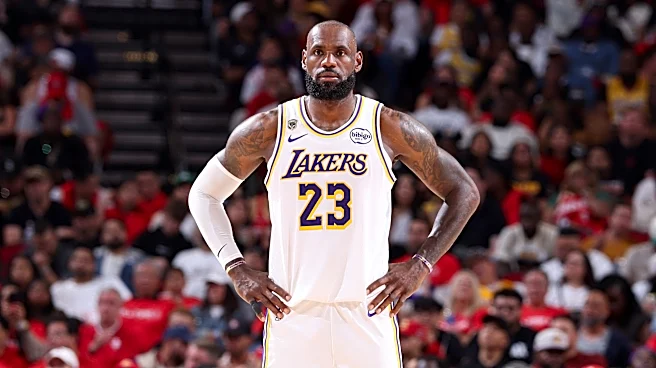







Welcome to our annual Lakers season in review series, where we’ll look back at each player on the team’s roster this season and evaluate if they should be part of the future of the franchise. Today, we continue our series with a look at LeBron James.
Nearly eight years ago, in the summer of 2018, I was driving in my car when I got a text message that just said “LEBRON JAMES!”
Shortly after, the floodgates of additional texts and social media posts broke open and confirmed what had been hinted at as
a real possibility, but never really believed, at least by me: LeBron was coming to the Lakers.
LeBron, now 41 years old, has done about everything he could have ever set out to do while with the organization he chose to come to alone on that fateful July day.
He’s won a championship, made multiple All-NBA teams, was an All-Star every season, broken countless individual records — including becoming the league’s all-time leading scorer and winningest player — and has even gotten to play with his son Bronny. He also helped shape the trajectory of the franchise beyond himself, serving as a major factor in getting the Lakers to trade for Anthony Davis after his first year with the team, which then, six years later, became a deal for the player James himself had said was one of his favorites in the entire NBA when Davis was flipped for Luka Dončić.
James has essentially played four careers — two with the Cavs, one with the Heat, and this one with the Lakers. He’s been a Hall of Famer in each of those stops, racking up accolades and statistical milestones that will likely never be matched, much less eclipsed. The phrase “nothing left to prove” is often thrown around too loosely for too many players, but there’s no athlete it ever applied to more than LeBron.

Judging James on what he continues to accomplish, then, can feel a bit strange, but also so ingrained into all of us for so long we know no other way. In many ways, then, this year was both a major success, but also a reminder of the dual realities that exist for a player who remains this good as a 23-year veteran but is no longer the version of the player that came to the Lakers eight seasons ago — even while making a max contract.
So, James is both a player who continues to impact winning, but no longer the singular driver of victories whose franchise’s every move is designed to supplement and be enhanced by him. Yet, even at this stage of his career, he still wows and amazes, just in different ways and a bit less frequently than before.
The Lakers and the league, however, are still lucky to have him. Whether that will continue to be the case remains to be seen. And in more ways than one…
How did he play?
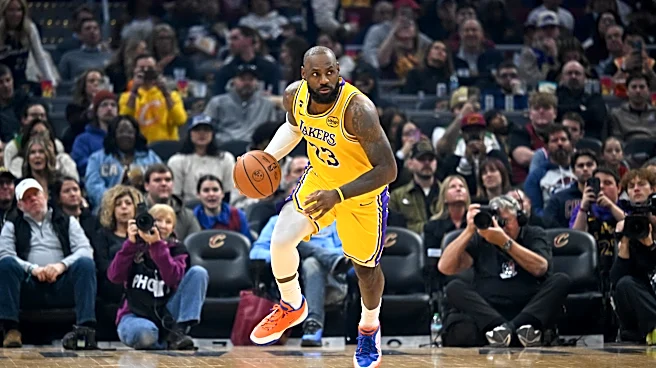
James had both an unfathomable year for someone of his age and longevity in the league and his least productive season in his tenure with the Lakers. His counting stats — 20.9 points, 6.1 rebounds, and 7.2 assists — were, again, excellent when contextualized by his age and his role, but they’re also his fewest points since his rookie season and his third-lowest rebounds per game of his career.
And while his shooting percentage overall of 51.5% remains well beyond respectable, the dip in his three-point percentage down to 31.7% was a substantive and meaningful in the style of game he played and how he could be most effective for the Lakers this season.
This was also the first season of his career LeBron was not available to the team on opening night, missing the first 14 games of the year with a sciatica injury that cost him all of training camp and the preseason. When he did return, he showed signs both of rust and age, working his way back into shape and searching for his game in the midst of the Lakers rolling through the first part of their season.
That said, LeBron did ultimately find his way and, over the course of the season, flashed his trademark adaptability that only comes from being one of the best and versatile players to ever play this game. With both Austin Reaves and Luka Dončić missing time over the course of the year, LeBron oscillated between primary and secondary roles, switching between being an on- and off-ball worker whose position in the pecking order was first to be adjusted whenever one of Luka or Reaves was removed from or returned to the lineup.
This culminated with James leading the Lakers into the playoffs as the last man standing as Reaves and Dončić were sidelined with injuries. Facing off against the Rockets as a huge underdog, James set the tone and led the Lakers to an upset, proving to be the perfect mix of productive player and puppeteer, pulling the strings to dictate the flow of the game while fostering focus and game-plan discipline within the rest of the team.
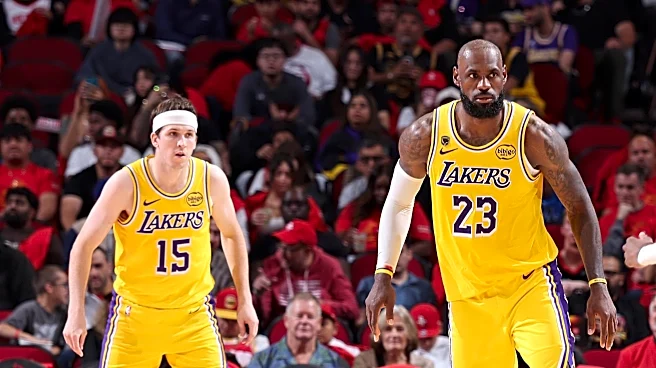
In one of the more memorable stretches of the series win over the Rockets, LeBron and Bronny teamed up for a flurry of 10-straight points.
These are the sorts of moments that will live on forever, while also serving as a reminder of what LeBron was still capable of as an impact playoff performer.
What is his contract situation moving forward?
For the first time in his Lakers’ tenure, LeBron enters the summer as an unrestricted free agent whose contract naturally expired. The Lakers still have LeBron’s Bird rights and can pay him up to his max salary, but he is also free to go into the marketplace and seek out the best deal he can from any other team.
Further, it remains to be seen what the Lakers plans are for LeBron and those Bird rights they hold with him. Will they keep his cap hold on their books and try to work out a deal with him early in free agency that will allow them to still go out into the market and either sign additional free agents or try to use cap space for a trade? Will they instead go full bore into the market as a cap space team and renounce LeBron’s rights early on, with the possibility of holding back some of that space to sign LeBron after they’ve already made other moves?
Needless to say, this is uncharted waters for both LeBron and the Lakers. And while there’s nuance in both of those scenarios above, it’s not a given that LeBron will be back at all, whether by his choice or the Lakers.
Should he be back?
This is the million-dollar question that, honestly, has no straightforward or easy answer.
LeBron is still good enough to help a team compete at the highest level. He showed in the Houston series he can impact winning and that his smarts and general know-how can be especially valuable in a playoff environment.
LeBron will also turn 42 next season and relying on him to be an every-night contributor in the regular season while still having enough juice to be a high-level difference maker in the playoffs does not feel realistic. If there’s one thing we’ve seen consistently in the playoffs for years, it’s that the habits you form in the regular season help determine the team you will be in May and June.
Threading the needle with the oldest player in the league to be both a regular season habit-former and being rested enough for a deep postseason run will be a challenge. Not impossible, but not easy.
Somewhat related, LeBron remains one of the most important and critical leaders in the league for whatever team he’s on. And while he showed he’s more than capable of thriving as a third option behind Luka and Austin, the full transition to this being Luka’s franchise will never fully happen with LeBron on the roster because of the inherent weight his status brings.
This isn’t necessarily negative or bad. It’s just the realities of a roster’s natural ecosystem. The degree to which it matters to those who make the decisions, however, will play a role in whether LeBron is back.

And, then, of course, there’s the question of salary. Beyond any role LeBron would be slotted into, what he’s paid matters a great deal when it comes to team building and how to put together the best roster possible.
What is LeBron willing to play for? What are the Lakers willing to pay him? Is there a scenario where LeBron takes the minimum? What about a salary equivalent to the mid-level exception? What if he wants closer to $20 or $30 million? What plans do the Lakers have this summer and how are those impacted by the huge variance in these sorts of numbers?
Fact is, the answers to all of these questions (and many more) from both LeBron’s and the Lakers’ perspectives make it very difficult to project whether he will be back. Now, if you’re asking whether I’d want him back, I’ll be honest and say it depends.
I think it’s hard to imagine the Lakers being a better team without LeBron. That said, I also firmly believe that this summer is the Lakers’ best chance to take major steps forward in building the next great team that can compete for a title. And building that sort of roster means taking long-term considerations, which do not necessarily align with having the oldest player in the NBA as a central part of the roster build.
I ultimately believe, then, that if the Lakers could functionally create an environment that does not need LeBron to be great, but then could add him on top to help push it forward, that would be the best outcome. That, however, likely means him taking as little money as possible and surrendering even more real estate in terms of role and cachet both on the court and in the locker room. How viable that is…I don’t know.
Like I said, finding the right answer isn’t so easy.
You can follow Darius on BlueSky at @forumbluegold and find more of his Lakers coverage on the Laker Film Room Podcast.