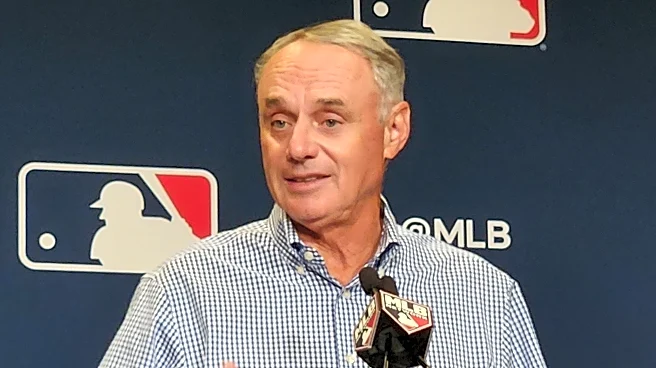



MLB Commissioner Rob Manfred has had many ideas to shake up the game in his 11-year tenure leading the sport.
Some of them have been good, like the pitch timer, larger bases and restrictions on defensive shifts. Others, like the placed runner (or, as it’s often called, the “Manfred Man”) have not been well-received by baseball fans.
Thursday, Manfred gave a wide-ranging interview to WFAN radio in New York on things he’s been thinking about regarding baseball’s future, reported by Evan Drellich in The
Athletic:
“We’ve talked about split seasons. We’ve talked about in-season tournaments,” Manfred said Thursday in a radio interview with WFAN’s Craig Carton and Chris McMonigle. “We do understand that 162 (games) is a long pull. I think the difficulty to accomplish those sort of in-season events, you almost inevitably start talking about fewer regular-season games.
“It is a much more complicated thing in our sport than it is in other sports. Because of all of our season-long records, you’re playing around with something that people care a lot about.”
Whether players would go for such a format change would also be a key factor. The MLB Players Association declined comment.
The “in-season tournament” would presumably be similar to the “NBA Cup” that the pro basketball league currently has. The thing is — does anyone really care about that? Manfred’s right about logistics and “playing around with something people care about.” Many baseball fans like the history of the sport and the way the schedule is currently set up, though it should be said that if you were creating something called “Major League Baseball” from scratch in the year 2026, there’s no way you would have a 162-game schedule. Somewhere around 140 games would likely be the sweet spot, with a schedule beginning in late April and ending in late September. That would help avoid the worst of the worst weather in northern cities like Chcago. Manfred is correct: Changing these sorts of things would be “complicated.”
One thing is for sure. If MLB ever did go to a split season, they need to avoid the mistake that was made after the 1981 strike was settled. When they simply declared the division leaders when the strike happened as “champions,” then had the second-half winners also as champions, that wound up having the NL teams with the best records in each division — the Reds and Cardinals — sit home in October. What they should have done was to have the second-half winner play the overall winner. If that happened to be the same team, then go to the first-half “champion.”
That said, a split season would likely be a non-starter for a number of reasons.
Also having said that, I do think that after expansion comes — and it will come, it’s just a matter of timing — the regular-season schedule will be reduced. This is because in a 32-team league, we will likely have 16 teams make the postseason. Is that too many? Absolutely yes. It is going to happen because the league can make more money selling postseason games to TV rightsholders than regular-season games.
What would a schedule reduction look like? The number “154” has been floated, largely for historical reasons, as MLB had a 154-game schedule from 1904 to 1960 (AL) and 1961 (NL). But any number between 150 and 156 would be workable. Now try to convince players that they should take a small reduction in salary because the schedule is shorter. Good luck with that.
Manfred talked about realignment on geographic lines, for the following reason that actually makes sense:
“We have those four-window days that I love,” Manfred said of the early rounds of MLB’s playoffs. “You get four baseball games in a day, it’s awesome. But when you think about the fans in the individual markets, you always end up with — because of the way we’re set up — you get Boston versus Anaheim in one of the early rounds. So you’re either going to be too late (in the day) for the fans in Boston or too early.
“If you realign geographically, you would look more like other sports, where you play up east into the World Series, and west into the World Series, and that 10 o’clock game on the (East) Coast that sometimes is a problem for us becomes a primetime game on the West Coast for the two teams that are playing. So there’s a lot of advantages to it.”
I’m going out on a limb here by saying Manfred’s point actually makes sense. If a 32-team MLB realigned along geographic lines into eight divisions of four teams each, the first round could be true “divisional playoffs,” where you’d have the first- and second-place teams in each division play (say) a three-game series, then move on to what would be the equivalent of the current Division Series round, with eight teams remaining playing four five-game series. At that point geographical separation doesn’t matter that much.
So how would such a split look? Let’s assume for the time being that Nashville and Salt Lake City are the two expansion teams (and even if it’s not those two, it’s likely one eastern city and one western city). That could result in divisions aligned like this:
NL East: Phillies, Mets, Nationals, Pirates
NL North: Cubs, Cardinals, Reds, Brewers
NL South: Braves, Marlins, Rays, Nashville
NL West: Dodgers, Giants, Padres, Diamondbacks
AL East: Red Sox, Yankees, Orioles, Blue Jays
AL North: Tigers, Guardians, White Sox, Twins
AL South: Royals, Astros, Rangers, Rockies
AL West: Angels, Mariners, A’s, Salt Lake City
This would actually be pretty elegant. No division would span more than two time zones and all are geographically compact. Also, Manfred said something in his radio interview that I was very happy to hear:
Manfred said on Thursday that markets that have multiple major-league teams — Chicago, New York, Los Angeles — should not have both teams in the same division.
“I think you would try to keep the two-team cities separate,” Manfred said. “That would be my thinking.”
That’s a relief. Personally, I would not want the Cubs and White Sox in the same division and the alignment above would accomplish that while still keeping the divisions geographically sensible. Also, only two teams (Rays and Rockies, both expansion teams) would have to switch leagues in the setup above, which would maintain most of 150 years of league history. Further, two geographic divisional rivalries would be created (Phillies/Pirates and Marlins/Rays).
To have this alignment and “divisional playoff” make sense, you’d also have to have a schedule more intradivisional.
Here’s one possibility:
15 games vs. every team in your division: 45 games
6 games vs. every other team in your league: 72 games
3 games vs. 12 of the 16 teams in the other league: 36 games
That’s 153 games. Add one more random game each year among the 12 teams in the other league and you’d have 154. In a schedule like this you’d rotate the divisions each team would play in the other league, so you’d play every team in three of every four seasons. I think this would be workable, it would still allow fans to see 25 of the 29 other teams against their favorite team every year, and it would make divisional play more important. I think that matters because in my view, baseball is a regional sport. Rivalries like Cubs/Cardinals, Red Sox/Yankees and Dodgers/Giants, among others, matter to fans.
No doubt, Manfred and the owners will make a schedule not like this and it won’t make anyone happy.
This, though, should make you happy. From Drellich’s article:
“I’m done at the end of this contract,” Manfred said. “I’ve told them (the owners) that, and I’m gonna stick to it. I’ll be 70. It is enough. … You have a certain period of time when you have things that you want to accomplish, you take your best shot, you try to get as much done as possible. And then it’s sort of time for the next guy with his set of things. And I think that’s healthy and good for this.”
Three more years. Try not to mess things up too much in the meantime, Rob.