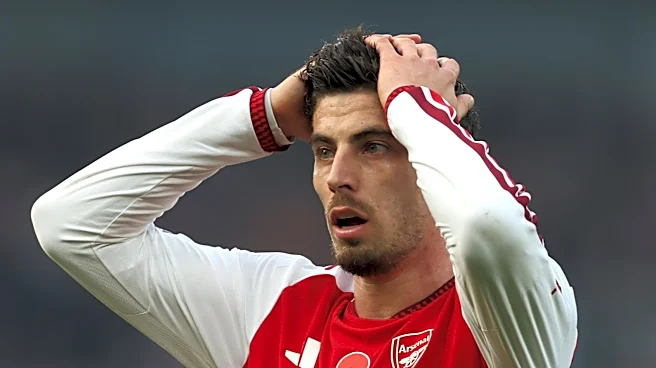






The latest Premier League Key Match Incident Panel results are in and what do you know, the referee and VAR really blew it on the Kai Havertz decision in the Hull City match. As the first half drew to a close, Hull defender Nobel Mendy grabbed Kai Havertz’s shirt from behind, taking him down, as he moved towards a loose ball served into the box several yards away from him. Replays showed that Havertz was in an offside position at the time of the foul. The referee did not award a penalty on the field,
was called to the monitor, and decided not to award a penalty because, as he explained to the crowd, Havertz was in an offside position.
This wasn’t a split-decision, it could have gone either way situation. It was flat-out wrong and the panel said as much. The five-person group (a Premier League representative, a ProRef representative, and three independents – former players and managers) unanimously decided the call on the field was incorrect and while the decision to call the referee over to the monitor was proper, the VAR intervention outcome was incorrect. You don’t see many 0-5, 0-5 rulings against the referee and VAR.
Of course, you don’t see many instances of both the referee and VAR misapplying / forgetting a Law of the Game, either. That’s what happened here. From the KMI panel outcome post on the PL website:
Why should Havertz have been awarded a penalty despite being in an offside position?
Being in an offside position, in itself, is not an offence. IFAB Law 11 says that a player in an offside position at the moment the ball is played or touched by a team-mate is only penalised on becoming involved in active play.IFAB Law 11.2 on offside
– a player in an offside position is moving towards the ball with the intention of playing the ball and is fouled before playing or attempting to play the ball, or challenging an opponent for the ball, the foul is penalised as it has occurred before the offside offence
– an offence is committed against a player in an offside position who is already playing or attempting to play the ball, or challenging an opponent for the ball, the offside offence is penalised as it has occurred before the foul challengeIf a player is fouled before becoming involved in active play, the foul is penalised as it has occurred before the offside offence. Therefore, in this instance, Arsenal should have been awarded a penalty.
I’d be interested to hear the VAR audio to better understand how the breakdown occurred. Did they forget how the Law worked? Did they incorrectly think that Kai Havertz did enough to clear the “attempting to play the ball” bar? Which person — referee or VAR — got the Law wrong initially? I’d find it informative to pinpoint the cause of the error. However you slice it, it looks as if both the referee and the VAR got a Law of the Game wrong and that’s really bad!
We’re in rare territory. According to the Premier League, there have been 223 KMIs reviewed. The referee made the correct call on the pitch 85% of the time. Following VAR intervention, they “got it right” 97% of time. This referee error falls into the 3% category that you really don’t want to be in and don’t want to see.
To drill down into that 3% world, it’s one thing for the referee and VAR to make a judgment error. That can happen. You’d rather not see it. They try to avoid it. But sometimes the two people that matter — the referee and VAR — see something differently than everybody else and their shared opinion is the wrong one. Humans make mistakes.
This isn’t that, though. There’s nothing about this decision open to interpretation, no moment you can point to, crane your neck, and see how and why someone might have seen it differently. Kai Havertz is a case-in-point example of a player moving towards the ball with the intention of playing it and not actually playing, attempting to play, or challenging an opponent for the ball. The foul should have been penalized because it occurred before the offside offense. They blew it.
Again, humans make mistakes. Getting the Law wrong is distinct from and worse than making a judgment error. You can make peace with the latter. The former is unacceptable. A referee has to know the Laws of the Game.
What happens next? Will there be consequences for the referee and VAR for making such a significant, fundamental error? Are there changes to be made to the VAR protocol to make mistakes like this less likely to happen again? Is there something to be learned from this situation about the referee-VAR relationship and interactions more generally? Were there any relationship, seniority, or power dynamics factors that affected communication and contributed to the error?
This is where it falls apart, at least for me. The increased transparency in the form of releasing some VAR audio and detailing the results of the KMI panel are a step in the right direction, but it’s not enough. Alright, you made a mistake and you admitted it. So what?
Shouldn’t there be another step? Something after admitting the error, like, you know, doing anything. Make some changes. Then, tell us what changes you’ve made! Otherwise, it’s just the “we’re sorry” bit from South Park.
Referees are sat down for matchweeks. Sometimes they’re demoted to the Championship for a couple games. But they come back and the mistakes keep happening. Surely there is another avenue ProRef and the Premier League might explore. I’m getting a bit of a “we’ve tried nothing, and we’re all out of ideas” vibe.
To be fair, as the Premier League points out, referees make the right decision on the pitch most of the time, 85% of the time, to be precise. With the help of VAR, they get the call right 97% of the time. That’s almost always! It’s a difficult job and they seem to be doing it pretty well. At least when measured by the standard they set as judged by the panel they created.
Oddly enough, Arsenal have been at the center of a number of the bigger mistakes of the season so far. Per the KMI panel, the Gunners have had 4 incorrect penalty decisions in the 10 matches they’ve played. That seems like too many penalty kick decision errors, doesn’t it?
Three decisions went against the club incorrectly (Aston Villa, Sunderland, and Hull City) and one incorrect decision favored Arsenal (Liverpool). The three that went against Arsenal did not change the outcome of the match. The one in favor of the Gunners against Liverpool may have, although it came in the first half of a match they were already leading 1-0.
Let’s hope we see fewer referee mistakes going forward on both sides of the ledger.