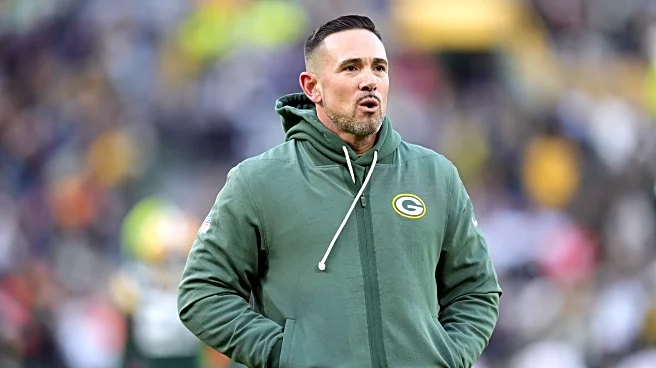




Earlier this week, ESPN’s Adam Schefter reported that the issue with the Green Bay Packers’ non-extension situation with head coach Matt LaFleur is not about their thoughts on him as a head coach; It’s about money. Schefter said at the time that he expects both LaFleur and general manager Brian Gutekunst to be back in Green Bay next year.
I have been told by sources that Gutekunst’s job was never really on the line this year (I hadn’t gotten a clear word on LaFleur’s situation), but that the lack
of an extension for Gutekunst was because of the perception of what an extension for one of the Packers’ key decision-makers meant without the other decision-maker receiving one too. ESPN’s Rob Demovsky has even reported that he believes that Green Bay’s general manager will gain even more power for the Packers next year, as he expects that the head coach will now have to report to the general manager, who would then report to new president/CEO Ed Policy, rather than the current structure where both the head coach and general manager report to the president independently.
On the money front, the Packers have generally been very, very (insert as many veries here as you want) cheap at the assistant coaching level, relying on internal development, but paying the head coach hasn’t really been an issue but one time when Mike McCarthy’s camp had it leak that he was interested in the Texas Longhorns job toward the end of the 2013 season. If you want to read some examples of the assistant pool being an issue, you can find them here. For now, we’ll keep this to LaFleur.
On Wednesday, Schefter spoke to ESPN Milwaukee about what’s going on in Green Bay right now. Schefter warned, “If they go on an extended playoff run, the price only goes up.”
When asked about whether he still believes that LaFleur will be the coach in 2026, he stated, “I think they absolutely want him back. Now the question is, how do they make that happen? It’s got to work for both sides. He wants to be back. They want him back. Can they figure it out?”
So, let’s talk about numbers. I was told by a source, an agent, that LaFleur’s first deal with the Packers was around $5 million per year, which now would be considered pretty low for just about any college program at the power four level, for what it’s worth. For example, Liberty, a program in the non-power conference Conference USA, is paying its coach that much this year and didn’t even compete in the league’s conference title game.
$5 million is a lot to me, a blogger. It’s not a lot for LaFleur, an NFL head coach.
I can’t nail down an exact number on what LaFleur is being paid now, but I’ve been told his most recent extension is probably less than double his initial salary, meaning that it’s under $10 million per year.
If it’s true that the Packers aren’t willing to go into the eight figures for a head coach that they want to keep, that’s extremely concerning. There’s no spinning that. Historically, since the revival of the team after the dark years in the 1970s and 1980s, they’ve sort of tapped into one market over and over as sort of a market inefficiency: First-time head coaches who were previously offensive coordinators.
The team has only been coached by one head coach who doesn’t fit that mold since 1992, the single year that Ray Rhodes coached Green Bay. Here’s the problem: If Green Bay really believes that they can’t go into the eight figures per year for a head coach, then that first-time head coach edge wears away, too, even if they do move on from LaFleur.
Last year, Liam Coen signed a deal worth $12 million per year to become a first-time head coach. Ben Johnson signed for $13 million per year. Las Vegas Raiders offensive coordinator Chip Kelly signed a $6 million per year contract, worth more than what LaFleur got on his first deal to be head coach. Spending in the NFL, with private equity money coming in, franchise valuations being more important than team profits (the Packers can never tap into that valuation because they can never sell) and teams learning how to manipulate the salary cap better after everyone had to do it beginning with the 2020 Covid season, has dramatically exploded the cost of both players and coaches in recent years. It’s gotten to the point where NFL commissioner Roger Goodell stated this summer that some owners are starting to question the integrity of the current salary cap.
To the Packers’ credit, their spending on players has been about league-average since 2020 (and they are sixth in the NFL in wins per player dollar), though that’s $210 million behind the number one team over that time, essentially a full year of cap dollars. Green Bay generally spends above-average on its scouting department, but isn’t by far and away number one there year after year, either. The coaching staff, particularly on the assistant level, is where the team falls behind the league average, based on conversations with agents who represent coaches. The big problem is that in a draft and develop program…the players have to develop…and the assistant coaches are the ones who have the most impact on that development.
My fear, as an unapologetic Green Bay fan, is that the cash for coaches problem is now trickling up from the assistant level to the head coach level. If that’s the case, don’t expect the team to go after John Harbaugh, who was making $17 million per year with the Baltimore Ravens (and might get a raise on the open market) if they enter the head coaching market this offseason.
When Schefter was asked if the team with a sitting head coach that reportedly reached out to Harbaugh’s agent on Tuesday was the Packers, he stated, “I’d be surprised.” He then said that LaFleur would have a similar market to Harbaugh, as the top candidate on the market, if he were to be able to get out of his contract.
As far as the market value for LaFleur goes, here’s what Schefter had to say on the topic:
“You come up with a number that makes him feel good, north of Ben [Johnson]. I think a lot of times it’s in the approach. If they come in under there, ‘Screw them,’ and then maybe eventually they get there.”
The way Schefter made an emphasis on the approach is important here. I’ve been told several times, and it’s been reported elsewhere as such, that the Packers severely low-balled special teams coordinator Darren Rizzi, now the assistant head coach and special teams coordinator of the AFC’s top-ranked Denver Broncos, when trying to build LaFleur’s first staff in Green Bay, to the point with those involved questioned why they even had Rizzi up for a visit if they were going to present a number that was so out of whack with the top-end of the market. That example is one of the most frequent things I’m pointed toward when I ask sources to explain what they mean by an underfunded coaching staff history in Green Bay.
Instead of hiring Rizzi, the Packers ended up going cheap by hiring Sean Mennenga, who hasn’t had a job since he was fired in Green Bay in 2020 and was only 50 years old at the time. He didn’t exactly retire due to old age.
Mennenga had only been a special teams coordinator for one year of his life, for a 6-7 Vanderbilt Commodores team (college football plays with vastly different special teams rules.) When Mennenga was fired, they promoted an internal Mennenga assistant, Maurice Drayton, for cheap to replace him. It wasn’t until their fourth special teams coordinator in five years that the team finally accepted that they actually had to spend at a Rizzi-level.
“You want the guy? Don’t be cute. Go get it done,” said Schefter. “If you don’t, move off him. So what the number is secondary to me to how the approach is done. It’s not hard to figure out what is a right number, but if you want to make somebody fight and grovel and bicker over it, that’s the way to lose and disinfranchise somebody.”