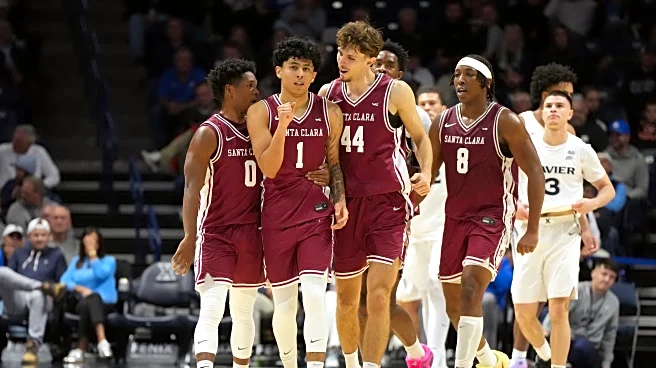




Gonzaga’s loss last season to the Santa Clara Broncos still stings. The Broncos torched the Bulldogs by hitting 18 of 38 from three and pouring in 103 points, the most ever scored by an opponent in the McCarthy Athletic Center. It was an ugly night that left no doubt that Gonzaga’s defense required immediate recalibration. Santa Clara’s Tyree Bryan went 7-for-12 on the night from deep while Gonzaga’s Khalif Battle somehow scored a grand total of 0 points on a night when 202 were scored total. Even
a 15 assist performance from Ryan Nembhard proved insufficient to stem the tide.
That night became a season inflection point for the Zags, triggering a lineup shift that elevated Emmanuel Innocent to the starting five, hardened the defense, and set off a stretch where Gonzaga held five straight opponents to under 40 percent from the field. A few weeks later, the Zags went down to California and settled the score, hammering Santa Clara by 20-plus. Still, the broader picture remains unsettled with the series split 2-2 across the last four meetings.
It doesn’t get any easier from here. This year’s Broncos arrive even sharper and more imposing than last year’s team, unbeaten in WCC play at 4-0, 13-4 overall, ranked 55th on KenPom and 62nd in the NET, fresh off dominant wins over San Diego and Pepperdine, and shaped by the same efficiency-first discipline that defines all Herb Sendek teams. The rematch tips at 8:30 p.m. PST in the Kennel, televised on ESPN2. This Santa Clara group ranks among the most formidable opponents Gonzaga will see all season.
Meet the Broncos
Folks… they’re a very good basketball team. Here’s the simplest way to understand just how good: Gonzaga nearly lost at home to San Diego Toreros last week in a game that everyone but Jalen Warley would prefer to forget. Just a few nights later that same San Diego team walked into Santa Clara and got obliterated by the Broncos 98-70, losing the rebounding battle 49-25 and shooting just 43 percent from the field against Sendek’s highly disciplined man coverage. Read straight through, the transitive math gets uncomfortable fast for Zag fans.
Santa Clara’s identity begins in the backcourt, where guard Christian Hammond functions as the offensive hub at 17 points per game on 51 percent shooting, including 41.4 percent from three, while logging nearly thirty minutes a night without any drop in efficiency. He is paired with Elijah Mahi, a physical forward who adds 15 points per game, facilitates the offense, and stretches defenses just enough to prevent clean help toward Hammond. The frontcourt supplies structure and deterrence rather than volume scoring, with freshman forward Allen Graves leading the team at 6.6 rebounds per game and sophomore Bukky Oboye standing 7’1” as a constant paint presence who may not contribute to the offense consistently, but whose size alone alters shot selection on the other end of the floor.
Depth and constant activity define the rest of the profile: nine Broncos average double-digit minutes, lineups rotate freely to absorb foul trouble, and the defense generates nearly ten steals per game by jumping passing lanes and pressuring ball handlers early. Offensively, Santa Clara leans heavily into volume from outside at roughly 30 three-point attempts per game, a style that creates wild swings and explains how this group can flatten opponents when shots fall and be exposed as a team without much of a Plan B when they don’t.
This one will come down to clean execution and perimeter pressure from the Bulldogs. They’ll need rebounding from all five spots on the floor and the kind of uptempo attack and offensive flow we finally glimpsed once again against LMU. The Broncos are no joke this season, and making sure they walk away with a W at home may prove to be the toughest challenge the Zags have yet faced this season.
How Gonzaga wins:
Rebound from the wings
Gonzaga wins this game when help on the glass comes from the wings, especially from Jalen Warley and Tyon Grant-Foster. If rebounding falls only on Graham Ike and Braeden Smith, Santa Clara stays comfortable and organized. The Broncos are built to keep their defenders glued to shooters and protect the paint just enough, which works fine until Gonzaga’s wings start crashing in from the outside.
When those wings attack the boards, Santa Clara’s guards get pulled into rebounding battles they want no part of, shooters get left alone for a split second, and defensive matchups start slipping. The advantage for Gonzaga shows up less in obvious put-backs and more in rhythm: cleaner kick-outs, tired closeouts, and a defense that slowly loses its shape. Santa Clara looks its best when everything stays orderly. Gonzaga tilts the game by making it messy.
Contain Hammond, protect the perimeter
Everything Santa Clara wants to do starts with Christian Hammond controlling tempo and forcing defensive help, because once he draws two eyes the ball starts flying to shooters without hesitation. Gonzaga’s priority sits less with shutting Hammond down completely and more with keeping him from collapsing the defense off the bounce, staying attached on kick-outs, and turning clean catch-and-shoot threes into contested, uncomfortable attempts. Santa Clara takes a high volume of threes by design, and the danger comes when Hammond’s penetration creates rhythm looks early in the clock. If Gonzaga keeps him in front, closes under control, and avoids scrambling rotations, the Broncos lose their fastest path to avalanche offense.
Reactivate Braden Huff
Getting Braden Huff back into rhythm sits near the top of Gonzaga’s checklist, especially after his only single-digit scoring night of the season came against LMU, where shots rimmed out and his timing looked a beat late getting to preferred spots. Santa Clara leans heavily on man coverage, and that structure creates openings for a versatile big once the defense gets pulled inward. When Graham Ike draws attention on the block, Huff becomes the pressure point, slipping into space around the free-throw line for short push shots, drifting to the baseline for quick turnarounds, and punishing defenders who stay glued to Ike a step too long.
This kind of big-forward versatility strains man defenses in ways ball movement alone cannot, because it forces centers and help defenders to make choices in uncomfortable areas of the floor. If Huff hits an early jumper or knocks down a three, Santa Clara’s coverage stretches upward, driving lanes widen, and the Broncos lose the ability to load up on Ike without consequence. Against disciplined man defense, a scoring big who can operate from multiple spots becomes the release valve, and Gonzaga becomes far harder to contain when Huff fills that role decisively.
Spread the floor and get downhill
Santa Clara’s defense functions best when the ball stays outside and possessions unfold on its terms, which makes Gonzaga’s ability to attack downhill from multiple spots the most direct way to break it. Braeden Smith and Mario Saint-Supery apply that pressure in different rhythms, forcing the first line of defense to collapse, while Jalen Warley and Tyon Grant-Foster extend that stress from the wings by getting to the rim early in the shot clock and turning closeouts into shots at the rim or free throws. When Gonzaga spreads the floor and commits to quick attack-and-kick reads the moment man coverage begins to bend, the Broncos’ shell loses cohesion and shooters emerge in windows that stay open just long enough to punish late recoveries. This matchup also sets up as a prime get-right opportunity for Gonzaga’s catch-and-shoot specialists Steele Venters and Adam Miller, who have combined to shoot 3-of-14 from deep over the last two games.
Final Thoughts
Gonzaga wins this game by refusing to let it remain clean, calm, or procedural. It loses only if Santa Clara gets to live inside narrow margins with extended possessions and stable spacing. That distinction—asserting pressure versus preserving comfort—defines the matchup far more clearly than any single stat line.