
Wali Jones, 83 years old but forever young, is not one of those back-in-my-day guys.
Yes, he’s justifiably proud of an 11-year pro career that saw him quarterback a Sixers championship team in 1967 and
at different times serve as sidekick on teams featuring Wilt, Moses and Kareem (no last names needed). But he’s not one to give modern-day players short shrift, not one to crow about his era overshadowing all others.
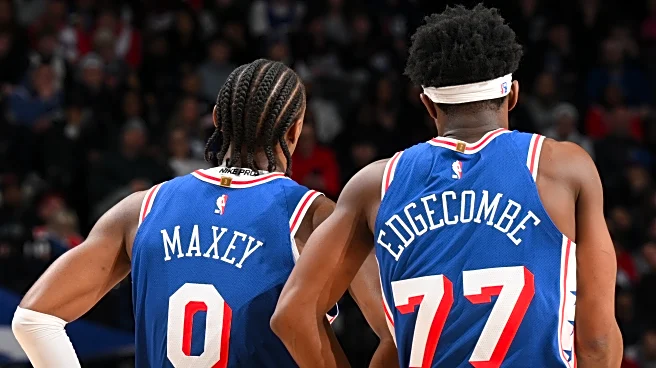
So when I asked him over the phone the other day if it’s possible that Tyrese Maxey and VJ Edgecombe could become the best backcourt in franchise history, he didn’t disagree.
“I’m enjoying watching these young players,” he said from his home in Miramar, Fla. “They can do so many things. My goodness, the athleticism of those two.”
In fact, he believes they are as fast a guard tandem “as I’ve ever seen, really.”
“These guys have the extra speed and the ability to jump that high,” Jones, a 6-foot-2 point guard in his younger years, said. “I ain’t never dunked a ball yet.”
It is early days, as Brett Brown used to say. Maxey and Edgecombe haven’t even played 40 games together yet. But Jones has seen what all of us have seen. Maxey, the dynamic sixth-year man, doing things like this, this and this. Edgecombe, the precocious rookie, doing things like this, this and this.
So yeah, it might be prudent to pump the brakes. But what fun is that? Isn’t wild speculation the way of the world? Isn’t it more interesting to contemplate having team cornerstones like these for the next decade?
Jones, for one, is taken not only by the guards’ potential, but that of the entire team.
“When I talked to (former teammate) Billy Cunningham the other day, we were saying we hope that (Paul) George can get healthy and (Joel) Embiid can get healthy,” Wali said, “because they have a chance to do something (as a group).”
Jones likes Quentin Grimes. He likes what Kelly Oubre Jr., now back from his knee injury, will bring to the table. He’s even enthused about Jared McCain, despite McCain’s second-year struggles.
“That young man can ball, too,” Jones said. “To me, when I saw him, he’s not afraid, he’s aggressive and comes into the game ready to play.”
The bottom line?
“When you talk about their backcourt, they have a good backcourt for the next 10 years if they keep those three guys,” Jones said.
That, of course, is the challenge, given health, roster churn, potential contract issues, potential off-court problems, etc. Consider that the guard tandem widely recognized as the best in franchise history – Maurice Cheeks and Andrew Toney – only enjoyed five good seasons together (one, in 1982-83, ending with a parade), before Toney’s feet betrayed him.
Allen Iverson and Eric Snow? AI was AI, and Snow was a worthy complement – good in his role, but offensively challenged.
Johnny Dawkins and Hersey Hawkins? Again, limited sample size. They were great together in 1989-90, when the Sixers won a division title. But Dawkins blew out a knee four games into the following season, and things were never the same.
This goes back to the days before the Sixers were the Sixers, but a best-ever argument could be made for the Larry Costello–Hal Greer pairing. Costello made five of his six All-Star appearances while serving as a running mate to Greer, the franchise’s all-time leading scorer with 21,586 points over 15 seasons. The first four of those came when the team was still in Syracuse, the other after it came to Philly in 1963.
Both players, now deceased, are in the Hall of Fame – Greer as a player, Costello (later a championship-winning head coach in Milwaukee) as a contributor.
Jones, a graduate of Overbrook High and Villanova, spent his rookie season (1964-65) with the old Baltimore Bullets before coming to the Sixers in a September 1965 trade for Johnny “Red” Kerr. He too speaks highly of that guard tandem, calling Greer “a consummate pro” and “an automatic 15-foot jumpshooter” and marveling not only at how Greer and Costello played both ends, but how they prepared themselves – “how they worked, what they did – steps, stretching.”
Jones was a worthy complement to that duo, and became a starter amid the ‘66-67 championship run, when Costello injured his Achilles (an injury from which he tried to return, by the way. Kayoed in January 1967, he played five games at the end of the regular season and two more in the playoffs – over a nine-day span – before shutting it down for good. Load management? Pshaw.)
Jones, who averaged 13.2 points during that regular season, was never better than in the Finals against the then-San Francisco Warriors, scoring 30 in the opener and 27 in the Game 6 clincher. He shared with me a graphic the other day showing he is one of 12 point guards in NBA history to average 20 a game in the Finals – Stephen Curry, Magic Johnson, Isiah Thomas, Oscar Robertson, Jerry West and Shai Gilgeous-Alexander are among the others – and the only one of those to score fewer than 14 a night during the regular season.
Jones spent six-plus seasons with the Sixers in all, and for his career averaged 9.8 points and 3.1 assists. Besides teaming with Wilt in Philly, he spent two seasons with Kareem in Milwaukee, and was a member of the ABA’s Utah Stars when Moses broke in, in 1973-74. With the help of AI (the technology, not the Sixers legend), I determined that no one else played with Wilt and Moses, much less all three.
Jones’ pro career ended with a 16-game Sixers swan song in 1976, but once told me he played recreationally until he was 75. One of the highlights along the way came at age 54, when he was part of a gold-medal-winning team at the 1996 Masters’ International Senior Games.
Mostly, though, he has spent his post-playing career doing good – holding clinics, emphasizing education to young people, etc. In fact he has a clinic scheduled for this Saturday at PCOM, the Sixers’ former practice facility.
It was in his guise as a clinician that Jones first came across Edgecombe, though he didn’t realize it at the time. A few years back he was one of the counselors at a camp in Edgecombe’s native Bimini – several current and former NBA players with Bahamian roots, including Mychal Thompson, Buddy Hield and Rick Fox, also took part – and it turns out Edgecombe, then 12 or 13 by Jones’ recollection, was one of the participants.
A coaching buddy has reminded Jones of that in recent years, telling him that Edgecombe was the kid with “all that potential,” as Wali put it, and offering photographic proof that the future Sixer was there.
Now we are beginning to see that potential being realized. Now we are seeing things Sixers guards have never done before, with the promise of even more down the line. Like so many of us, Wali Jones can’t help but wonder what is yet to come, and what this tandem’s ceiling might be.