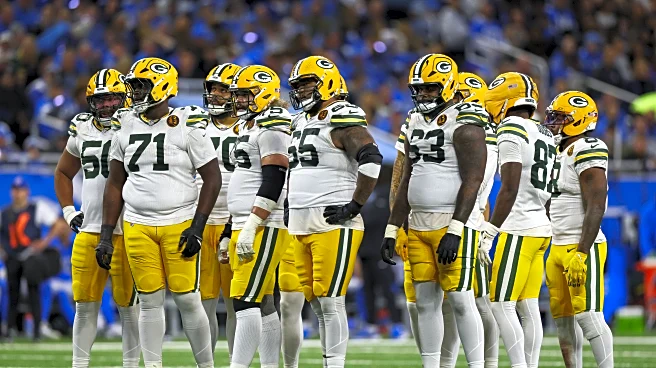

As someone who has hand-charted the Green Bay Packers’ rotations on offense and defense this year, I want to go position-by-position through the Packers’ roster, detail how the depth chart stands (at least
as of Week 18) and try to tell the story of the team that will be facing off against the Chicago Bears on Saturday night. I’m going to try to stack this depth chart as true as I can, but there are times when the true answer is that two (or more) players really share a role. We’ll get into that and all the nitty-gritty, including how injuries have impacted the depth chart, in this piece.
Quarterback
- 1: Jordan Love
- 2: Malik Willis (shoulder/hamstring)
- 3: Clayton Tune
Obviously, Jordan Love is going to be the starting quarterback when healthy. Despite going down with a concussion the last time the Packers and Bears faced off, Love passed concussion protocol last week and served as Clayton Tune’s backup in the team’s less-than-competitive game against the Minnesota Vikings.
If Malik Willis (shoulder/hamstring), who was inactive against the Vikings, is healthy, don’t be surprised if Tune is released this week to make up some room on the Packers’ roster. Remember, Green Bay ended up making 23 total roster moves last week, so there’s been a lot of change to the team recently.
On the flip side, general manager Brian Gutekunst, who typically doesn’t keep three quarterbacks on the 53-man roster (the big exception was when the team was redshirting Jordan Love and didn’t allow him even to be the team’s backup in his rookie season), has said in the past that he might keep three in the playoffs, where the league’s third-quarterback rule becomes more impactful.
On paper, teams can only go into games with 48 active players (from their 53-man roster and two possible practice squad call-ups per week). The third quarterback rule, though, states that if the team has two active quarterbacks on the 48-man gameday roster, and both of them get hurt, then a healthy-scratched third quarterback (if he’s on the 53-man roster or one of the two practice squad quarterbacks) would be eligible to enter the game, if and only if the team accepts that the previous two quarterbacks will no longer be able to return to action.
In short, the third quarterback rule is a way for teams to steal an extra gameday player in a disaster scenario.
Running Back
- 1: Josh Jacobs
- 2: Emanuel Wilson
- 3: Chris Brooks (passing lean)
Josh Jacobs has been dealing with a knee contusion ever since he had an unpleasant meeting with MetLife Stadium’s turf on November 18th. Last week, the Packers made Jacobs one of their four healthy scratches for the game in their meaningless matchup against the Vikings, when Green Bay actively tried to put the lowest players on their depth chart on the field for as many snaps as they could physically handle.
Jacobs will be the bell-cow running back for the playoffs, barring some sort of health setback. What gets really interesting is what the team does in the backup running back role.
While Emanuel Wilson has held down that role for a good chunk of the year, blocking back Chris Brooks has played as many or more snaps than Wilson in four of the Packers’ last six games. Initially, Green Bay tried to use Wilson in a route-running role (14 receptions for 95 yards on the year) and Brooks in two-back looks, with him as a run blocker, or as a lone pass-protector. That seems to have changed recently, though, as Brooks is getting on the field more on passing downs as a route-runner. Against the Vikings, despite playing fewer snaps than Wilson (which is actually a good sign for Brooks, with how reversed snap counts were for the Packers in Week 18), Brooks was the team’s leading rusher (61 yards, 4.7 yards per carry) over Wilson (44 yards, 2.4 yards per carry).
The x-factor at the position, but not in the wild card round, is whether 2024 third-round pick MarShawn Lloyd, who has dealt with a series of injuries in his short time in Green Bay, will be able to return to the field. The Packers were seemingly ready to clear the runway for a Lloyd return until he suffered another hamstring injury in December. Lloyd went back on the injured reserve and is not eligible to rejoin the 53-man roster until the divisional round of the playoffs next week.
Practice squad running back Pierre Strong Jr. has been elevated to the gameday roster three times this year (Weeks 7, 12 and 15), but only when the team was dealing with gametime injuries to either Jacobs, Wilson or Brooks, who all appear to be healthy enough to go against the Bears. Despite Strong being called up to the pool of 55 players who can make the team’s 48-man gameday roster, he was a healthy scratch three times and never got on the field for Green Bay in the regular season.
Wide Receiver
- 1/2: Christian Watson/Romeo Doubs
- 1/2: Christian Watson/Romeo Doubs
- 3/4: Matthew Golden/Dontayvion Wicks (concussion)
- 3/4: Matthew Golden/Dontayvion Wicks (concussion)
- 5: Bo Melton (knee)
- 6: Jakobie Keeney-James
The Packers’ depth chart at wide receiver is tiered. Consistently, Christian Watson and Romeo Doubs have been the team’s preferred outside receivers when healthy. If they aren’t healthy, the team leans on a combination of Matthew Golden and Dontayvion Wicks, who generally are rotational guys for the Packers. Behind Golden and Wicks is usually Bo Melton.
Both Wicks (concussion, missed Week 18) and Melton (knee, left action in Week 18) are currently dealing with injuries. On top of that, Savion Williams, the team’s third-round rookie who has been just behind Melton in the pecking order in the second half of the season, went on the injured reserve last week with a lingering foot issue that has been bothering him all regular season.
Jakobie Keeney-James was called up from the practice squad last week to the 53-man roster, which was a bit of a surprise to me. Previously, the team had only made Will Sheppard a gameday elevation from the practice squad at the receiver position. Sheppard, while active in Green Bay’s Thanksgiving matchup against the Detroit Lions, didn’t play a snap for the Packers in the regular season. Keeney-James handled both punt and kick returns for Green Bay against the Vikings, for what it’s worth.
Slot Receiver
- 1: Jayden Reed
- 2/3: Matthew Golden/Dontayvion Wicks (concussion)
- 2/3: Matthew Golden/Dontayvion Wicks (concussion)
- 4: Bo Melton (knee)
Jayden Reed! No, we didn’t forget about him. Reed is the Packers’ primary slot receiver, a role he has almost exclusively played in his three years with the team. Reed is smaller than the typical Matt LaFleur-era receiver, and it seems pretty clear at this point that LaFleur likes him in the slot and only in the slot.
Typically, the next man up when Reed isn’t in the mix, like when he had his stint on the injured reserve earlier in the year, is one of Matthew Golden or Dontayvion Wicks. Bo Melton falls in line behind that (and so did Savion Williams). Christian Watson gets more snaps in the slot than Romeo Doubs, but they both usually only get those looks when the team is throwing out funky formations, like with tight ends or running backs split out wide.
Tight End
- 1: Luke Musgrave
- 2: Josh Whyle (passing lean)
- 3: Darian Kinnard
You can’t really talk about the tight end position in Green Bay this year without bringing up injuries. Tucker Kraft, who still ranks eighth in the NFL at his position in yards after the catch despite just playing eight games in 2025, was the team’s starter until he was lost for the year with an ACL tear. In incredibly poor timing, the Packers also waived Ben Sims, at the time the team’s fourth tight end, just before the Kraft injury, while trying to open up a spot on the 53-man roster and attempting to land Sims back on Green Bay’s practice squad. Instead, the Minnesota Vikings claimed Sims, which was the end of Sims’ run with the Packers this year.
A couple of weeks ago, blocking tight end John FitzPatrick tore his Achilles tendon. That’s how the Packers lost three of their top four tight ends in 2025. Last week, practice squad tight end McCallan Castles was also added to the practice squad’s injury list, essentially the injured reserve for practice players. To say the least, it’s been a bloodbath at the position this year for Green Bay.
In response to all of these injuries, the Packers brought up Josh Whyle, a former fifth-round pick that Gutekunst was able to secure at the cutdown deadline, from the practice squad to the active roster. Whyle was a pre-draft visitor to Green Bay in 2023, so the team has clearly had its eyes on him for a while. The team has also used swing tackle Darian Kinnard as a tight end in various looks since Kraft’s injury.
Over the last two weeks, the Packers called up Drake Dabney from the practice squad to the gameday roster. Dabney played most of Week 18 (44 of 50 snaps), but he remains a practice squad player and not on the 53-man roster. Short on players at the position, though, don’t be shocked if Dabney either gets called up to the gameday roster again this postseason or even makes the 53-man roster outright.
In Week 17, the Packers’ last “competitive” game, Whyle played 28 snaps to Musgrave’s 18 in a pass-heavy script. Funny enough, considering the receiving game was supposed to be the big calling card on Musgrave’s scouting report coming out of college, Green Bay has leaned on Whyle more than Musgrave in recent weeks when they actually need to throw the ball.
With that being said, the Packers basically put Musgrave in bubble wrap, playing him just two snaps against the Vikings, while Whyle took on 36 offensive snaps and also played 13 more on special teams. Truthfully, I think that Green Bay views Musgrave as their current starting tight end, but if the Packers start to chase points, then assume that Whyle’s snaps will shoot up like a rocket, as they did against the Baltimore Ravens two weeks ago.
Offensive Line
- LT: Rasheed Walker
- LG: Aaron Banks
- C: Sean Rhyan
- RG: Anthony Belton
- RT: Zach Tom (knee/back)
- 6: Jordan Morgan (T/G)
- 7: Darian Kinnard (T/G)
- 8: Jacob Monk (C/G)
- 9: Lecitus Smith (C/G)
The starter missing in this group is center Elgton Jenkins, who was lost against the Philadelphia Eagles on November 10th, but the team also has Travis Glover and Donovan Jennings on injured reserve, who were supposed to be depth pieces this year. In fact, Glover’s season-ending lat injury in the summer is probably why the Packers were proactive and traded for former Eagle Darian Kinnard at the cutdown deadline. Jennings had only played six offensive snaps and seven special teams snaps in 2025 before he suffered a throat injury last week in practice and was shut down until at least Super Bowl week.
After Jenkins’ injury, Sean Rhyan, who previously split time at right guard with Jordan Morgan, moved to center. When Morgan, who has played much better at tackle in recent weeks, couldn’t hack it as an every-down guard, Anthony Belton, a rookie second-round pick, took over at the position.
As it stands right now, the Packers’ preferred offensive line (with Jenkins out) is Rasheed Walker, Aaron Banks, Rhyan, Belton and Zach Tom (left to right). Morgan has been receiving playing time recently as Tom’s injury replacement, as Tom has been dealing with both a knee injury and a lingering back issue. Generally, I would say that Morgan is the “next man up” at every position other than center, as the Packers have been trying to keep Kinnard free to play some tight end looks.
The other backup linemen on the team are Jacob Monk, who is probably the next man up at center, and Lecitus Smith, who was signed from the practice squad last week after Jennings’ injury.
Two other players might make a gameday appearance (likely on the field goal protection unit) this postseason: John Williams and Brant Banks. Williams has been on the physically unable to perform list all season after suffering a back injury before training camp. He has been practicing with the team and is designated to return, though. Don’t be shocked if he displaces Smith.
Banks was also available on gameday for the Packers in Weeks 2 and 4. In Week 4, Banks was responsible for the blown assignment on field goal protection that led to the Dallas Cowboys blocking a kick and ultimately forcing a tie. He was waived the next week (likely due to the roster situation more than his performance) and was claimed by the Tennessee Titans, where he spent all of one week before reverting to Green Bay’s practice squad. What a journey for the undrafted rookie.
Defensive End
- 1: Rashan Gary
- 2/3: Lukas Van Ness/Kingsley Enagbare
- 2/3: Lukas Van Ness/Kingsley Enagbare
- 4: Brenton Cox Jr.
- 5: Barryn Sorrell
- 6: Collin Oliver
- 7: Arron Mosby
Hey, you’ve made it over 2,000 words at this point. This is the part where we finally mention how bad it sucks that Micah Parsons tore his ACL. Aside from Myles Garrett, no pass-rusher in the NFL was more impactful this year than Parsons. Then he was just gone.
The hope was that Parsons and Rashan Gary (along with some help from Lukas Van Ness) would be the best pass-rushing duo in the league this season. Now, Parsons is out of the picture (for the 2025 season), and Gary has been one of the most disappointing players league-wide this year.
Van Ness had arguably the best game of his career against the Ravens two weeks ago (he and Gary didn’t play a snap against the Vikings), after dealing with a foot injury from October 12th on, which included him missing action for two full months. Hopefully, Van Ness can turn it back for the playoffs.
The Packers got back Brenton Cox Jr. and Collin Oliver from their injury lists recently, which has really clogged the whole depth chart at the position. Two weeks ago, both Barryn Sorrell and Oliver, the team’s rookie fourth- and fifth-round picks, were healthy scratches against Baltimore. In Week 18, though, Sorrell had a bit of a breakout game, which might make the team rethink keeping him as a healthy scratch against the Bears.
To make Sorrell active, though, Green Bay will probably have to healthy scratch Brenton Cox Jr., as Aaron Mosby is one of the team’s true special teams contributors.
[The real special teams aces (non-returners or specialists) on the 2025 team are Mosby, linebacker Nick Neimann (currently on the injured reserve), cornerback/receiver Bo Melton and safety Zayne Anderson (currently on the injured reserve). The other non-starters, for the most part, are just playing special teams because someone has to in the Packers’ always young draft and develop program.]
Nose Tackle
- 1: Colby Wooden
- 2: Warren Brinson
- 3/4: Nazir Stackhouse/Jonathan Ford
- 3/4: Nazir Stackhouse/Jonathan Ford
The Packers planned for Kenny Clark to be their starting nose tackle in 2025, but then the Dallas Cowboys made the demand that he be part of the Micah Parsons trade. I don’t blame Colby Wooden here because at the combine in 2023, he was just 274 pounds (he’s clearly heavier now), but he’s not an NFL-caliber starter at the position. It had to take a Parsons-level trade to put Green Bay in a spot this poor at nose tackle this year, sort of a perfect storm.
As we wrote about this offseason, the free agent market at nose tackle was bare. In the draft, nose tackles went much higher than they were projected to, as a response to the weak free agent market. There weren’t big names made available for the Packers in-season, as every team held onto their big-body defensive tackles tightly.
That’s how you get Wooden, officially still listed at 274 pounds on Green Bay’s roster, playing 55 percent of the team’s total defensive snaps at nose tackle in 2025.
Behind Wooden, things haven’t been much better, either. Initially, the plan seemed to be that Nazir Stackhouse was going to be the backup at the position, with Wooden subbing out for the Packers’ three-defensive-end “Cheetah” looks. Basically, Green Bay’s three-technique tackle (usually Karl Brooks) would be the lone defensive tackle on the field while an extra defensive end kicked into the interior line (usually Micah Parsons or Lukas Van Ness) in obvious passing situations.
The problem is that obvious passing situations eventually were hard for the Packers to come by, leading to long double-digit-play drives in the second halves of games, which you could visibly see gassing Green Bay’s defensive tackles.
In response to that trend, the Packers began to start looking for new nose tackles, as the shelf life of Stackhouse’s contributions usually hovered around 10 to 15 effective snaps a game (which isn’t terrible for an undrafted rookie!) When rookie sixth-round pick Warren Brinson had to play more three-technique following Devonte Wyatt’s injury (more on that later), Green Bay picked up Jordon Riley from the New York Giants’ practice squad and claimed Quinton Bohanna from waivers.
Riley was put on injured reserve last week, while Bohanna was waived by the team to make room for the new addition of Jonathan Ford, a former Packers draft pick who has spent the last year or so with the Chicago Bears. Ford made his regular-season debut with Green Bay last week against the Vikings, the same week he rejoined the Packers.
This is probably the Packers’ weakest pre-injury position in 2025, and it will probably be the position that the team wants to address the most in the 2026 draft. (I apologize to those of you clamoring for cornerbacks.)
Three-Technique
- 1: Karl Brooks
- 2: Warren Brinson
- 3: Lukas Van Ness (Cheetah)
- 4/5: Barryn Sorrell/Kingsley Enagbare (Cheetah)
- 4/5: Barryn Sorrell/Kingsley Enagbare (Cheetah)
Initially, the plan was for Karl Brooks to be the team’s rotational three-technique behind starter Devonte Wyatt, eat some special teams snaps and play “Cheetah” snaps in 2025. With Wyatt going down with a fractured ankle on Thanksgiving against the Lions, though, Brooks has been pushed up to a true starting role at the three-technique position.
To backfill for Brooks, sixth-round rookie Warren Brinson is now the next man up. That’s sort of all the team has at the position, as Colby Wooden, Nazir Stackhouse and Jonathan Ford have been used as true nose tackles this year (Brinson is really the only hybrid tackle in the entire room.)
In passing situations, though, don’t be surprised to see defensive ends Lukas Van Ness, Barryn Sorrell or Kingsley Enagbare to kick inside on “Cheetah” snaps. They’ve all done that at different points this year.
Linebacker
- Mike: Quay Walker
- Will: Edgerrin Cooper
- Sam: Isaiah McDuffie
- 4: Ty’Ron Hopper
This position is very simple, because all four of the Packers’ contributors this year are healthy. Quay Walker is the team’s middle linebacker, with Edgerrin Cooper being the other linebacker in nickel looks. In 4-3 looks, Isaiah McDuffie comes off the bench as the team’s extra linebacker.
Whenever Walker or Cooper has been hurt, McDuffie takes over their role, and then 2024 third-round pick Ty’Ron Hopper backfills as the team’s third linebacker for McDuffie.
Both Nick Niemann and Kristian Welch have previously been on the 53-man roster, but they are more special teams contributors than true defenders. Both are on the injured reserve, though Niemann is designated to return and has been practicing with the team. When the Packers are in a pinch, they have called up practice squad linebacker Jamon Johnson, an undrafted rookie, to the gameday roster. Last week, he got his first defensive snaps of the regular season, as he had spent most of his time this year on special teams.
Outside Cornerback
- Left: Keisean Nixon
- Right: Carrington Valentine (pass lean)
- 3: Trevon Diggs
- 4/5/6: Shemar Bartholomew/Jaylin Simpson/Bo Melton (knee)
- 4/5/6: Shemar Bartholomew/Jaylin Simpson/Bo Melton (knee)
- 4/5/6: Shemar Bartholomew/Jaylin Simpson/Bo Melton (knee)
Alrighty, if saying that nose tackle is a bigger need than outside cornerback for next year’s Packers didn’t make Green Bay fans mad enough at me, here’s another shot: I think Trevon Diggs is going to back up Keisean Nixon and Carrington Valentine in the playoffs.
While LaFleur gave some lip service to the idea of Diggs starting in the postseason, it had a lot more of “we’re not ruling anything out for anyone” vibes than a true commitment to Diggs. I’ve seen fans post the question of “Why did we waiver claim Diggs if we weren’t going to start him?” The answer is simple: The Packers’ depth at the position got nuked in Week 17.
Against the Ravens, Nate Hobbs and Kamal Hadden, the team’s third and fourth outside cornerbacks, were both injured and later placed on the injured reserve. In Week 18, had the Packers not claimed Diggs (and his half-million-ish remaining cap hit in 2025), the team would have been one injury away from having to play two practice-squad call-ups (Shemar Bartholomew and Jaylin Simpson) or Bo Melton (who at this point might be a cornerback in name only) in the postseason.
Green Bay went out of its way to protect Carrington Valentine (who didn’t play a snap of defense) and Keisean Nixon (who played just five) in Week 18 against the Vikings. I don’t doubt that there might be certain situations (like we saw in the Ravens game) where the team will want to try to get Valentine off the field in obvious run situations (it’s not the strength of his game). In those looks, I can see Diggs coming in and playing in place of Valentine, as the Packers tried to do it against Baltimore with both Hobbs and Hadden before their injuries.
Still, though, I expect Nixon and Valentine to out-snap Diggs in the postseason. I hope that Diggs intercepts every pass that an opposing quarterback throws, returns them all for touchdowns and the Packers win the Super Bowl, but until I see him actually displace a starter, I won’t believe it’s happening this year.
Good luck making sense of the cornerbacks behind the top three on the depth chart, by the way. Bartholomew and Simpson didn’t play a snap for the Packers’ defense this year until the JV game versus Minnesota. Melton hasn’t played a single snap of defense all year, despite contributing on offense while he’s been listed as a cornerback on the official roster.
Slot Defender
- 1: Javon Bullard (knee)
- 2: Kitan Oladapo
With Trevon Diggs backfilling at outside cornerback, the position where the Nate Hobbs injury really hurts the Packers is in the slot. Before Hobbs’ injury, he and safety Javon Bullard sort of split time in the nickel position throughout 2025, with Hobbs playing more obvious passing situations (and doing it pretty well).
Bullard was injured against the Vikings, but both he and LaFleur claim that he’s going to be okay. The only other player who has lined up in the nickel spot this year has been safety Kitan Oladapo, who played limited snaps at the position before Week 18 (we’re talking like less than ten) in prevent situations at the end of halves.
If Bullard can’t go on Saturday, Oladapo will be the next man up. After that, it would be anyone’s guess.
Safety
- 1: Xavier McKinney
- 2: Evan Williams
- 3: Javon Bullard (knee, run lean)
- 4: Kitan Oladapo
- 5: Johnathan Baldwin
Xavier McKinney has been the team’s starter all year, and, for the most part, so has Evan Williams. There are certain situations where Javon Bullard comes in and plays safety in 4-3 looks against run-heavy situations (like recently against the Ravens), but Bullard is situational while Williams is the starter.
Usually, the player next up behind that trio is Zayne Anderson (who is a true defender, too, not just a special teams player), who is now on the injured reserve. Kitan Oladapo, the 2024 fifth-round pick, has looked solid in limited playing time over the last two years and will have to backfill for Anderson if there’s another injury at the position (remember, Bullard also starts in the slot).
The Packers signed Johnathan Baldwin to the 53-man roster from the practice squad last week. Before Week 18, Baldwin hadn’t been active on gameday for Green Bay this year. Baldwin was a nickelback at the college level with UNLV and moved to safety this offseason. The undrafted rookie was one of the Packers’ biggest financial commitments in the post-draft free agent class, along with nose tackle Nazir Stackhouse and linebacker Jamon Johnson.
Jaylin Simpson is officially listed by the team as a safety, but all indications are that he’s a cornerback for Green Bay. In Week 18, all his snaps were at cornerback. Previously, Simpson has spent time with NFL teams at both positions.
–
I’ll update this post throughout the week if there are any changes to the 53-man roster. Until then, feel free to yell at me about what you think I got wrong in the comment section.