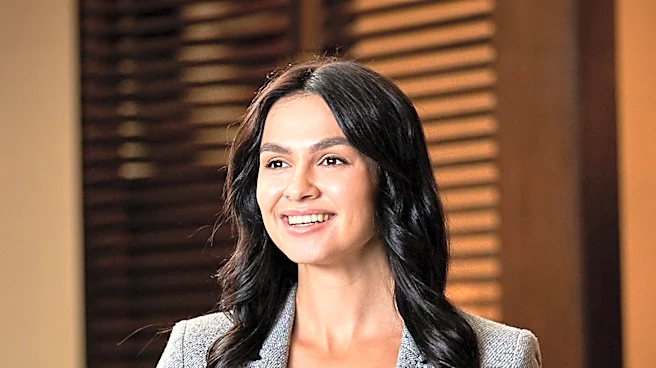


The University of Michigan has (finally) found its next permanent president, as the university announced on Tuesday that is has hired Vanderbilt Provost and Vice Chancellor for Academic Affairs, Dr. C. Cybele Raver, as its next president.
The Board
of Regents will hold a special meeting on Tuesday, Sept. 1 at 11 a.m. to have a formal vote. Once she is officially approved, Raver will officially take over for interim president Domenico Grasso on Tuesday, Dec. 1.
“Dr. Raver has a proven record of building strong teams, expanding research excellence, and strengthening every institution she has served,” said Michael Behm, chair of the U-M Board of Regents, in a press release. “She understands what it takes to lead a complex, world-class university — and she shares our unwavering belief that Michigan has been, is now, and must remain the best university in the country. We are confident she is the right leader for this moment and we look forward to the board’s formal vote.”
“It is an extraordinary honor to be considered as the University of Michigan’s 17th president at this pivotal moment in higher education,” Raver said in the same press release. “Michigan’s scale and impact across research, education, economic growth, and public service are unmatched and I’m eager to build on its remarkable legacy. I look forward to working alongside faculty, staff, students and alumni to lead Michigan forward with clarity and confidence.”
Raver, a nationally recognized leader in higher education and university strategy, will replace interim president Domenico Grasso, who has been overseeing the university during one of the more turbulent stretches in recent Michigan history.
Raver has served in her role at Vanderbilt since 2021, where she has overseen a series of transformational initiatives across the university’s academic enterprise. Under her leadership, Vanderbilt launched the College of Connected Computing, recruited five new deans, strengthened the university’s research infrastructure and spearheaded Discovery Vanderbilt, an initiative designed to catalyze innovation across the institution.
Additionally, the university surpassed $1 billion in annual research expenditures under her leadership, a significant milestone that speaks to Raver’s ability to grow and manage a major research university at the highest level.
Vanderbilt expanded its academic footprint to New York City and West Palm Beach during Raver’s time there, and the university approved a new interdisciplinary science building. To me, that all signals someone who thinks ambitiously about institutional growth and academic reach.
Beyond her administrative accomplishments, Raver is a distinguished scholar in her own right. She was the Cornelius Vanderbilt Professor of Psychology and Human Development at Peabody College and a fellow of the American Association for the Advancement of Science. Her research focuses on children’s development, education policy and poverty; her work has garnered more than $24 million in funding.
Prior to her time at Vanderbilt, Raver served as deputy provost at NYU and held faculty roles at the University of Chicago and Cornell University. She earned her PhD in developmental psychology from Yale.
Michigan is hiring Raver at one of the most consequential moments in the university’s recent history. The athletic department is in the midst of implementing sweeping reforms recommended by the Jenner & Block investigation into the culture and conduct of the athletics department. The university is also in the process of searching for a new athletic director following Warde Manuel’s pending departure at the end of the calendar year, and both of its flagship athletic programs — football and men’s basketball — are going through coaching transitions under Kyle Whittingham and Mike Boynton Jr., respectively.
Against that backdrop, the Board of Regents needed to find a president who could provide stability, institutional credibility and a clear vision for where Michigan goes from here. Raver’s track record at Vanderbilt of building research infrastructure, expanding academic reach and driving institutional growth suggests she is a leader who is comfortable managing complex, multi-faceted organizations.
Furthermore, Raver’s background — research, data and evidence-based decision making — brings a perspective to the role that is different from what Michigan has had in recent years. For a university that has spent the better part of the past year dealing with the consequences of accountability failures and cultural breakdowns inside its athletic department, a president with that kind of background could be exactly what the institution needs.
[ADD TRANSITION TIMELINE — when does Raver officially take over, what is Grasso’s role going forward, any transition details available]
For Michigan athletics, Raver’s arrival will be closely watched. She will inherit the ongoing implementation of the Jenner & Block reforms, as well as the search for the new athletic director. She will also be tasked with rebuilding the university’s institutional reputation after a difficult several years; how quickly and effectively she engages with those challenges will tell us a great deal about the kind of president she intends to be.
One thing is clear, though: Michigan needed a fresh start at the top. Thankfully, Raver appears to be exactly that.