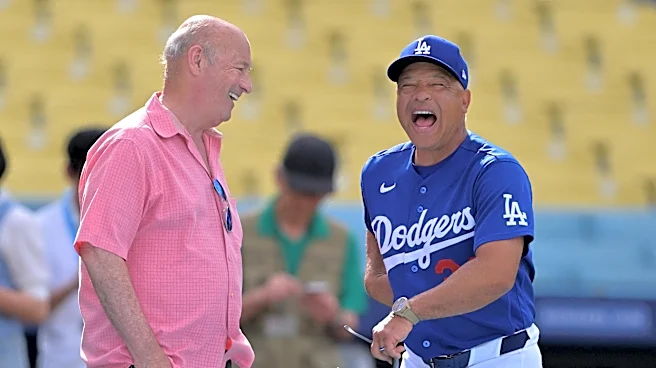


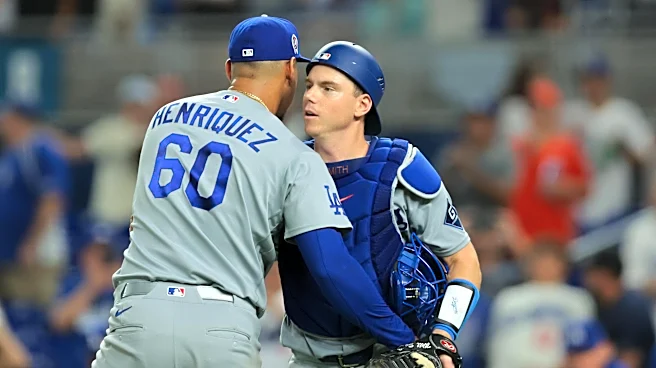


The Dodgers with their win over the Cincinnati Reds on Monday night at Great American Ball Park are back in the postseason, just as they have every year dating back to 2013. They tied a major league record by making 14 postseasons in a row.
That’s every full season of Guggenheim Baseball Management owning the team. The president and CEO, Stan Kasten, was president of the Atlanta Braves for all but two of their 14 postseasons in a row from 1991-2005. Atlanta’s postseason run was interrupted only by
the 1994 strike, during which the postseason and World Series were canceled. When the 1994 season ended on August 12, the Braves had the second-best record in the National League at 68-46, but trailed the best-in-baseball Montreal Expos at 74-40 in the National League East.
Last week I asked Kasten to compare his pair of 14-postseason franchises in Atlanta and Los Angeles.
“The eras were different. Our game was really different. Our managers were different guys, they have very different styles. What’s interesting to me that I think is far is that team won in different ways over different years” Kasten said. “One year they had great pitching, another year they had great hitting, another year they had great defense. This team is the same. It changes its formula to win.
“We had an aggressive use of all forms of acquiring talent. That is to say we drafted, we traded, and we signed free agents. We did all that, we utilize the same tools here. We started out with a very low payroll, but by the time it was over we had a very high one because the guys got good and we kept them all together.”
When the Braves started their postseason run in 1991, they had young pitchers Tom Glavine and John Smoltz atop the rotation, and were joined by free agent signing Greg Maddux two years later. Those pitchers combined to win six Cy Young Awards for Atlanta and are all in the Hall of Fame. They started 32, 27, and 27 postseason games, respectively, for the Braves.
The Dodgers’ lone rotation constant was Clayton Kershaw, with his three Cy Young Awards, an MVP, and 30 postseason starts since this current postseason streak started in 2013. But Kershaw didn’t make a start in either of the last two postseasons, injured in 2024 and used sparingly in relief in 2025. During the Dodgers’ first 13 straight postseason runs, Walker Buehler (18 starts) and Rich Hill (11) are the only other pitchers to make at least 10 postseason starts, though Yoshinobu Yamamoto will join them with his first start this October.
“The game was just different. Best example is starting pitching. We had three guys [in Atlanta] who didn’t miss a start in 10 years, virtually, and here we can’t go two weeks without someone going on the injured list,” Kasten said. “It’s because of a difference in medical procedures and evaluations, and it’s also a difference in style. We had different bullpens in that you didn’t need any kind of depth in the bullpen. Also, we had deeper benches offensively.
“It’s a 30-year difference, but I think the 30 years that has really made a difference in how the game has changed.”
The Dodgers have adapted based on the available arms at the time in recent postseasons. After winning a championship in 2020, they ran out of healthy starting pitchers in 2021, 2022, and 2023. In 2024 they basically had two and a half starting pitchers in Yamamoto, Jack Flaherty, and a shaky Buehler coming off his second Tommy John surgery. They rode a dominant bullpen (and a resurgent Buehler) that October to a title.
In 2025 the Dodgers bullpen was much shakier, but they had an incredibly stable rotation with Yamamoto, Blake Snell, Tyler Glasnow, and Shohei Ohtani. That quartet made every start last postseason and combined for a 2.55 ERA and 28.8-percent strikeout rate over 113 innings in 17 games, accounting for 68.5 percent of the team’s innings. That group was the closest the Dodgers had to a rotation like those old Braves teams.
“Those pitchers dominated the whole decade of the 1990s, right? We don’t have the same kind of style dominating this, so I don’t know how to compare them,” Kasten said. “I just think both teams had a fierce dedication to maximizing all the tools available at the time.”
Kasten in July was in Cooperstown for the induction of longtime Braves center fielder Andruw Jones into the Hall of Fame. Jones is the eighth member of those Braves teams from 1991-2005 in the Hall of Fame, along with Greg Maddux, Tom Glavine, John Smoltz, Chipper Jones, Fred McGriff, manager Bobby Cox, and general manager John Schuerholz.
“One interesting thing is we had a GM and a manager [in Atlanta] that both went to the Hall of Fame,” Kasten said. “I think we have that here [in Los Angeles], too.”
The Braves won the division — first in the NL West, then the NL East after realignment — for all 14 of their postseason appearances. The Dodgers won the division in 12 of the last 13 years, and won 106 games in the year they didn’t win it. This year, the Dodgers are up 9 1/2 games on the Padres in the NL West and a magic number of three to claim yet another division title.
In the first three division titles for the Braves (1991-93) there was no Division Series, which meant winning the division meant straight into the NLCS. The current Dodgers era has included the wild card game plus the wild card series in addition to the Division Series. Atlanta from 1991-2005 played 125 games in their 14 postseasons, with nine trips to the NLCS and five pennants. The Dodgers in their first 13 postseasons of this run have played in 136 games, with eight NLCS trips and five pennants.
The Braves won one championship during their dominant stretch, and were eventually overshadowed by the New York Yankees, who won four titles during that same period. The Dodgers were in the same boat of “only one” championship just two years ago, before becoming the first MLB team to win back-to-back titles in a quarter century and shedding that proverbial weight.
Championships are the ultimate goal, but sustained excellence isn’t easy, and should be appreciated. For instance, from 1991-2005 while the Braves made the postseason 14 times in 14 tries, the Yankees with 11 playoff trips were the only other team to make the postseason more than six times.
In the current Dodgers stretch of 14 playoff years in a row, the closest teams to them are the Yankees, Braves, and Houston Astros, who if they each make it this year will have 10, 10, and nine postseason berths in the last 14 years.
In other words, even in their worst seasons during these stretches, the Braves and Dodgers always made the playoffs, while every other team had several seasons watching the postseason from home. Baseball is a daily grind for eight or nine months every year, from the start of spring training through the postseason. Consistent excellence should be rewarded.
“We did go to the World Series five times in one decade. That’s extraordinary, and I was unbelievably proud of that,” Kasten said of his time with the Braves. “Im unbelievably proud of the five times we’ve gone here. The 162 is just so much more difficult than people appreciate, and it remains a truism in baseball that our postseason in baseball is a crapshoot. I’m sorry if you don’t like it, that’s the truth.
“That I think it’s a good thing for all of us in baseball because whenever you say — like last year, I had to discuss this a lot when people said we were ruining baseball, what I’d point out was our system. We have the firewall, which is our postseason. No matter what you do, you still have to contend with short series, and short-term injuries. Anything can happen.”
How the Dodgers perform in October will determine their fate this postseason, just like every year. But the fact is, they already did much of the heavy lifting, earning yet another ticket to the dance, however it ends.
“You don’t appreciate the winning without a certain amount of losing. It’s the adrenaline you get from both extremes. It’s what makes our game special,” Kasten said. “There’s no question that there’s nothing like winning it all.