

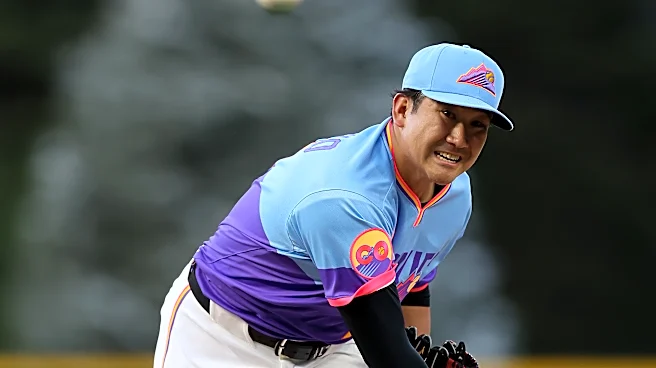
For most folks, the start of their career means the end of school. It doesn’t matter if you work in finance, healthcare, the arts or athletics. However, that is not the case for all athletes. The Colorado Rockies provide continuing player education, helping their Latino players learn English language and get acquainted with US culture.
It’s an essential part of player development for future Rockies who are not from the United States. After all, learning a new language and becoming comfortable with
a new culture provide off-the-field challenges, and all of this happens while players are continuing to develop their baseball skills.
In this multi-part series, I will be taking you behind the scenes of the Rockies Cultural Education & Development Program.
First up, how it came about.
A brief history of the program
The Rockies Cultural Education & Development Program was first established in 2012 by Josh Rosenthal – brother of former Rockies assistant general manager, Zack Rosenthal. Josh was a former Peace Corps volunteer and felt the need for the players to do more than be able to speak English. He pitched the program to Vice President of International Operations Rolando Fernández, and the rest is history.
Within the year, they hired Angel Amparo – a former systems and structural engineer – as the Cultural Education & Development Coordinator.
“We pretty much started from scratch with this,” Amparo said. “We were like, ‘What do you want this to look like?’ So we decided on a curriculum in terms of what we needed and a syllabus that we thought was beneficial for our players. This was with a lot of feedback from the coaches, the player development staff and the front office. So we wrote this – I don’t think we knew what we were doing for the first couple of years. They were pretty touch and go, learning and trial by error. But as the years went by and we got more into it… I was focused primarily on just the kids in the Dominican Republic, and Josh could focus on the kids in the States.”
After eight years, Rosenthal left the Rockies organization, and Amparo and a team of four teachers have continued to administer the program from the Dominican Summer League all the way through Double-A:
- Julio Medina – Lead Teacher (Dominican Summer League)
- Steven Baumann – English Teacher (Arizona Complex League)
- Dr. Yulonn Harris – English Teacher (Fresno & Hartford)
- Paul Worley – English Teacher (Spokane)
The Rockies originally had a formal program for players in Triple-A and the major leagues, but found it to be challenging due to the constant roster turnover.
“I still communicate with them and we still do a lot of virtual teaching,” Amparo said. “We still offer them any type of English language learning programs that we use and they have access to it. But since they’re at that level and they’re older and more mature – not that we’re babysitting them – we give them the option. We want to tailor to what [they] need.
“So what I do with the Triple-A and major league kids is ask ‘What do you want? What would help you this season?’ And based on what they tell me in their feedback, I design something specific for them that can help them.”
Teacher hiring process
The interview process for teachers is extensive.
“I look for someone who has some experience with either inquiry-based learning, project-based learning or Socratic teaching,” Amparo said. “Knowledge of baseball isn’t a game changer. It’s nice if they have it, but Yulonn (Harris) didn’t know anything about baseball when she was first hired, but she was so qualified and she’s learned so much over the years about the team. I look for unorthodox-type teachers, very outside-the-box teachers.
“I have them create a lesson plan for me, and then I have them do a mock class with their affiliate,” Amparo continued. “I’ll be there and I want to observe. And based on that, I make my decisions. But I’m picky. When I hired Steven (Baumann), we interviewed 74 candidates. And I ask the players who they like afterwards because obviously they work together for the whole season, or multiple seasons, so I want to make sure they have a good connection with this person.”
Term structure
Classes are provided to all signed Latin players, approximately 120-140 players per season. Classes are offered in a hybrid format with both in-person and virtual components for the duration of the season, starting in April and running until September. In the DSL, players take classes every day from 4-7 pm after their morning games. Once players get stateside, the teachers are given more flexibility based on game schedules, but they are still required to meet at least three times per week with two days of asynchronous content. Additionally, the DSL teachers hold office hours for 30 minutes every Monday, Wednesday and Friday.
In addition to their own internal team, the Rockies also collaborate with other teams across Major League Baseball.
“We have monthly meetings with MLB and all of the other education coordinators,” Amparo said. “We have Zoom meetings, and we always get together at the Winter Meetings as well. I have my little clique with the Twins, the Phillies, the Guardians, the Marlins and the Orioles, so we always get together monthly and we meet at one of our academies. We just brainstorm some ideas because the whole purpose of this is to build better men.”
The main focus of the department is its structured curriculum and syllabus for English-language acquisition through intentional, progressive lessons that are tailored to the realities of a career in professional baseball. There is a standard curriculum, but the teachers are given autonomy to change things as long as it’s beneficial to the players.
“We collaborate on it,” Amparo said. “We have our Rockies Evaluation Matrix with these ‘can do’ statements for different levels. It goes from white, which is rookie, to purple, which is more advanced. So even though we have this as a guideline, I give them the autonomy on lesson plans and projects. One thing that I encourage for the affiliates is to do more interactions with the media and talking with more native speakers. In Arizona, we’ve done presentations to local high schools there. We meet monthly and [the teachers] always come to me with a project or idea that they want to do and as long as it aligns with our matrix of what we’re trying to do, I give them autonomy to do it.”
Other lessons the Rockies have implemented include a spelling bee competition, an egg drop competition, play-by-play commentary, mock commercials, and chess tournaments. Additionally, the players take workshops on financial literacy, contract negotiations and general communications. They also learn vocational skills such as graphic design and PC repair.
Closing thoughts
The Rockies were ahead of the game when it came to helping their Latino players acclimate to working, living, and playing baseball in the United States.
Next week, I’ll discuss the intricacies of the curriculum itself.
On the farm
Triple-A: Albuquerque Isotopes 17, Oklahoma City Comets 4
Just like the big league club, the Triple-A Rockies beat the Triple-A Dodgers. And while the Rockies made things close at the end, the Isotopes jumped out to a 5-0 lead in the first inning and never looked back, including a six-run seventh. They scored in every inning except for the second and eighth, and there was scoring by at least one team in every inning. Every single Isotopes starter had at least one hit except for Charlie Condon (No. 1 PuRP), but he went 0-for-3 with two walks, two runs scored and two strikeouts. Sterlin Thompson (No. 13 PuRP) was the belle of the ball, going 4-for-5 with four RBI and two runs scored. Adael Amador, Cole Carrigg (No. 4 PuRP) and Braxton Fulford each had three hits, and Blaine Crim had two.
On the pitching side, starter Sean Sullivan (No. 8 PuRP) tossed five innings and allowed three runs on four hits with four walks and four strikeouts.
Double-A: CANCELLED: Hartford Yard Goats vs. Richmond Flying Squirrels
Sunday’s Yard Goats game against the Richmond Flying Squirrels (San Francisco Giants) was cancelled due to inclement weather and will not be rescheduled since Richmond doesn’t return to Hartford this season. The Yard Goats will begin a six-game road trip to Portland, Maine against the Sea Dogs (Boston Red Sox) on Tuesday.
High-A: Vancouver Canadians 5, Spokane Indians 2
The Indians struggled against the Canadians again on Sunday afternoon. The pitching staff performed well, with starter Brody Brecht (No. 3 PuRP) throwing three innings without allowing a hit nor a run while walking two and striking out five. Nathan Blasick pitched 0.2 scoreless innings with two hits, a walk and two strikeouts, but Stu Flesland III struggled in his 3.1 innings of work. The left-hander allowed three runs on four hits with three walks and three strikeouts. Lefty Justin Loer came in for the final two innings, and allowed two more runs on a home run with two hits and a strikeout.
On the hitting side, only three prospects recorded hits: LF Jacob Humphrey (2-for-4, R, BB), SS Kelvin Hidalgo (3-for-4, RBI, K) and 3B Jacob Hinderleider (1-for-4, R, RBI, K).
Single-A: Ontario Tower Buzzers 23, Fresno Grizzlies 7
While the Triple-A Rockies piled it on the Triple-A Rockies, unfortunately the Single-A Rockies were piled on by the Single-A Dodgers. On the pitching side, the only pitcher to have a clean outing was RHP Manuel Olivares, who allowed two hits with a strikeout in just 0.1 innings of work. Of the six pitchers used, LHP Brady Parker got the worst of it — allowing six runs on six hits with three walks and five strikeouts. Interestingly, he was one of three that didn’t allow a home run, but was still saddled with the loss.
On the hitting side, Roldy Brito (No. 11 PuRP), Derek Bernard and Tanner Thatch each recorded two hits. Jeremy Ciriasco recorded one, but the rest of the lineup was silent. That said, they only racked up nine strikeouts as a team.
‘Seeing her is a piece of history’: Ohtani, Roberts meet 100-year-old Nagasaki survivor | MLB.com
Ahead of the Rockies game on Saturday, 100-year-old Momoyo Nakamoto Kelley was in attendance and was able to meet her favorite Japanese players — Shohei Ohtani, Roki Sasaki, Yoshinobu Yamamoto and Tomoyuki Sugano — and Dave Roberts, who was born in Japan. After surviving the atomic bomb at 19, Kelley and her husband emigrated to the US in the 1950’s and now reside in Salt Lake City.
1 early-season development each team can believe in | MLB.com
The Rockies have been tinkering with their pitching strategy. Thomas Harding specifically cites Chase Dollander, Antonio Senzatela and Zach Agnos as positive developments in the bullpen, as the Rockies attempt to not burn it out too early in the season.
Join the conversation!
Sign up for a user account and get:
- Fewer ads
- Create community posts
- Comment on articles, community posts
- Rec comments, community posts
- New, improved notifications system!
Please keep in mind our Purple Row Community Guidelines when you’re commenting. Thanks!