




Winning starts at the top of the lineup.
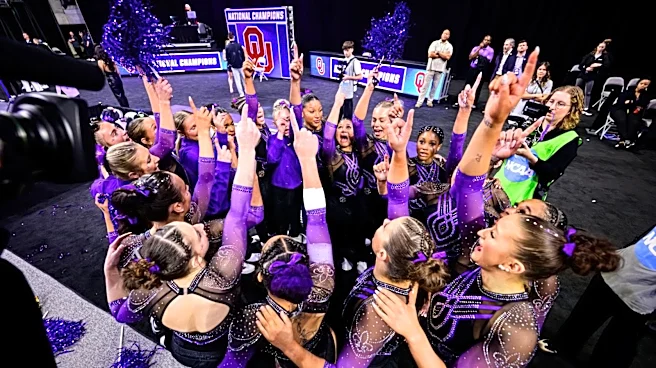
Earlier this week, I talked about how LSU needs to get more production from other gymnasts in their lineup so Kailin Chio doesn’t have to carry the scores as much. This is part of a greater thing that I noticed when analyzing LSU and Oklahoma from 2026. If you’re curious about the data I’m using, this is a link to a Google folder which includes the spreadsheets with all the data about every routine.
Kailin was LSU’s anchor on vault and beam, and she was fifth
on floor. This whole analysis began when I got curious about one thing: what parts of LSU’s lineups on each event were the best at scoring 9.9+ and what parts were the worst at doing that. That led me to wonder the same thing about Oklahoma, and the differences between LSU and Oklahoma were obvious. By doing this, I’ve come to the most complete hypothesis about how the Tigers can usurp the Sooners. If LSU gets more production from the front half of their lineups on each event, then they will beat Oklahoma more often.
Data on LSU’s early lineup production
LSU had six lineup spots on each of the four events in 2026 for a combined total of 24 lineup spots. Across 16 meets, eight of those 24 spots had 10 or more scores of 9.9. Of those eight, just one, the third spot on bars, came in the front half of the lineup. Comparing that to Oklahoma is slightly unfair since OU competed 17 times in 2026, but if you look at the lineup spots that went 9.9+ at least 11 times, three of the seven came from the front half of the lineups.
One thing that got me curious was how often each time started with a 9.9+. I started by looking at the first two routines of each rotation. Overall, LSU got a 9.9+ from at least one of their first two gymnasts 30 out of 64 times, or 46.88%. It happened six times on vault, 11 times on bars, five times on beam and eight times on floor. For comparison, Oklahoma did that 46 times out of a possible 68, or 67.65%. They did it 11 times each on vault, bars and floor, and they did it 13 times on beam.
I then expanded and looked at how often each team got at least one 9.9+ from a gymnast in the first half of their lineup. For LSU, that happened 46 times out of 64, or 71.88%. They did it 10 times on vault, 15 times on bars, 11 times on beam and 10 times on floor. The only time they didn’t get a 9.9+ in the first half of bars was at the national semifinal. Oklahoma dominated this by doing it 59 times out of a possible 68, or 86.76%. They did it 15 times on vault, 13 times on bars, all 17 times on beam and 14 times on floor. Let’s go deeper.
Production by event
When it came to early production, LSU did best on bars. The strong starting three of Lexi Zeiss, Ashley Cowan and Madison Ulrich did a great job of setting up Kailin Chio and Konnor McClain later. The fifth spot in the lineup struggled to get 9.9s, with only six such scores, and that’s one spot that has to get fixed in 2027.
Floor was a tale of two halves. The back half of the lineup scored a 9.9 a combined 83.33% of the time (40 times out of 48), but the front half combined to do it just 41.67% of the time (20 times out of 48). LSU’s been very capable of getting early production on floor, especially in the past few years. If they can get that up, they’ll get an even greater advantage on floor.
Vault was the Kailin Chio show, but that’s because she owned an event that tends to give people fits. The first, second, third and fifth spots in the vault lineup had fewer combined 9.9+ scores, 14, than Kailin Chio had as the team’s anchor in every meet, 15. The biggest spot that concerns me is the fifth spot, which had fewer 9.9s than the second or third spot. LSU had three 49.5+ vault rotations in 2026, none of which came in the postseason. If the production on vault gets fixed, something this team is more than capable of doing, they’ll be a better rival to Oklahoma’s dominance. One last thing to point out is that Oklahoma crushed the rest of the country on vault, leading #2 LSU by more than a tenth in the NQS. Oklahoma may own that event, but there’s no reason to let them own it that hard.
Beam is the event where things must improve the most. The worst spot in the lineup out of all 24 by 9.9s scored was the second spot on beam. In all 16 meets, LSU got just one 9.9 from that spot, a 9.900 from Emily Innes in the Oklahoma meet. The fifth and sixth spots on beam had 11 9.9+ scores each for a total of 22. The first four spots in the lineup combined for 19 9.9+ scores. Konnor’s clutch 9.9500s at NCAAs came because of the issues with production before her routines. If LSU’s going to beat Oklahoma, those issues need to get sorted.
Conclusion
In 2025, LSU got off to a hot start on vault against Oklahoma and beat them at home when the Sooners faded down the stretch. At SECs, LSU started strong on bars and kept the pressure on Oklahoma the entire meet. In 2026, Florida won the SEC title by keeping things close with Oklahoma for long enough to snipe them with a massive final bars rotation. In 2024, Oklahoma missed the national championship when they couldn’t overcome a bad start on vault. Oklahoma shoots out the gates and challenges everyone to try and catch up before they cruise to a victory. It’s not like they slow down, but they rarely hit the gas in the final rotation.
If LSU’s going to get their first national championship win over Oklahoma, they have to figure out how to start strong so their anchors can hammer the scoring. I love the additions of Jordyn Lyden and Skye Kerico even more than before because they bring early production on beam and bars that compliments the anchors.