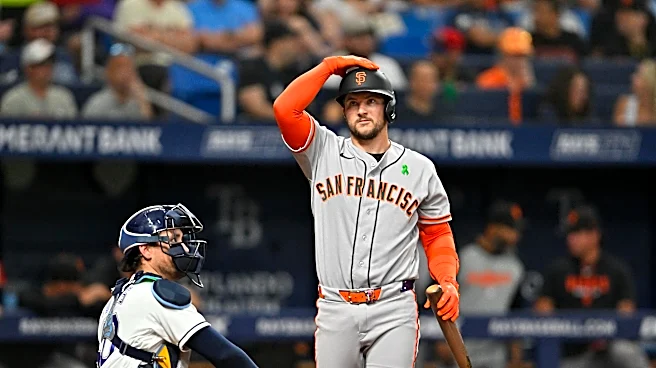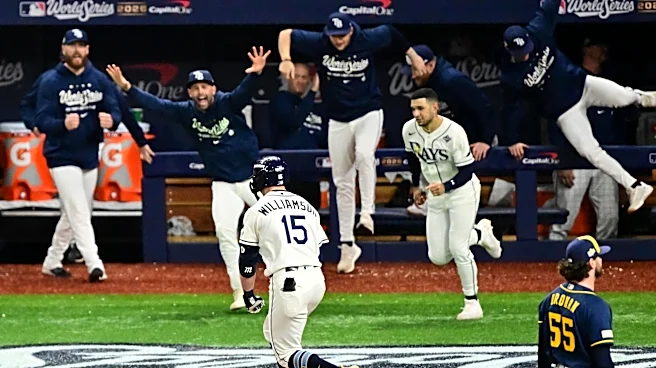

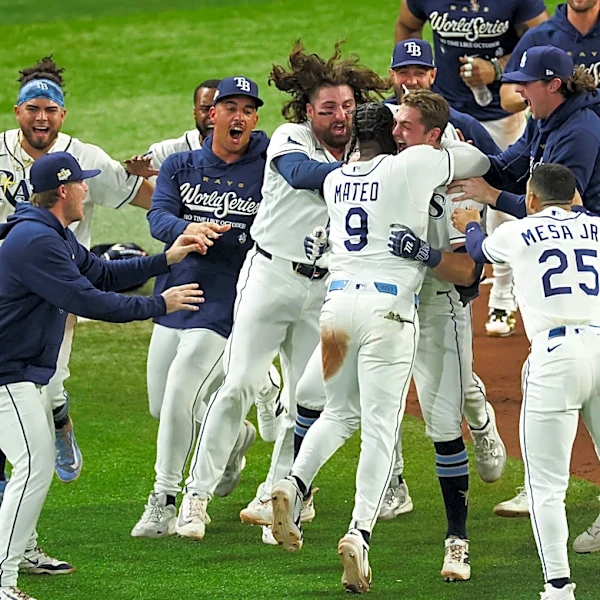

Yesterday, The Athletic put out a list ranking the top 40 free agents with predictions on where each will land. The San Francisco Giants were mentioned at least a few times, and the most prominent one was probably Brandon Lowe, who had a tremendous power season in Pittsburgh (35 homers) to go with a triple slash of .260/.331/.493 (121 wRC+) — gosh, the Tampa Bay Rays could’ve used a hitter like him in the World Series. Anyway, rather than examine all the times the Giants were mentioned, it got me thinking
about which hitters the team could target.
I’ve already rundown the pitching market, but rather than make a tiered analysis of the entire free agent group expected to be available, I thought I’d zero in on players who made it through what I think is a pretty reasonable filter, just based on what we’ve learned from this season of Buster Posey’s President of Baseball Operations tenure: contact! The team craves contact! The lineup wants the hit tool, and it’s willing to sacrifice walks for them.
At first, I thought that put Lowe at a disadvantage with a .260 batting average, but the Giants hit just .245 as a team and the sport hit .244; AND, even in that famous May through July stretch where the Giants had the 7th-best offense in MLB, they hit .256/.316/.434, so, it’s not like they’re necessarily focused on Luis Arraez types. So, let’s set the bar at .256 and be scrutinize the position mix a little bit. I think the Giants are set at first, short, third, center and right field. Casey Schmitt and Marcelo Mayer are definitely answers for second base (and left field, in the case of Schmitt), but let’s consider those spots upgradeable, with the upgrade pushing one of these two into a firm position. And, just for fun, since Daniel Susac will be optionable in 2027, I included a catcher.
And before you stomp into the comments to declare that only you see the wisdom in the Giants aiming to lose another 97 games, please note that there’s no reason for the Giants to do that. They’ve somehow managed to improve their farm system despite spending hundreds of millions of dollars to produce one of the worst professional sports teams in the world today that’s a total disgrace to the fans in the actual city where they play. Yes, it’s improbable for a team to buy a 20-win improvement, but I’d rather the Giants spend their money on baseball talent. And, who knows, maybe it’s not about buying 20 wins. It’s about buying 7 or 8 and expecting some dead cat bounces and some gradual improvements from the younger players — you know, the same plan as this season lol.
Randy Arozarena — RHH/LF/32
2026: .281/.381/.484, 10.1 BB%, 21.6 K% (151 wRC+)
What area of the roster would he improve: Outfield depth
A teeeeeeeeeeeeeeeeeeeeeerrible outfield defender (-5 Outs Above Average, -11.7 Defensive Runs Above Average) who posted a career year heading into free agency for the first time. This is a classic STAY AWAY free agent hitter profile of a guy who elevated himself in a platform season but is also on the wrong side of 30. The Giants used to be tempted by these types of guys all the time.
On the other hand, Arozarena is energetic and a quality hitter. Sort of like a potential best case scenario for Heliot Ramos. But the prior three seasons (which included being traded from Tampa Bay to Seattle) show a player not far off from the contract run of 2026: .237/.343/.413, 10.8 BB%, 25.7 K%, 120 wRc+. He will absolutely cost the team a win over the full season because of that terrible defense (he’s averaged -11 Defensive Runs in every full season of his career), but his bat makes up for it.
If you put him in left, then Schmitt and Mayer become the second base duo or middle infield backups. Arozarena would be the best of the group that’s only Jung Hoo Lee, Jonah Cox, technically Harrison Bader, Scott Bandura, Turner Hill, Grant McCray, etc.
Still, a Scott Boras client and someone whom Boras-connected media figure Jim Bowden predicts will get a 5 year, $124 million deal (or in that range). I don’t think the Giants would pony up $25 million annually for a hitter who has been 20% better than the league average for his career. He would be a good addition at the right price, and I don’t think that’s necessarily the right price for the Giants.
Mauricio Dubon — RHH/LF-CF-SS-2B-3B/32
2026: .276/.321/.399
What area of the roster would he improve: Position player depth
Compared to Arozarena, the Giants could spend significantly less to get Dubon (Bowden projects 2 years, $16 million) for similar value (both 2+ fWAR players). He is a lot of batting average with little power (career .118 ISO). A scrappy underdog utility guy who is a plus defender up the middle — +17.1 Defensive Runs Above Average, +19 OAA in Houston last season; +6 in Atlanta this year and that’s with most of the value coming from shortstop and center — might be the kind of veteran steadying force Tony Vitello could use if the injuries pile up again.
The depth chart analysis gets a little trickier because he does sort of rain on Jonah Cox’s parade, since he can play second and center. However, it’s important to keep in mind that Cox struck out 65 times in 169 PA (38.5 K%), Casey Schmitt is often hurt, and Marcelo Mayer has yet to prove himself. Even though all the Giants’ top prospects are middle infielders, again, it’s Dubon’s versatility that adds the value and makes him a good fit. Not as a big offseason move, but as a potentially important one — especially if the Giants fail to upgrade their pitching staff’s stuff and rely again on dudes who pitch to contact.
Seiya Suzuki — RHH/RF/32
2026: .270/.368/.473
What area of the roster would he improve: Outfield depth
Probably because the Cubs’ outfield was pretty amazing, Suzuki’s defense numbers this year look great. He’s +5 Outs Above Average and 88th percentile in outfield defense. He’s got some speed (63rd percentile sprint), but mainly, he has a lot of power from the right side. His .204 ISO ranked 33rd among qualified MLB hitters (just slightly ahead of Arozarena’s .203), so, you’d get heaps of power on top of the average.
Again, because of free agency, he’s on the wrong side of 30, and the projected 5-year deal for $120 million takes him to his age-37 season. Not advisable for a team like the Giants, but he’s closer to 30% above the league average. He’s more like a 3.5-win player to Arozarena’s 2+, so, if you had to choose between just those two guys, Suzuki makes more sense if the money’s about the same.
Also, except for Petco Park (.691), Suzuki has a .760 or better OPS in all the NL West parks. He’s only played right field in his MLB career, so imagine flipping Jung Hoo Lee to left to put Suzuki in right with Cox/Dubon/Gilbert in center.
Brandon Lowe — LHH/2B/32
2026: .260/.331/.493
What area of the roster would he improve: Infield depth
There’s probably a version of this post that makes more sense because I break this down by position. With Casey Schmitt and Marcelo Mayer (and, to a lesser extent, Jonah Cox and Gavin Kilen) in mind, the second base group of free agents worth discussing is made up of Luis Arraez, Jazz Chisholm, and Brandon Lowe. All left-handed hitters, by the way.
Yes, Lowe has played some outfield (160 innings in LF, 171 innings in RF) as well as 1B (155 innings), but he’s basically a second baseman (6,148 innings). He’s also the oldest of the entire bunch of names I’ve mentioned in this blurb. He also has the most power (66 home runs the past two seasons).
But like Arozarena, he really picked it up a notch in his final season before free agency. It wasn’t his career year (that was 2021: 39 homers, 136 wRC+ in 615 PA), but it was his best since 2021. It was also a career high in games played (150).
Meanwhile, Chisholm had a down year offensively (98 wRc+; career: 108) but his defense was still great, putting him in the zone of the 3.5-4 fWAR player he has been throughout his career. He’s also the youngest of this bunch (29) and steals a lot of bases (171 in 716 career games). He’s just a .245 career hitter and he doesn’t need Ron Washington’s tutelage to improve his defense, but he’s like Arozarena in that he’s a charismatic, fun personality type to add to the mix and coming off a down year there might be some value to be had.
Or, the Giants could just reunite with Luis Arraez. The only real problem with that is he’s basically second base and first base, that batting average, while good, is basically it. He can be about as valuable as Chisholm.
If you add any of these players, then Casey Schmitt becomes the de facto left fielder, which I think is probably for the best. He can also be a great fill-in for Matt Chapman for when he gets hurt (as he is entering his IL era).
Austin Hays — RHH/LF/32
2026 season: .280/.305/.400, 3.8 BB%, 25.7 K% (93 wRC+)
What area of the roster would he improve: Outfield depth
He actually ended the season with the Padres and hit .316/.344/.456 in 26 games (61 PA). I mention this because, for his career, he’s a .263/.313/.434 hitter (105 wRC+). His career ISO of .171 is just a bit above the league average over the span of his career. The White Sox signed him to a 1-year, $6 million deal before the season and wound up releasing him due to lots of time missed with leg injuries. This would be the depthiest of depth moves for a team that ignored Hays once already in favor of Will Brennan and Jared Oliva. But he fits the contact approach, has been a decent defender at times (according to Statcast) when healthy and has meaningful MLB experience (86 HR in 720 games, All-Star in 2023).
TJ Friedl — LHH/CF-LF/31
2026 season: .172/.255/.255, 8.1 BB%, 23.2 K% (43 wRC+)
What area of the roster would he improve: Outfield depth
The diminutive (5’8”) Pleasanton native got MVP votes in 2023 and heading into 2026 had a career slash of .257/.344/.414, a 9.5 BB% and 15.9% strikeout rate (108 wRC+). He’s an okay defender with not as much speed as you’d think — fast, but not elite — and his career batted ball profile is suboptimal: 86.9 career exit velocity. The Reds DFA’d him in September.
But I keep looking at that batting average and that low strikeout rate and I wonder if Hunter Mense could come up with a plan for him and if his age-31 season on the horizon might create a situation where the Giants could get him for a year and for not very much… just to see if there’s something in there they could unlock. Like Hays, it’s some really good MLB experience. It’s not like the Giants need a lot of experience at every position, but this post isn’t advocating for the Giants to get every player mentioned. Like, if they only added Friedl to the hitting group, you could see the reasons why and projected a modest success because of them.
Ryan Jeffers — RHH/C/30
2026 season: .256/.353/.461
What area of the roster would he improve: Catching depth
Now, I’m inclined to believe that Buster Posey can size up a catcher just by looking him in the eye, so, maybe he’s already passed judgment on Ryan Jeffers. But just from an offensive standpoint, he would backstop the lineup in so many ways. Over the past 4 seasons, he’s been about 20% better than the league average albeit in a part-time role (429 games, 1,632 plate appearances). As a catcher, that’s really important. His time as a DH is less important, given the Devers-Eldridge of it all.
But Bowden’s blurb speaks to the downside risk of signing him:
On the defensive side, he’s an average pitch blocker but doesn’t control the running game well.
I would think that if you’re a catcher you have to be able to do one of those things really well and, ideally, be at least “okay” doing the other thing. Susac, for example, is 29th percentile in Blocks Above Average, but 80+ percentile for all of Statcast’s other catching metrics (CS Above Avg, Framing, Pop Time). In 2026, Jeffers was 51st in Blocks, third percentile in CS Above Avg, 37th in Framing, and 33 in Pop Time. Even the blocking number is an illusion because it had never been that high before in his career. Unless the team felt like it could coach up some element of his defense, I fear that his inclusion on this list is a folly on my part.
But what do you think? Should the Giants aim for 95 losses and hope for many more? Or, expect that most of the same hitting group will be as good (for the veterans) or better (for the developing players) if left mostly intact and not worry so much about bringing veteran hitters into the group? Do you think that I’ve misinterpreted that Giants’ emphasis on batting average? What players would you suggest who don’t need to be traded for?