


The New Cleveland Browns were reborn in 1999 and struggled to gain any footing in the league. A lot of head coaches, GMs, and players came and went.
Mike Holmgren had been a successful head coach while at the helm of the Green Bay Packers, including winning Super Bowl XXXI. He then became the head coach of the Seattle Seahawks beginning in 1999.
RELATED: QB PAUL MCDONALD INTERVIEW
In the 2003 NFL Draft, Holmgren selected QB Seneca Wallace out of Iowa State in the fourth round. This was the draft in which
QB Carson Palmer of USC was selected first overall.

At the time, the Seahawks had Matt Hasselbeck entrenched at quarterback with Trent Dilfer as his backup. Wallace filled in nicely as QB3, slated for development behind two seasoned veterans. In his five seasons in Seattle, Wallace played in 48 games with just 14 starts under center. However, because he was such a gifted athlete, Holmgren would insert Wallace at receiver at times, or as a Wildcat option.
In the 2005 NFC Championship Game between the Seahawks and the Carolina Panthers, a convincing 34-14 Seahawks win, Wallace made a pivotal reception that became the game’s longest pass completion. The victory placed Seattle in Super Bowl XL against the Pittsburgh Steelers.
Holmgren stepped down as head coach of the Seahawks in order to take off for a year. He was an analyst for NBC plus served as an analyst for Seattle Sports station KJR 950AM. The following season, he accepted the job of President of the Cleveland Browns. One of his first orders of business was to work out a trade with his former team to obtain Wallace.
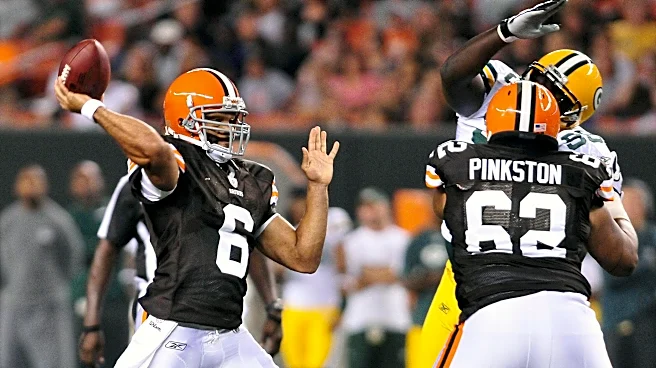
Wallace played two seasons in Cleveland. He suffered a high-ankle sprain, which derailed his time with the Browns, and only played in 14 games with seven starts. Wallace played eight seasons in the NFL. His career stats: 64 games played, 22 starts, threw 788 attempts with 468 completions for 4,947 yards, a 59.4% completion ratio, converted 237 first downs, tossed 31 touchdowns with 19 interceptions, and had a 64.4 QB rating. He also rushed 68 times for 293 yards with another score, and had six receptions for 106 yards.
A California kid, Wallace grew up in Rancho Cordova, just a stone’s throw east of Sacramento, which is two hours from San Francisco. He was a standout athlete playing for Cordova High School on their basketball and football squads. As good as he was in football, he was a standout in basketball despite being 5’-11” and 190 pounds. He was named All- Sierra Conference and All-Sacramento Honorable Mention in basketball and recognized as one of the top basketball talents in his region.
He also lettered in football, where he won multiple football honors.
But because of his size, he did not see a future in basketball past the college level. He accepted a scholarship with Sacramento City College to play football because he did not have enough credits. At Sac City, he absolutely shined. He set the school record by amassing 513 passing yards in a single game, a record that stands today. He was a standout QB who had great legs and made lots of damage as a runner. He ran a 4.56 in the 40, which added to his elusiveness.
Wallace then made the decision to transfer to Iowa State for the 2001 college football season. He had bonded with their head coach, Dan McCarney, and the campus just felt like home. He won the starting QB position for his junior and senior campaigns, and started 25 games with 411 completions on 712 attempts for 5,289 yards, a 57.7% completion ratio, threw 26 touchdowns and 27 picks, with a QB rating of 124.6. He rushed 237 times for 912 yards and added another 15 touchdowns.
In his junior year, he was named the “Big 12 Newcomer of the Year, and as a senior, he was voted Second Team All-Big 12.
Wallace was taken by the Seahawks in the fourth round of the 2003 NFL Draft. He played a wide variety of positions in order to get himself on the field, including quarterback, receiver, and as a Wildcat option. In 2010, the Browns traded a seventh-round draft pick for him. Later, he signed with the New Orleans Saints, San Francisco 49ers, and the Green Bay Packers, where he played in two games with one start.
After he hung up his cleats, he was a coaching assistant with the Dallas Cowboys, coached high school football, and recently was the QB coach with the St. Louis Battlehawks of the UFL.
Wallace has been inducted into several Hall of Fames:
- Sacramento City College Hall of Fame (2013)
- Rancho Cordova High School Hall of Fame inaugural class (2015)
- Iowa State Athletics Hall of Fame (2019)
Today, Wallace resides in Prosper, Texas. His wife, Abbie, and their three children are Christians. He has a foundation called Joyce’s Angels, which is in honor of his mother, who passed away from Multiple Myeloma.
Dawgs by Nature staff writer Barry Shuck had a great conversation with Wallace about his playing career, including his time with the Browns.
Shuck: You played basketball and football at Cordova High School. You were named All-Conference in basketball. At some point, did you think that basketball was going to be your path?
Wallace: I did a little bit and enjoyed playing the game of basketball. Growing up in Sacramento, California, you were playing basketball on the streets, and it was easy to play with or without anybody else. All you needed was a ball and a hoop. But with football, you could play catch with one other person, but that was it. You don’t play it by yourself. So, naturally, I gravitated to basketball. But my first love was soccer. I played soccer for about six years around some clubs, and I just remember my buddies growing up in California; they would always drive by when I was at soccer practice, and they were on their way to football practice. I played my eighth-grade year of Pop Warner and then in the ninth grade in football all the way through high school. But I played soccer through the seventh grade. I played basketball and football through high school. I always loved basketball. I have a goal in my backyard. But football took me to another level. I was able to go and play in college, but I didn’t put all my resources into basketball. Once I started playing football in high school, it was over after that.
Shuck: At what point did you decide to pursue football over basketball?
Wallace: Probably my junior year. I was All-City and All-District for basketball and played all the way through high school, but unless you are 6’-6” and go on to score 30 a night, it’s hard to make it. Football gave me more opportunities, and I got a lot of scholarship offers. And that’s at the point where I decided, like, you know what, football’s going to take me to a different level and give me an opportunity to play in college.

Shuck: How did you end up at Sacramento City College?
Wallace: The short version is I wasn’t qualified coming out of high school. I didn’t have enough qualifications to transfer coming out of high school. You have to have four years of transferable English, four years of some other transferable subjects, and they just put some basic communications to get you to graduate high school. They put a lot of people in those classes who they don’t really consider going to college. It was unfortunate, but in my senior year, going to my junior and senior counselors, you have to have XYZ classes in order to get offered. In my junior and senior years, I ended up taking three years of English, geometry, and all these classes to get above a 750 SAT. Those are hard courses. I did all this and got 1110 on my SAT. I got a scholarship offer from Oregon State, accepted the offer, and was there for about two months. They had to petition for the last class. They said if you get your three years of geometry, Spanish I and II, they said they could petition for the last English class and should be able to get me through. We did all that; I went to school, and the petition didn’t go through. We had letters from principals and counselors, and they denied it. So, I ended up having to go to a junior college. My mom found out she had cancer that well, so it was a blessing that I was already near home.
Shuck: I know this has to be a misprint. Is it true you threw for 513 yards in a single game at Sac City? That is still a school record.
Wallace: It was funny because my first year, I was just a quarterback coming out of high school. I was just an athlete and happy and honored to get a scholarship. Because at that time, we hadn’t had anybody get a scholarship in our world. We used to be very dominant in football, but there is an Air Force Base there, and the Air Force Base kind of sent a lot of the people that were coming in. We probably didn’t have a player from football get a scholarship in 15 years. So, I ended up getting my ticket as an athlete. Now, in junior college, I went there as a receiver for the first seven games. When I found out my mom was sick, I ended up going in late, so I didn’t get there until the summer. So, they say you’re short but athletic, and then they say I am going to be like a receiver, so I said that’s fine. The starting quarterback ended up breaking his wrist in Week 6 or 7. I took over after that and broke all the records. I am in the Hall of Fame there and am very proud of my time there. That junior college was super competitive and was one of the best junior colleges at the time.
Shuck: You had a great career at Sac City. Several schools offered you a scholarship, but two wanted you to move to receiver. Which schools, and how did that conversation go?
Wallace: That conversation was going on coming out of high school. When I got to junior college, I started to really hone in on the skills and developed a little bit more mentally and physically on the game at quarterback. So, for me, I had all the confidence in being an athlete, but I had a quarterback coach who was really good about what he did at the time. He actually played the position at UNLV, and his name was Jarod Brown. That’s when I really started to get better. So, when I started to be recruited, Iowa State was heavy into recruiting junior college transfers because they knew they had to get guys that were older and seasoned who would come in and play immediately. I was a JUCO All-American, and there were several schools that wanted me to go to their program, but wanted me to move to a new position. There were a lot of schools that were interested. But during that time, you got to think this was a different era of football. Programs like Miami or some of these other schools, a lot of them didn’t want to take that risk on a shorter, and I’m going to say this quite frankly, black, undersized quarterback. I had to play that game, and I understood that. It was whatever opportunity came about. I had a great recruiting trip to Iowa State, which was in the Big 12. They recruited me heavily, and they were going to give me that legit opportunity that I was looking for. It came down, honestly, to Kansas State and Iowa State. Iowa State didn’t have a quarterback at that stage who was leaving, and they didn’t really have a veteran guy. K-State had just signed a JUCO All-American named Mark Dunn. I prayed on it and ended up making the right decision to go to Iowa State.
Shuck: When Lamar Jackson was drafted, there was talk about him moving to running back. Seeing him at the podium, did you have flashbacks when you were asked to move position?
Wallace: Absolutely. Nothing changed. I mean, that was the thing. Even a player like Vince Young was told, literally, that they always wanted him to move positions. They always thought that we weren’t smart enough to process information quickly. We were too athletic, and so we needed to play a different position and all that stuff. So, I had those doubters who wanted to sit there and say Hey, you know, we want to put you in a different position. But I didn’t allow it. I didn’t want that to happen because I knew what I brought to the table. I knew at the end of the day, that’s what I love to do. I love the leadership qualities that you need to have as the quarterback. And I think that’s definitely what God put me on this earth to do. So, when those teams came for me, it went back to when I was coming out of high school, and I was happy just to get a scholarship. Like, I didn’t grow up knowing. I didn’t have siblings that played in college. So, to get an offer like Hey, you’re going to school on a full ride.

Shuck: Iowa State was the only school to see you as a pure quarterback. What was head coach Dan McCarney like?
Wallace: Coach Mac was awesome. He’s one of the main reasons I ended up picking Iowa State. He and his staff did a great job of providing more of a family relationship type deal. When he tried to recruit me, it was truth and honesty the whole time. For me, his leadership qualities, the things that he demanded of us even before I stepped on the grass, were what I knew from him. I knew that was the kind of quarterback head coach that I wanted to go play for and that I wasn’t going to have to fight to play my position. I had to know there was so much trust in me. I ended up going to Iowa State, and he had a mixed staff. I just knew it felt like home, and that was the reason why I started going there.
Shuck: Iowa State played a pro-style offense. How did this prepare you for eventually playing in the NFL?
Wallace: Funny that you ask because you don’t know this stuff, right? You’re on a journey. And as a young man back in the early 1990s to early 2000s, you don’t know what path football is going to take you. You don’t know what direction you’re going to go. You just don’t want to sit on the bench, and you’re just playing. So, you’re not thinking about what system suits me the best so I can get an opportunity to play in the pros. You’re thinking about how I can get on the field early and just play the game of football and let everything else take its course. So, for me, I wasn’t thinking about what style of offense. But the coaches were. Coaches are thinking about what suits our offense best and what we can do. It just happened that I had great coaches there at the time. Coach (Steve) Brickey was the quarterback coach that year and became the offensive coordinator the following season. Those guys ended up mentoring me, and it just turned out to be a great fit. I had competition for the job, but I ended up pretty much earning the position. I would say probably the first week of spring ball, and after that it was over just because there wasn’t someone on that roster quarterback-wise that was as dynamic as me. They needed somebody who could be able to create outside the pocket. They knew what they were up against because if Coach Mac at the time was truly loved up there, he wanted to build a legacy and get back-to-back-to-back bowl games, and he needed a quarterback like me. I think I identified that quickly, and it turned out to be the best fit for me.

Shuck: In your first season, the offense was designed to run the ball. Is that frustrating for a guy like you who likes to air it out?
Wallace: Yeah, yeah. We were really balanced. That’s the thing I loved about what we did, and not knowing it would help me play the West Coast system for 10-plus years. Because that is what we did, right? We were balanced. We ran the ball 20-25 times a game. Now we were still Iowa State. We didn’t have the luxury of being able to have all the top recruits in the country, right? We knew what we were up against. It wasn’t like we could go out there and air it out 40 to 50 times a game. We had to slow games and had the strength to run the ball and throw the ball as efficiently as possible. And we did that. I think that was the reason why we were able to have some big games and successful games and continue to keep building a brand of Iowa State and what they wanted their identity of football to look like.
Shuck: In Week 7 against Texas A&M, you threw 46 times and completed 30 for 348 yards and two touchdowns. Before that, you had limited attempts in each game. What caused the coaching staff to throw the ball in that game?
Wallace: That’s a good question. I don’t know why the A&M week was like that. I’m thinking back on it, that probably was one of our first big road tests that we had up to that point. But it was just the style of game and maybe it was they started to take the leash off for a little bit. He’s trying to get our system and understand what our philosophy is about, and let’s open it up. Especially if you wanted to take that next step in development and what we were doing, we needed to be able to say, hey, let’s give you the keys and see where he could take us. And maybe that was the reason behind throwing that much. When I look back on it, obviously I set the standards for what my career was going to look like at Iowa State and being in the Hall of Fame or the Heisman race. Because that junior year is what catapulted me into the Heisman conversation for my senior year. That was just kind of the thing that happened during that time. When you throw 46 times in the game and walk off the field, you’re proud of it. I think during that time, trying to set the standard for Iowa State football, I think that was just something that we had to do. I had some games like the A&M game where we were forced to throw it, maybe because they had a great defensive line and maybe we didn’t get enough push in the run game.
Shuck: You know we have to talk about “the run” against Texas Tech in your second season. The entire time you were running from defenders, were you still looking downfield for somebody to throw to, or just running for your life?
Wallace: I was looking. Everything seems to slow down, and I think that was kind of the thing. I was still looking down, and when I decided to scramble out to my right, I was thinking I was going to go out of bounds. But I didn’t. And the defense kind of slowed up, and once they slowed up, that was the reason why I was able to cut back. They just relapsed and allowed me to keep that cutback lane. The angles that they used weren’t very good, which allowed me to make that run happen. And I picked up some great blocks. It just allowed me to kind of get into the position that I was in on the cutback. None of that stuff would have happened if I didn’t have Michael Wagner and Jamal Montgomery picking up some big blocks for me.
Shuck: Let’s talk about Michael Wagner. On that play, he laid a devastating block for you on the very last defender who had a shot at stopping you at the 11-yard line. That one play made you a household name. Did you name a kid after Wagner?
Wallace: I wish I did. It was one of those teammates doing what they do. He’s in the history books probably just because of that, which was awesome. You got to have guys that are willing to sacrifice their bodies. You got to have guys who are willing to pick up blocks for you. That’s just the way it is, man. But at that point, it’s me going back to Sac City and just being an athlete. So, there’s no Michael Wagner Wallace. No nicknames – no none of that.

Shuck: You were drafted by the Seattle Seahawks. What was your rookie contract worth, and what was the first major item you bought?
Wallace: $3.5 million. So, the nice thing for me was I was able to make some good amount of money before I got drafted. To this day, I know everybody likes to tell the story. Back then, an early fourth-round draft pick. I was probably projected to be in the third round. Quarterback Chris Simms was still on the board and ended up going to Tampa Bay. He was the last quarterback taken in the third round, and I was the next quarterback off the board. I had car deals and a lot of different things that allowed me to make money off the field before I even had to touch my contract amount. So, that was a nice thing. I made over $100,000 just with signings and appearances and stuff like that. I was able to put that away and use that endorsement money. At the time, the NFL minimum was like $225,000 to $285,000. I was able to put money away and not even really touch my signing bonus of $365,000. I kind of just used that to kind of help me through the year. Then after a few years, they gave me a contract extension, and then another extension. So, they got me my rookie deal and two extensions, so that gave me seven years in Seattle. I bought a white Yukon Denali.
Shuck: The Seahawks’ quarterback room was deep with Matt Hasselbeck and Trent Dilfer. You played some quarterback in games, and at times at receiver. In 2005, you made a magnificent catch in the NFC Championship Game. What was it like knowing that if your team won the game, a trip to the Super Bowl was next?
Wallace: We won that game and ended up in the Super Bowl. That was special to be part of something that involved almost every member of our team. That reception was the longest completion in that game. It was for 37 yards. To be able to have that stat where you have the longest play in an NFC Championship Game was special to me against a cornerback that was with us the year before. That was kinda my highlight. It was cool to be able to be part of that. That was in Year 3. We had all these guys that I learned from about how to be a pro. I think when I was drafted, Coach Mike Holmgren told me, “Hey, you’re a quarterback, son.” You’re going to learn how to play quarterback and play in the West Coast system. We’re going to get your attributes, your strong suits, and we’re going to build an offense around you.
Shuck: In Super Bowl XL, the Pittsburgh Steelers were the #6 seed while your Seahawks were the #1 seed. After one quarter, your team was leading 3-0. What changed the tempo in this game?
Wallace: The first half, if you go back and watch it, you can go research this. There’s a ref who came out and said that he screwed the game, and he actually got paid. This is probably 10-15 years later. He never refed another game. We had two touchdowns in the first half that were pulled off the board. Ben Roethlisberger was trying to dive across and hit the pylon, and his helmet went across the goal line but not the ball. In the first half, teams are trying to feel themselves out. In the second half, they came out and created some explosive plays. I think we played well for four quarters of football, but they were just too explosive, and we weren’t able to kind of create that game. We just didn’t have enough.
Shuck: I found two interesting stats about you. One, you ended the 2008 NFL season as the league leader in Passing Touchdown-to-Interception Ratio, with 3.67. And you also hold the Seahawks team record for the longest passing touchdown: 90 yards to Koren Robinson in the same season. What do you remember about that play?
Wallace: That play was awesome. That play was something that we talked about for that week, and Coach Holmgren knew we were identical teams, both West Coast. They knew our system, and we knew they were a very aggressive defense. We wanted to take advantage of how they played on defense. So, what we did was put in a double move first play. We got a penalty on us on the kickoff that set us back to something like our three-or four-yard line. And Coach was like, you know what? This probably is going to work out better. Screw it, we’re going to leave it in. First play of the game. We’re probably going to get pressure here because that’s what a lot of teams like to do when you’re backed up: try to bring pressure. So, we just left it on. We got the look, I felt the pressure coming, had a great route, gave it some space, and laid it in there. Probably the ball was about 35 yards in the air, and he caught it and did the rest. Now, it is in the record books.

Shuck: Where were you when you found out that you had been traded to the Browns in 2010, and who was the first person you told?
Wallace: I was pretty loyal to the Seahawks fan base for years and very loyal to the staff for giving me an opportunity to get drafted. When Holmgren decided to retire, he told me his wife wanted him to walk away for about a year, and that he was coming back. He said he didn’t know where, but I did not think he was going to Cleveland. He signed with the Browns and made this big announcement. It was probably two days later that they reached out to my agent. My agent called me and said that Mike was probably going to trade for me, and just be prepared to be ready. It was during the offseason, so literally it wasn’t until I was driving in and my phone rang and my agent said, Mike just traded for you. Get your stuff packed and be ready to go to Cleveland. Obviously, the first ones I told were my brothers and my girlfriend at the time, who became my wife.
Shuck: You started Week 2 for Cleveland at home against the Kansas City Chiefs. What is it like sitting in the locker room, knowing you are going out for your first start for a new team?
Wallace: Cleveland is a very interesting city. It has good people. They’ve been burned so many times. I can remember being down three points at halftime, and they’re booing us. It’s a hard place to win, but they are traditional, they are blue-collar, and when you win, they’re going to love on you. Cleveland taught me a lot. It was an organization that was going through a lot of transitional changes at the time, and probably still had their internal issues. But as a whole, the city has had some good quality players. They have had great players come through there. I mean, Josh Cribbs. We had our opportunities. It’s just unfortunate that things happen in Cleveland that are unexpected; the unexpected craziness happens in Cleveland. Guys getting hurt. I got my ankles hurt. Jake Delhomme got a high ankle sprain. Colt McCoy got a high ankle sprain. I got a high ankle sprain. Now, how do all three-year quarterbacks get injured in one year? It’s a lot of craziness that happens. But I met a lot of good people and have nothing but positive things to say about my time in Cleveland.

Shuck: After just one season with the Browns, your head coach, Eric Mangini, was fired, as was your OC, Brian Daboll. Pat Shurmur was hired as the new head coach, but there wasn’t an offensive coordinator was hired. Did this make it awkward for the offense to have the head coach in dual roles?
Wallace: They were giving Pat Shurmur the opportunity to be that guy, which this I believe was his first time as a head coach. Philosophy-wise, he was West Coast. Which was nice, right? Because Mangini was not. It was a good fit for me. Now, obviously, they went out, and they drafted Brandon Weeden in my second year. They were still trying to find their identity and find out who was going to be their franchise quarterback. And Weeden was an older quarterback. So, there were a lot of things that kind of transpired during that time that kind of led to Pat Shurmur’s demise. Going into Year 3 for me, it was really funny, and it was the fact that they transferred the ownership to Randy Lerner. When they sold the team, the new ownership came in and immediately started cutting people’s salaries right across the board. They even got Mike to cut his salary. He finished that year, and they fired him. I think Mike only did 3 ½ years in Cleveland.
Shuck: What was Joe Thomas like?
Wallace: Joe Thomas was great. I had three games straight where I was really getting into my groove. Against Atlanta, I was playing good ball, and I was starting to pick up the offense. Everything was flowing, and I got a high ankle sprain from a rush by John Abraham in the second quarter. Joe Thomas is a smart player and is just really smooth on everything, and that’s why he’s so well loved there and a heck of a left tackle. Joe hated to have help on his side, and he definitely hated having a tight end chip the defender. One, it was a sign of disrespect to the tackle, saying that we need to give you help. It also brings him off balance. If I have to stay on balance to stay square, some guys will play off that. They will spin off the chip. So, he didn’t like when they would chip at all. I can hear him saying it now.

Shuck: On March 3, 2011, you signed a three-year deal with the Browns. Did you feel that you would become the starting quarterback from that moment on?
Wallace: Well, that was kinda the deal. The Browns were giving me a shot, paying me some money, and they thought it was worth it. But again, injuries happen. Injuries derailed my career. And I wouldn’t even say derailed; I was 34 or 35. It’s part of the game. Yes, I got the new deal and got a solid deal. It was okay for what my body of work was at the time. But it was a mix of Cleveland. Once the team was sold, it was like they decided to start cutting money here, and we got Brandon Weeden and Colt McCoy, and we got XYZ. If they didn’t see me in the future of this franchise, let’s cut ties. I think Colt played maybe one more year. After that, it was just a hot mess of everything.
Shuck: How does a California guy handle the cold environment?
Wallace: It was tough, it was tough. It started once I got to Iowa. I was a little bit more prepared for the cold weather. I still remember going there in January. I grew up in Sacramento, and I can drive up north and be in Tahoe in an hour and a half. But I only did that twice. Did I grow up in cold weather? No. I went to Iowa State in January and lost my luggage, so for the first week, I had nothing. That was a huge culture shock. But I think it allowed me to play in some of these cold-weather places like Cleveland, Seattle, and Green Bay. It wasn’t bad, and that’s football, though. When the weather changes, we get deep into the fall, and you get deep into the winter; that’s when I feel like it’s football. I love it. What helps when everything is cold is that it slows down the pass rush, especially if you are dealing with snow. Early on, when it’s hot, guys are like bullets and people are playing fast.
Shuck: Where were some of your favorite places to eat while with the Browns, or grab a brew?
Wallace: “The Melt” was good. That was kinda me and my wife’s spot. Another one: “XO Steakhouse.” Phenomenal. Then there was “Shinto Hibachi.” A lot of good stuff that came out of Cleveland. Well, you know what? If I did drink, I would tell you where the best places were, but I was never a drinker. We stayed downtown, and there were a lot of different places to go hang out and grab a beer. The culture in Cleveland is nice. And just knowing where to move around to the different places that made it kind of nice. But I couldn’t answer where it was a good place to go get a brew.

Shuck: After you hung up your cleats, you coached high school. In 2025, you were hired as the QB coach for the St. Louis Battlehawks of the UFL. How did you get that gig, and what was that season like?
Wallace: Relationships. Ever since I retired, it was an easy transition into coaching. For most football players, you can go right into coaching in some capacity. You can take your shoulder pads off and say you want to be a coach, and it’s there. You are seeing that trend a lot more now. So, for me, it was kind of getting out there, and I coached with the Dallas Cowboys for a year during the COVID year. I was always doing different things. They used to have this college All-Star bowl game called the “NFLPA Bowl.” It was around about six or seven years or so maybe more than that. I was asked to go out and get part of the staff for two years, so I went out there, and I built relationships. One of those was with Anthony Becht. Anthony played during my time with Tampa Bay and the Jets. Anthony saw how I was working and said that if he ever got an opportunity to go coach, he said he would bring me on. I said cool. That’s how that relationship started. First, he wanted me to be the OC, but I had never even been a position coach, so I was hired as the quarterback coach with the Battlehawks in the spring. I was actually a high school coach at the same time at a public school. Then I got a job as the OC at a private high school. Anthony reached out at the same time about a second year, but this time in Orlando. The only problem is I was full-time at this private school, and we have spring ball. So, I can’t just leave my guys during the spring to coach with Anthony, who has been reassigned to the new Orlando team. The crazy thing about this story and the reason I’m telling you this is that the head coach decided to let me go on June 20th for no reason based on differences in philosophy, so not only am I not coaching high school, but I missed the UFL season as well.
Shuck: Other than money, how has the NFL changed since you played?
Wallace: It’s more friendly to quarterbacks, talking from that perspective. When I say friendly, there are more opportunities for quarterbacks who were like me, the guys not 6’-5”, to get an opportunity to play the game. You’re talking about guys like Russell Wilson being 5’-11” and Kyler Murray. There are more guys that look like that. There are more guys getting an opportunity based on the population of the world, even though he didn’t make it, but to be in camp and be able to get a good opportunity to play. There are younger-minded offensive coordinators, and the game is transitioning from high school to college to the pros. So, they’re following the trend of how these kids are all being developed in high school and how they’re all being developed in college. Think about what Brock Purdy’s doing with San Francisco. It’s West Coast, but it’s very plain off of what Purdy does well, and that’s how the game has changed. It’s very exciting to watch, but the trend is not the way it used to look back in the day. You had Tom Brady and Payton Manning, and those two guys were standing right there in the pocket and throwing, and it worked for 10 years for everybody. That’s how it was. But now you have quarterbacks scrambling and doing a bunch of different things. Not just from a financial standpoint, the amount of money these guys are making – it’s the amount of money that they’re not investing early on in these players. And the quarterback specifically. Because a lot of them are getting thrown in the fire when they might not even be ready. But back in the day, when you’re giving a guy who’s drafted $50 million, they want him to play. I need to make sure Aaron Rodgers is ready to play when he hits the field. You’re gonna supply that system to learn. Back in the day, you weren’t seeing guys getting cut that were drafted in the first round after just two years.

Shuck: What is your fondest moment of being a Cleveland Brown?
Wallace: That’s a tough one. I think the fondness in the bond of relationships that I grew with the players on those Browns teams. I became closer with my teammates in Cleveland more so than in Seattle. I don’t know why, maybe because I was a little bit older. We struggled in a lot of games when I was in Cleveland, where we won like five or six games in a season, or whatever that number was. So, it wasn’t a lot of wins to be a part of. But it was special to be able to beat a team like Cincinnati at home that was kind of a rivalry game, you would say, because they’re in the same state and division, with Peyton Hillis running for 250 yards. And being part of that whole environment. That was fun. Then the next year, seeing Peyton on the cover of “Madden.” That was cool. I mean to be able to have that’s what I’m saying we had a lot of great moments that year. We ran the ball well, and we had a great offensive line with Alex Mack, Greco, and Joe Thomas. It would always be that one thing that would derail us from having that ultimate success.
What is your favorite Seneca Wallace memory?
Join the conversation!
Sign up for a user account and get:
- Fewer ads
- Create community posts
- Comment on articles, community posts
- Rec comments, community posts
- New, improved notifications system!
Download the SB Nation app on iOS or Android.