




In Part 1 of this story, it was explained how the Cardinals franchise began and its original owner, Chris O’Brien, a Chicago-area house painter. The team began at the “Morgan Athletic Club” which was situated on the Southside of Chicago. Back then, athletic clubs were in business the same way that folks have gym memberships in order to work out. Of course, the Morgan Athletic Club lives on as an upscale portion of State Farm Stadium.

Except back then, it was strictly a place for men to gather, work
out, swim, participate in boxing, and most athletic clubs went even further by developing sports teams and competing against other city gyms as well as other nearby towns and cities.
RELATED: NAMED AFTER THE COLOR NOT THE BIRD PART 1
The Cardinals began as one of these gym teams, traveling around Chicago and nearby states to play baseball and, later, other football and athletic club teams.
Here is the conclusion of the story of how the Cardinals were named after the color, and not the bird. Keep in mind, this is not an attempt to tell the entire history of the franchise, just that the Cardinal bird was not part of the franchise originally and was added later.
From Morgan Athletic Club to Racine
The Morgan Athletic Club did not own any open property where a baseball or football team could practice or play their home games. It was just a building in a row of buildings in a busy city.
So, the gym had to find a place for both practices and games for its members. Back then, cities would leave an entire city block for parks so that children would have an area to play instead of being stuck playing in busy streets. City life was congested, and kids needed a place to run around.

Not far from the Morgan Athletic Club was a park called “Normal Park” at the corner of 61st Street and Racine Avenue in Chicago. The park was larger than most and owned by the City of Chicago. In the middle was a multi-sport venue that allowed high schools a place to compete and host baseball games. Wooden stands were constructed and had permanent seating.
Like most baseball fields, a full-size football field would fit inside, going across the entire outfield and foul territory. Both the baseball and football teams of the Morgan Athletic Club were able to practice and play home games on that sandlot field.
Very nice stately homes surround all four streets in Normal Park. The City of Chicago had numerous athletic clubs dotted within its boundaries, and these gyms would compete against each other on a regular basis, whether in baseball or boxing matches. As football teams were added, the competition simply added another sport for its members. Most teams were comprised of factory workers, policemen, shop owners, dock workers, mechanics, coal miners, former college athletes, and men from all walks of life who wanted to remain in shape.
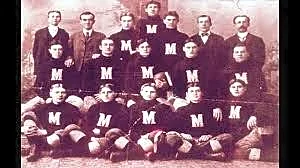
O’Brien renamed his team the “Racine Normals” to identify his Chicago team’s location of Racine Avenue at Normal Park. There were several teams in Chicago, and the new team’s name identified which part of Chicago they were from. At the time, every team wore tan colored leather pants made for football with a drawstring stitched inside the waistband. Then teams would have a colored jersey made of wool with matching stockings that ran all the way up past the knees.
In 1901, the University of Chicago bought its football squad new uniforms. Their team’s name was the “Maroons.”
O’Brien offered to purchase their old threads. Being the Maroons, obviously, the University’s colors were maroon and white. But over time and the rigors of playing a violent sport, plus the fact that the sun fades anything red or purple faster than other colors, the old uniforms had a faded burgundy hue at this point. When O’Brien saw the colors, he exclaimed that they weren’t maroon, but cardinal red.

From this point, his team was known as the “Racine Cardinals.” Cardinal red, that is. For a team to be christened a pigment such as cardinal red wasn’t anything abnormal. Just like playing for the Maroons was anything unusual.
With so many athletic clubs in a big city such as Chicago, plus surrounding areas, it was just a matter of time before a formal league would form. A very loose association called the “Chicago Football League” was formed of several local clubs, such as the Chicago Tigers and the Chicago Stayms Foresters, as well as some outside teams like Hammond (Indiana), several Illinois cities such as Rockford, Decatur, and Racine, plus Milwaukee (Wisconsin).
These were regular athletic club teams that had consistent facilities to host games. Schedules were thrown together in any manner. Teams would also cancel at any time, and it was not uncommon to play double-headers in order to save on the travel expense.
Stadiums were actually small fields with minimal bleachers and usually were difficult to keep out patrons who didn’t pay. The officials wore all white clothes and wide-brimmed hats, and were one part of the expense report. Every coach was also a player, and after each contest, the dividends were split between the two clubs on the spot after the field rental and referee fees were taken care of.
Other football leagues also formed with regional clubs, such as the “New York State League” and the “Ohio League.” Later, the “Pacific Coast League” sprouted up.

In 1920, a meeting was organized to begin a new football league that would encompass teams in New York, Pennsylvania, Illinois, and other Midwestern states. It was named the “American Professional Football Association” (APFA) with 14 charter members.
Before joining this new entity, O’Brien changed his team’s name from the Racine Cardinals to the “Chicago Cardinals” in order to represent a major city. Two years later, the APFA was renamed the “National Football League.”
The bird’s appearance
Charlie Bidwill had been a lifelong Chicago Bears fan. At one point, he loaned Bears owner George Halas $5,000 and then arranged a loan with a local bank for another $5,000 in order to keep the Bears afloat.
Bidwill later purchased the Cardinals in 1932, with the first year under the new management in 1933.
At the time, all professional sports teams had a cartoon logo. The Bears’ emblem featured a football with a bear coming over the side with a paw out, ready to defend itself. Bidwill’s Chicago Cardinals only had a double “C” as its logo. Bidwill wanted something different, something that would blend in with the other NFL clubs.

The New York Football Giants had a stadium with a huge quarterback coming out of the center, ready to throw the winning touchdown pass. The Cleveland Browns had an elfin creature using a stiff arm as he rambled down the field. The Portsmouth Spartans used a player who high-stepped a kick. When they relocated to Detroit and were renamed the Lions, their cartoon logo was a ball carrier running alongside a fierce lion.
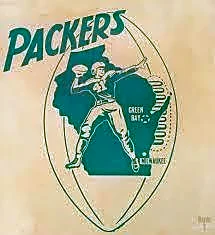
The Green Bay Packers had a goldish football with the State of Wisconsin emblazoned onto the ball with a quarterback about to heave it long and a star representing the city. The Baltimore Colts depicted a bucking stallion holding a football while jumping over the crossbar of the goal posts. The Cleveland Rams displayed a blue and white ram head. The Frankfort Yellow Jackets had the letters “FYJ” with a yellow jacket character in front. When the team moved to Philadelphia and became the Eagles, that logo was a flying eagle holding a football in its talons.
And the Canadian Football League did the same thing. A leaping tiger with the Hamilton Tiger-Cats. A football surrounded by wheat and ribbons with the Saskatchewan Roughriders. A schooner ship with waves and oars for the Toronto Argonauts. And so on.
Bidwill wanted a cartoon logo. Their emblem was a large “C” with a smaller “C” cradled inside, but no cartoon drawing. It’s difficult to draw a color. And what exactly would that representation become? Just a large, solid oval with a dark red hue?

In 1947, he commissioned a cartoon logo of a cardinal bird sitting on top of a solid white football with its claws secured into the laces of the ball.
But why a white football? One may wonder why the normally brown football would be white in this logo as an oddity, but at the time, the NFL played its night games with a white football. Plus, the contrast of the dark red feathers with a black outline and black markings made the bird noticeable without having to surround the entire fowl with a thick white outline.
The bird had arrived. Finally, the Chicago Cardinals had a logo.
What is fascinating is that the Cardinals captured the 1947 NFL Championship that same year for their second league title. Unfortunately, owner Charles Bidwill had passed away before the season.

In 1960, a new bird logo was developed, depicting the Cardinal as a football player crossing the goal line under the “H” style goal posts. When the franchise relocated to St. Louis, the goal posts were substituted for the St. Louis arch. In 1970, when the American Football League and the NFL merged into one huge league, the football player bird was canned for a new logo, which was simply a cardinal bird head with a mean gaze.
Minor tweaks to the standalone cardinal bird head were made in 1988 and also in 1994. The bird head was changed again in 2005, making the entire logo sleeker, the bird’s eyes more menacing, and now had a solid black outline. It is the logo used today.
The franchise still uses cardinal red as its primary color. They have incorporated yellow, black, and white as secondary shades into their design, which opens up a large possibility for uniforms and advertising.
And the transition from being referred to as a color to an actual animal is a plus. There is now something tangible that the team can be represented by instead of just a combination of letters or a solid splotch of paint.