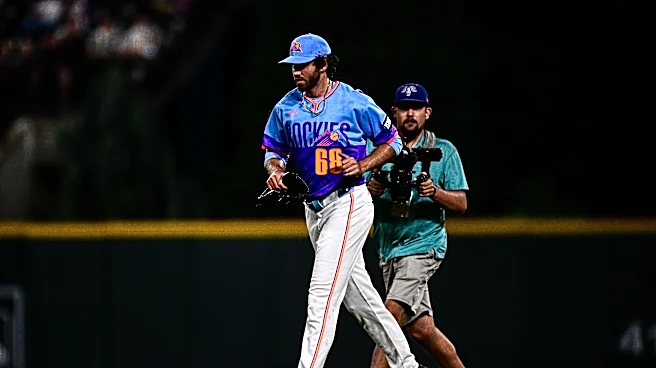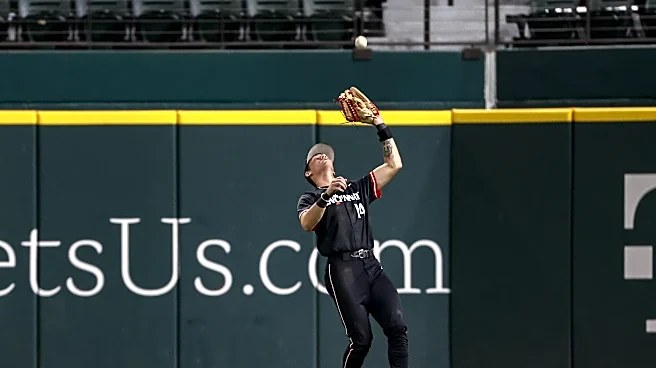




It’s time to reveal the five players who made it the closest to the mid-season 2026 top 30 Purple Row Prospects (PuRPs) list — the Honorable Mention PuRPs — as voted on by the Purple Row community recently. For each player, I’ll include a link to individual stats and contract status (via Baseball-Reference), as well as notes on their 2026 season if applicable. I’ll also include where I put each player on my ballot. All ages are as of the day the article is posted.
35. Jack O’Dowd (39.2 points, 8 ballots), 2025 Free Agent, C/1B in Double-A (25)
O’Dowd has taken a non-traditional
path to Double-A over the last few years. The lefty-hitting, righty-throwing 25-year-old (yes, he is the son of former Rockies GM Dan O’Dowd) was undrafted out of Texas as a second baseman in 2024 after struggling in college (.257/.330/.423 in four years with only 12 homers combined). O’Dowd spent the summer after his draft year playing for West Virginia in the MLB development league, where he expanded his defensive utility to include both corner infield positions and catcher while producing a .797 OPS offensively.
That was enough for Billings in the independent Pioneer League to sign O’Dowd in 2025, where something big clicked. O’Dowd was dominant offensively, hitting .333/.449/.642 with an impressive 22 homers among his 53 extra-base hits in 395 plate appearances. The Rockies, no doubt familiar with O’Dowd from years past, signed him to a minor league deal this past off-season, and O’Dowd has rewarded them with a big affiliated ball debut.
O’Dowd was assigned to Low-A Fresno to begin the year, where he was 3.9 years older than league average. It’s not too surprising then that O’Dowd raked to the tune of a .345/.385/.702 line with seven homers in 96 plate appearances (155 wRC+). Promoted to High-A Spokane in late May, where he was 2.5 years older than league average, O’Dowd continued his tear with a red-hot .359/.451/.664 batting line that included nine more homers in 153 plate appearances (177 wRC+).
A further promotion to Double-A Hartford was next in late June, where O’Dowd is only 1.3 years older than league average. So far in 121 plate appearances, O’Dowd has held his own in Hartford, hitting .245/.322/.462 with five homers (102 wRC+). Defensively, O’Dowd has split his time evenly between catcher and first base, though it’s been more first base as he moves up the ladder. As a backstop, O’Dowd has only thrown out 5 of 42 would-be base thieves while committing seven errors.
None of the national prospect watchers are ranking O’Dowd yet (and neither am I for the moment due in part to his age relative to level and questionable defensive fit). He’s playing catch-up right now given his delayed prospect launch, but O’Dowd’s performance so far in affiliated ball has been excellent. I would expect him to fit on Hartford’s roster next year, at least initially.
34. Alessander De La Cruz (45.6 points, 8 ballots), 2023 International Free Agent (GER), OF in Complex League (20)
De La Cruz is an international man of mystery for the Rockies. Signed in the 2023 international free agent class out of the Dominican Republic (though he was born in Germany), the righty outfielder earned a $650k signing bonus — second only to Robert Calaz in the Rockies’ class that year.
De La Cruz spent two years in the Dominican Summer League, the second of which was an offensive breakout that got him on prospect radars (149 wRC+). He came stateside in 2025 and was just above league average offensively in the Complex League but didn’t particularly stand out.
This year, De La Cruz repeated the Complex League at a league average age and absolutely laid waste to it, hitting .372/.495/.628 with 15 steals and six homers among his 25 extra base hits in 198 plate appearances, good for a 172 wRC+ while manning right field! De La Cruz improved his batting results across the board, bringing his strikeout % down 12 points to 21% year over year while increasing his walk % from 10 to 19%. He jumped from one to 15 steals and from 11 extra-base-hits to 25.
Despite the success this year, the shadow for De La Cruz is that he will have one more professional season before he is Rule 5 eligible and he has yet to make an appearance in full season ball. Furthermore, the Rockies placed De La Cruz on the 60 day IL shortly with an undisclosed injury before the end of the ACL schedule on July 24th. In other words, De La Cruz doesn’t have as much time to impress as some of the players he’s competing with for a shot at the Show. De La Cruz, despite the injury and timeline concerns, shows enough promise for me to rate him as a 35+ FV player, which in this up cycle for the system means he’s outside list consideration for me right now.
33. Ethan Hedges (52.5 points, 7 ballots), 2025 3rd Round (USC), 3B in High-A (22)
Colorado’s third-round pick in the 2025 draft (77th overall) out of the University of Southern California was Hedges, who was the number 29 pre-season PuRP. The 6’1” 22-year-old righty was a two-way player during his draft year has been a third baseman as a professional. Hedges signed for $950k, about $110k below the slot value for the pick. As a prospect, Hedges boasts an elite arm (as a college pitcher, you’d hope so) and some good athleticism on defense, though there isn’t another standout tool.
Hedges was a three-year starter with USC, accumulating a combined batting line of .308/.413/.488. In 2025 he hit a very strong .346/.462/.619 with 14 HR among his 30 extra-base hits and 10/10 steals in 288 plate appearances, which equates to a 147 wRC+. In addition, he appeared in 15 games as USC’s closer, throwing 15 innings and getting 9 saves with a 2.40 ERA and 1.13 WHIP.
After signing, Hedges was assigned to High-A Spokane to begin his professional career. In 20 games with Spokane down the stretch, Hedges struggled with the adjustment to pro ball, hitting .195/.303/.234 with three doubles in 89 plate appearances (just a 50 wRC+). Propping those numbers up was an 11% walk rate, which tracked with his college stats.
In 2026, Hedges is back with Spokane, where he is 0.5 years younger than league average. He his hitting better this year, though still at a below league average clip (91 wRC+) with a line of .267/.333/.427 that includes 13 homers in 423 plate appearances.
MLB Pipeline ranked Hedges 159th overall in the draft (well below where he was picked) and now places him 21st in the system as a 40 FV player with a 65 arm and 55 field grades:
While his time at instructs after the season was cut short because of a concussion, the Rockies are intrigued with what Hedges might bring to the table. He has a good feel to hit from the right side of the plate, with a line-drive approach and a knack for barreling up the baseball. It can be loud contact at times and while it’s more extra-base authority right now, the hope is the jump in the bat the Rockies saw can translate to more over-the-fence pop in the future.
Hedges moves well enough to play third base capably, though it’s the arm that fired low-90s fastballs as a reliever for the Trojans that really stand out. His instincts help all of his tools play up across the board.
FanGraphs ranked Hedges 109th in the draft class and lists him 37th in the system as a 35+ FV player with a 60 arm:
Despite big numbers at the plate, [Hedges] stands out more with the leather than the bat. On that side of the ball, he’s a plus defender with good range, supple hands, an ability to make plays when leaving his feet, and a 70 arm (he was the Trojans closer last year and touches 95 off the mound). At the plate, he’s quick to the ball with a short but not especially powerful swing. It’s tricky for even great defenders at the hot corner to profile if they’re not thumping at least a little bit. The paths forward are thus either coaxing a little more pop out of the bat or, more likely, working Hedges in at other positions in preparation for a utility role. If all else fails, you could put him back on the bump, though we’re presumably a couple years from needing to seriously revisit that possibility.
Hedges should be able to handle the hot corner defensively, but it’s his offensive projection that’s more of a question for scouts. The potential suggested by the draft pedigree and bonus was enough for me to place Hedges in the 35+ FV player tier. Hedges will likely start 2027 with Hartford where he will be at league average age.
32. Bryant Betancourt (82 points, 14 ballots), 2021 International Free Agent (VZ), C in Triple-A (22)
Betancourt represents a catching prospect with some potential just one step away from The Show. The 5’11” 22-year-old lefty-hitting, righty throwing Venezuelan catcher is a bat-first player with power and good contact ability who also has a strong arm and improving receiving skills. He signed back in 2021 for $80k and has steadily moved up the minor league ladder over six seasons. Betancourt’s first prospect attention came in 2022 when he hit 11 homers in the Dominican Summer League, ranking second in the league as part of a campaign where he had a 1.136 OPS as an 18-year-old. From 2023 to 2025, Betancourt came stateside and advanced a level each year with slightly below average offensive production each season while splitting time between catcher and first base as one of the younger players in the league each season.
In 2026, Betancourt was assigned briefly to Triple-A Albuquerque for two games to start the year, then was sent to repeat back at Double-A Hartford, where he was 1.7 years younger than league average. Serving solely as a catcher defensively, Betancourt hit .269/.337/.513 with 14 homers among his 30 extra-base-hits in 268 plate appearances, good for a 117 wRC+. In late June, Betancourt was promoted back to Albuquerque, where he is nearly five years younger than league average. Despite the offense-friendly environment in Albuquerque, Betancourt has struggled at the level in a small sample as a part-time player, hitting .197/.266/.366 with three homers in 81 plate appearances (41 wRC+). Behind the plate, Betancourt has thrown out 29% of runners this season while committing eight errors and allowing 10 passed balls.
Betancourt is ranked 23rd in the system by MLB Pipeline as a 40 FV player with a 60 arm grade:
A strong left-handed-hitting backstop, Betancourt had shown some early offensive acumen when he reached double digits in home runs in his second season in the Dominican Summer League but hadn’t really put things together consistently at the plate since then until this year. He has a solid overall approach, limiting his swing-and-miss, though he still can chase out of the zone a bit too much. His commitment to his approach, though, has allowed him to tap into that power more in 2026 — especially to his pull side — helping him set a career high in home runs.
Betancourt has always had plus arm strength, and it’s accurate, allowing him to throw out around 33 percent of potential base stealers in his career. His receiving metrics have improved every season, and he has the kind of intangibles behind the plate teams love to see. The Rockies think he could develop into an everyday big league catcher if he keeps trending in this direction.
In Brendan Gawlowski’s system overview for FanGraphs in March, Betancourt was unranked and lumped with Cole Messina into the “Upper Level Depth” section and summarized collectively as potential third or fourth catchers.
Betancourt was left unprotected and un-selected in the Rule 5 draft this past off-season and I suspect a similar fate for him this time around. Before the Rockies drafted two catchers in the top three rounds in this June’s draft, Betancourt was my favorite at what was a weak position for them, but he falls more into the 35 FV bucket than as someone I considered for my ballot. He is still a contender for a big league spot though, given the thinness of production after Hunter Goodman from that position this year.
31. Landyn Vidourek (94 points, 14 ballots), 2026 Trade (LAD), OF in Low-A (22)
To me, Vidourek is the highest upside player the Rockies acquired at the trade deadline — he was one of two players the Rockies received for Seth Halvorsen. The 22-year-old was the Dodgers’ third-round pick last year from the University of Cincinnati, receiving an under-slot $552k bonus as a player with plus raw power, plus speed, and a double-plus arm. Left out of that package of course is a reliable hit tool — Vidourek has a good idea of which pitches to swing at, but he doesn’t make enough contact. Vidourek has struggled with swing and miss as a pro, striking out in more than a third of his plate appearances so far with a passive approach.
This year, Vidourek was sent to repeat in Low-A, where he is about a year older than league average. In the Dodgers’ system, Vidourek struck out in nearly 39% of his plate appearances en route to a walk heavy .170/.332/.311 line including six homers in 256 plate appearances (74 wRC+). Between the walks and the strikeouts, about 58% of Vidourek’s plate appearances ended without a ball in play. After the trade, Vidourek stayed in Low-A and has seen similar results in 18 games, hitting .150/.338/.283 with two homers in 78 plate appearances and a 56% K+BB% (75 wRC+). Defensively, Vidourek has split his time between center and right field, throwing out three runners while committing three errors.
Vidourek ranks 34th in the system according to FanGraphs as a 35+ FV player with the aforementioned 60 grades on raw power/speed and a 70 on his arm, balanced by a 30 present hit tool:
Somewhere between James Outman and Jeren Kendall is the Dodgers’ most recent lefty-swinging outfielder with superb physical tools stacked around big-time whiffs. Broader and longer-levered than even his 6-foot-1 frame would suggest, Vidourek flashed his easy above-average raw power at the MLB Draft combine and racked up a 51% hard-hit rate in a tiny sample at Low-A Rancho Cucamonga. He also struck out a third of the time there despite below-average chase and signs of good spin recognition. Vidourek’s hands are busy in his load, and his lower and upper halves are often out of sync with each other, rarely allowing him to make mid-flight adjustments.
Vidourek’s plate approach is as polished as his barrel control is unrefined, and while he’s speedy enough to cover center for now, he’s best in the right field corner where his huge throwing arm is a true weapon. As a college hitter, even one this tooled up, he could probably be dismissed for such protracted hit tool issues in a lesser player development operation. But players who post 90th-percentile exit velocities in their pro debut merit watching for what their swing looks like in the spring, and Vidourek looks strong enough to swing hard with a quieter operation. Even a 40 hit tool could be enough to make him a regular. Outman and Kendall remind us that’s more than an idle notion.
Keith Law of the Athletic wrote this about Vidourek after last year’s draft:
Cincinnati outfielder Landyn Vidourek (3) struck out too often this spring, especially for someone in a mid-major conference, with an in-zone whiff rate well below the Division 1 median. He needs a better two-strike approach as well, as he expands too much and gets himself out, rather than trying to make more contact and let his strength come into play. He’s a plus runner with some of the best batted-ball data in the class, including a hard-hit rate of 55 percent and a dozen balls hit into play at 110 mph+ this year. It’s a reach in the third round, but this is the Dodgers’ sort of upside play.
Vidourek hasn’t been a pro for very long and has some excellent athletic clay. If the Rockies can make some adjustments to his bat control, Vidourek could be an impact big leaguer. Much easier said than done of course, which is why he ranks as an Honorable Mention instead of on the big list. Vidourek is a 40 FV player for me and was one of my final cuts from my list because so much of a big leaguer’s profile is already present. We’ll see how Vidourek performs next year, likely in High-A, after a full off-season in the Rockies’ program.
To see the players that did make the cut, check back over the next couple weeks as I unveil the mid-season 2026 PuRPs list five at a time!
Join the conversation!
Sign up for a user account and get:
- Fewer ads
- Create community posts
- Comment on articles, community posts
- Rec comments, community posts
- New, improved notifications system!
Please keep in mind our Purple Row Community Guidelines when you’re commenting. Thanks!