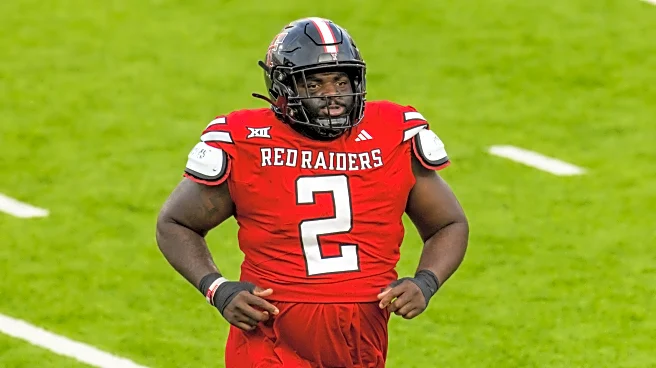

With the Las Vegas Raiders widely expected to select Indiana quarterback Fernando Mendoza with the No. 1 overall pick of the 2026 NFL draft, the speculation surrounding the Raiders’ upcoming draft class
really starts in the second round. Meanwhile, Las Vegas could use a gap-filler on the defensive line, and Texas Tech defensive tackle Lee Hunter currently ranks 48th overall on NFL Mock Draft Database’s consensus big board , as of Jan. 20.
The 6-foot-4, 320-pounder combines size and excellent strength to be a run-stuffer in the trenches. He’s coming off an impressive season where he ranked tied for ninth among all Power 4 interior defenders with an 84.5 run defense grade from Pro Football Focus. Additionally, the former Red Raider was tied for eighth with 23 defensive stops against the run, owning a 0.6-yard average depth of tackle and the fourth-best run stop rate at 11.9 percent.
Given the Raiders’ need for a run-stuffing nose tackle and Hunter’s current draft projection, this could be a perfect match in the second round with the 36th pick overall. So, let’s dive into the tape and see what he can bring to the table.
What stands out most about Hunter’s tape is his ability to win at the point of attack, especially when left one-on-one.
This is the first play of the game in the second round of the College Football Playoffs, where Oregon is trying to run up the middle with a split zone call. With Hunter lined up as a shade-nose or 1-technique, he gets a base block from the center and immediately resets the line of scrimmage. That allows him to get extension on the block and shed, finishing the rep in the backfield with a tackle for loss.
What’s really impressive about the Texas Tech product’s game is the strength and violence he has with his hands. That couldn’t be more evident than it is on this rep, as Iapani Laloulu, Oregon’s center, was basically just a speed bump on the way to the running back. Also, Laloulu was a first-team All-American and would have been a draft prospect in this year’s draft class had he not decided to go back to school. In other words, this rep is against good competition, too.
We’ll get another rep between Hunter and Laloulu, as this was a long afternoon for the Duck.
Oregon goes with an outside zone run this time, and Hunter is head up on the center as a 0-technique. Post snap, he does let Laloulu get outside positioning on him with the reach block, which could create a cutback lane in the A-gap. However, the defensive tackle’s strength at the point of attack allows him to recover by locking out the center to reset the line of scrimmage and play in the offense’s backfield.
From there, Hunter gets his feet going and moves laterally enough to flow with the play and avoid getting reached. His strength and ability to control the block come into play again, helping him finish the rep by shedding Laloulu and making the tackle. Nose tackles aren’t going to make many stops against outside zone runs, especially when going from the hash marks to the middle of the field, but the big man finds a way here.
Hunter can afford to be more consistent against double teams and combo blocks, as he can get into some problems staying in the gap when his pad level starts to rise. However, when he plays with good leverage, the former Red Raider’s size and strength allow him to be effective even when taking on two offensive linemen.
Here, Hunter is lined up as a 0-technique again, as Utah tries to run power. He attacks the center with solid pad level, getting his helmet under the center’s, before the guard combo blocks him en route to picking up a linebacker. That knocks Hunter into the other A-gap initially, but because he attacks and beats the man he’s lined up across from, the defensive tackle can recover and then escape the center’s block to make a tackle near the line of scrimmage.
This is a good example of not only being a boulder in the running game, but also the ability to disengage from blocks and make plays for short gains.
We’ll get another look at a combo block, but Hunter uses a different technique to defeat it this time.
Oregon runs duo where the center and left guard are responsible for double-teaming the nose tackle. However, Hunter uses a swim move to beat the center, Laloulu, and split the double team. While his pad level isn’t good this time, he manages to survive contact from the guard and stay in his gap. The defensive tackle has done his job at that point, but he gets extra credit on this play by using a hump move to defeat the guard’s block and make another tackle right at the line of scrimmage.
For more context, the guard is Emmanuel Pregnon, another option that the Raiders should be looking into on Day 2 of April’s draft.
Speaking of that swim move, the potential second-round pick uses it frequently as a change of pace to defeat blocks. Combined with his impressive strength at the point of attack, that helps keep offensive linemen on their toes throughout a game.
He’s lined up as a 3-technique and on the backside of Arizona State’s play call. The Sun Devils’ left guard is trying to keep Hunter from crossing his face, but is in a bad position with his nose over his toes at the point of contact. As a result, Hunter catches the guard leaning and gets a clean win by defeating the block with a swim move. Then, he works flat down the line of scrimmage to get another tackle for a short gain.
Finally, Hunter doesn’t use quickness and agility to make offensive linemen miss often, but this could be another tool in his tool bag as a change of pace at the next level.
We’ll see a similar rep as the last one in the clip above, only Oregon runs inside zone to the weakside of the formation and Hunter is head up on the guard or in a 2-technique. Also, Texas Tech is slanting the defensive line to the strongside, making him responsible for the backside B-gap.
Technically, the defensive tackle is outside of his responsibility since he ends up in the C-gap after working laterally on the slant. However, he manages to close the B-gap with his man by making the left tackle whiff. That puts Hunter on the tight end’s inside shoulder, who has no chance to make that block with the size mismatch and by the defense catching him off-guard. So, Hunter defeats that block easily and works flat down the line of scrimmage to get another tackle for a short gain.
While the Texas Tech product doesn’t offer much as a pass-rusher, the Raiders’ run defense could certainly use the boost he can provide. In drafting Hunter, Las Vegas’ defensive line would get the gap-filler it was missing this past season.