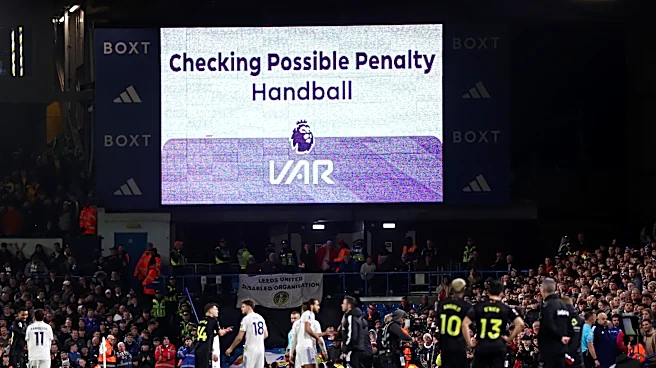








For many, the World Cup will be an afterthought as we gear up towards an exciting new season of club football. Sunderland fans in particular have a lot to look forward to, with the lads having the additional pleasure of playing European football come September. However, the World Cup raised some interesting questions (for me at least) about the use of football’s Video Assistant Referee and led me to wonder: what can we expect from VAR and the officials using it this season?
Perhaps the first and glaring
issue that needs looking at is the previous patterns of usage we’ve seen from VAR. Many perceive VAR as ‘ruining the game’ for the reason that almost every play seems to be under scrutiny. Some fans and players have even spoken of their refusal to celebrate goals due to the fear that it will be overturned. However, the trend does show that this is technically not the case.
Data from the last three seasons of Premier League football shows that VAR usage is actually on a downward trend. In the last three years, VAR usage has decreased each time, with last season seeing a record low for the amount of times the tool was used in any of the seven years since its introduction. Of all the European leagues to use VAR, the Premier League actually had the lowest intervention rate, with around 0.28 interventions per game of the competition.

Furthermore, the average delay incurred by the usage of VAR in Premier League matches last term fell from 65 seconds to around 40 seconds instead. So, the raw data seems to suggest that VAR, in the Premier League at least, is actually becoming more streamlined and being used either more reservedly or more efficiently. The Premier League’s doctrine of using VAR can be described as ‘use only when necessary’ or, in other words, the much-discussed ‘clear and obvious mistake’ situation.
Yet the World Cup broke this trend of fewer VAR interventions. Now, before I go into details, I will gladly concede that there are differences. Obviously, the World Cup is not nearly as regular a competition as the Premier League and it is altogether a different type of competition, so these factors need to be considered. The lack of regularity of World Cups arguably makes the mistakes made in them more highlighted, which perhaps unfairly skews our opinion on its officiating standards. It is therefore somewhat fair to say that we shouldn’t expect the exact same situations or the same treatment in the Premier League.
However, the matter of doctrine and how VAR is used is concerning. There was an average intervention rate of around 0.5 interventions per game in the World Cup. In addition to this, from the Round of 16 onwards, the average rate of decisions overturned after a VAR consultation also stood at 0.5 per match.
This suggests that VAR was being used more aggressively. Instead of being used to correct the clear and obvious, the increased usage of VAR seems to almost suggest that the system was being used to eliminate wrong decisions altogether.
This raises a difficult and concerning question. Should we complain about trying to eliminate refereeing mistakes from the game? Or is it important that we accept that some mistakes will always occur in refereeing football and that it is instead more pressing that we use VAR sparingly to eliminate the occasional mistake that has been missed in real time, such as an actually dangerous tackle, or foul play leading up to or preventing a goal?

To some extent, there is no reason why we cannot have a little bit of both. The World Cup boasted some impressive kit, such as the most advanced system of semi-automated offside tracking seen yet. This is a positive step forward as it speeds up the rate at which decisions are made as well as improving accuracy.
However, overall, I believe that the World Cup set the wrong example at times because a more sparing use of VAR is arguably better for the game. Let me explain why.
Despite the record-low usage of VAR in the Premier League last season, there were still adjudged to be 18 errors made by the review system last term. The majority of these errors were from situations where VAR failed to intervene in situations where the referee was retrospectively judged to have made a clear and obvious mistake. This number is down from 31 mistakes the season before and another 34 the season before that, but it does beg the question: if VAR is failing in its job to spot the clear and obvious, what is the point of it?
Furthermore, whilst there is no reason to wet the bed worrying that the Premier League will make their referees and video assistant referees be as litigious as FIFA made theirs at the World Cup, it is still more than pertinent to ask whether we can improve the system overall.
A good example of an effective video referral system is arguably that of rugby. Football’s cousin has laid out clear parameters about how the Television Match Official (TMO) should get involved in the game. Rugby referees are often the ones to refer an issue to the TMO and do so on their own terms. How they ask the TMO is both clearly defined and important to the final outcome of their decision. For example, asking the TMO, “Is there any reason for me not to award this try?” suggests that the referee has already made a soft decision on the outcome and now wants to ensure he has all the evidence to back it up. The referee takes a level of authority in the decision and is not asking the TMO to overturn his decision but is instead ensuring that he hasn’t made a major mistake anywhere.
Football could learn a lot from this style of refereeing, in my opinion. It is important that the referee feels as comfortable referring situations to VAR as they do referring situations to him or her. This is because it both implies confidence on the referee’s behalf – they feel firm and confident in their decision and simply want to make sure – and it also means that VAR is not always in the ear of the referee but instead there when needed, thus meaning that VAR isn’t simply just controlling every one of the ref’s decisions from afar.
The larger issue at play here is not that VAR is inherently bad but that referees and VAR need to be more consistent together. The average quality of refereeing arguably needs to improve, with a greater degree of consistency from game to game. Furthermore, both VAR and the referees must understand the system’s place in the game. It is not a replacement for the referee but instead a tool at their disposal; its usage therefore needs to reflect that. Referees must be as confident without VAR as they are with it and cannot use it as a crutch, nor should VAR be involved in every decision in the field of play.
Ultimately, the World Cup offered some exciting progress in the world of refereeing, with the semi-automated offsides system being a welcome upgrade. However, we mustn’t forget that football is a highly paced game that feeds off speed, skill and occasionally luck. The odd refereeing mistake is part of this luck. If we can eliminate major mistakes without policing every minute detail of the game, we will have created a useful system that actually improves the game instead of ruining it or grinding it down to a state of frustrating inertia.