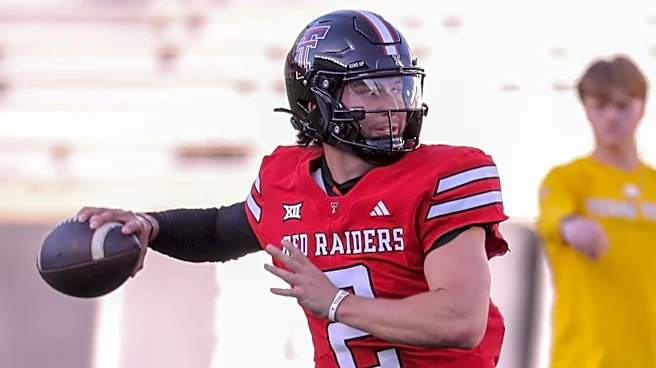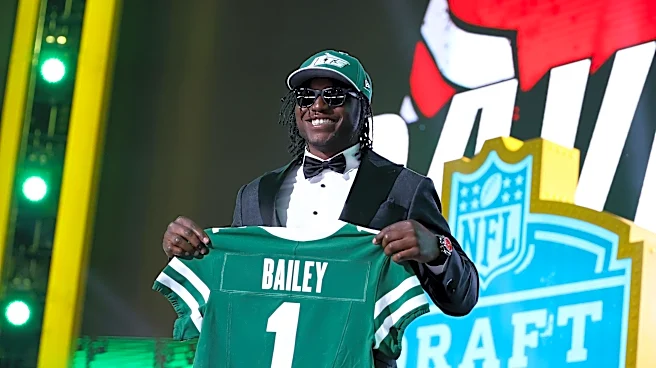



Over the next few months, we’ll be breaking down all of the rookies added by the Jets during the draft and as undrafted free agents. We continue today with edge defender David Bailey.
The 22-year old Bailey is listed at 6’3” and 251 pounds and was the second overall pick out of Texas Tech. He was a unanimous all-American last season, as he was tied for the most sacks in the nation with 14.5.
Background
Bailey was a four-star high school recruit who racked up 15.5 sacks in his senior year and enrolled
at Stanford.
In his freshman year, Bailey started nine times and ended the season with 46 tackles, 8.5 tackles for loss, 2.5 sacks and two forced fumbles in 11 games.
2023 saw him start five times but his production was solid. He had 34 tackles and five sacks in 10 games.
In 2024, Bailey remained in a part time role, making just two starts. He had 31 tackles and seven sacks but also forced five fumbles.
Having graduated, he transferred from Stanford to Texas Tech and broke out in a full-time defensive end role. He started 13 of 14 games and had 52 tackles, 19.5 tackles for loss, 14.5 sacks, three forced fumbles and three pass breakups.
The 14.5 sacks was tied for the most in the nation and he was named as a unanimous all-American and the Big XII defensive lineman of the year.
After he was invited to the combine and senior bowl (although he didn’t participate in the latter), the Jets opted to select Bailey with the second overall pick in April’s 2026 draft.
Let’s move onto some more in-depth analysis of what Bailey brings to the table, based on in-depth research and film study.
Measurables/Athleticism
Bailey showcased his athletic ability at the scouting combine when he was clocked at 4.50 in the 40-yard dash and posted an outstanding broad jump of 129 inches. His vertical was 35 inches.
He did not do any agility drills or the bench press, and there is some concern about his play strength, particularly when setting the edge.
Bailey possesses above average length and big hands, but overall is a little on the small side.
Usage
Bailey’s role at Stanford was a rotational outside linebacker role, which saw him employed situationally. It was rare for him to play off the ball or drop into coverage, although he did step off the line to match up with a slot receiver at the snap from time to time.
After the transfer to Texas Tech, Bailey became a full-time defensive end. At times, he was aligned over a tackle or even inside.
Motor
Bailey is a relentlessly violent pass rusher who keeps on coming and here’s one of the best examples of that you could hope to see.

He played 50 snaps six times in 2025, including 73 in one game, so a starter’s workload shouldn’t be beyond him.
At times during his Stanford years, Bailey didn’t always play to the whistle, which was presumably more of an effort issue than a lack of conditioning. There were a few plays here and there where he was wandering around while a play was still going on and might have influenced the outcome if he had bothered to chase down what he clearly saw as a probable lost cause.
This should definitely be characterized as inconsistent effort rather than consistently bad effort, though, because he also made some maniacal hustle plays. It also wasn’t something that was apparent in his Texas Tech film, at which stage he was clearly trying to set a good example and maximise his own output.
Pass rush
Bailey obviously had outstanding production as a pass rusher with Texas Tech but actually, his per-snap production at Stanford was similar. You would typically expect diminishing returns from doubling someone’s workload, but Bailey was impressively able to maintain his levels.
As a pass rusher, Bailey relies heavily on an outstanding get-off and typically wins by beating his blocker to a spot or going through him with momentum.

There are mixed reviews about his explosiveness and fluidity in terms of his ability to bend the edge, especially after this aspect of his game came under added scrutiny when footage of a less-than-perfect combine drill was released. However, you won’t find many better examples of bending the edge on film than this:

He perhaps needs to learn to show more in terms of transitioning smoothly to counter-moves, because he often didn’t really need to do that since his original plan was often successful.
Run defense
Bailey’s run defense is a concern for many, although Jets head coach Aaron Glenn has been quick to point out he doesn’t really share those concerns and he did grade out well last year, according to analytical site Pro Football Focus.
Still, there are situations where he struggles to hold up at the point of attack and shows poor discipline on the edge. Again, though, he’s inconsistent with this rather than being a constant liability. He can penetrate or stand up his man at times, especially when he comes off the line with the same kind of explosiveness as he does when pass rushing.
As you’d expect, Bailey is at his most effective in situations where he is not blocked (for example staying at home on the edge to contain a cutback or pursuing downhill when a run goes away from him). This also means he relies a lot on creating situations when he can elude blocks rather than taking them on, which could more more of an issue when he’s playing as a conventional lineman when realistically you need to be able to do both.

So, while he might be effective at slashing through the line to shoot a gap, he needs to work on his ability to stack and shed, otherwise teams will just start to use his momentum against him to ride him out of running lanes. Even so, he has shown he can get off blocks. He just might take the long way round or give up ground in doing so.
Watching his run defense performance, the bigger concern might not be an inability to hold up at the point of attack. Instead, it’s arguably more concerning that he doesn’t play with discipline and can lose contain as a result.

As mentioned above, the fact his default is to try and shoot gaps and avoid blockers is an issue here because he can find himself getting sealed off or caught in traffic rather than taking on a block and being able to do a better job of seeing the play develop.
Technique
Bailey shows some slick pass rushing moves, including an effective cross chop, a dip-and-rip and an inside spin counter.

In addition to his impressive get-off, Bailey can display some solid punch power, which can be an asset in the trenches as well as when rushing the passer.

If he allows a lineman to get their hands inside on him, Bailey can be locked up and struggle to separate. He therefore need to work at his hand usage and the accuracy of his strikes, but defensive line coach Karl Dunbar should be able to tighten that up.
There’s often an interesting game of cat and mouse going on between Bailey and his blocker. If Bailey pre-determines that he’s going to swat away the lineman’s initial punch, as he seems to do regularly, then the lineman can delay his punch and get Bailey off-balance. However, Bailey will often just accelerate past the lineman and rip through, or counter inside when this happens. Again, Dunbar may be able to help him to maximize his chances of winning these battles and truly unlock his potential to be completely unstoppable.
Special teams
Bailey did play some special teams in college. In addition to rushing kicks and punts, he served as a blocker in punt protection in 2022 and covered kicks in 2024. In all, he had three special teams tackles and one penalty in his career.

Tackling
Bailey wasn’t a particularly productive tackler in college, but he shows good closing speed and finishing ability. In pursuit, Bailey has impressive range and shows terrific hustle.

His missed tackle numbers are not particularly high. Seven is the most he ever had in a season and his missed tackle percentage dropped in 2025. The majority of the missed tackles he did have in his career were on failed attempts to bring down the quarterback rather than on running plays.

Forced fumbles, primarily on strip sacks, are a big part of Bailey’s game. He had 10 in four seasons during his college career, including eight in the past two years.
Coverage
Bailey’s experience in a linebacker role gives him some coverage experience and although he didn’t really achieve much within that role to make him dropping into coverage be anything other than a changeup he doesn’t look too bad in such situations.

When he was covering at Stanford, this almost exclusively entailed dropping off and then limiting the damage on any short passes thrown in his direction. Nevertheless, it probably helped him overall that he rarely needed to do it last season.
Bailey had four passes defensed in his college career, all on passes deflected at the line of scrimmage or plays where he stepped into a passing lane to bat a pass down.
Instincts/Intelligence
Bailey’s head coach at Texas Tech, Joey McGuire, praised his football IQ and how well he was able to adapt to their system and his new role, although he has mixed results in terms of anticipating things like screens and not being fooled by misdirection.
It was not uncommon to see Bailey do things like running straight past a ball carrier on a draw play or pursuing a player who doesn’t have the ball because he doesn’t realize the quarterback kept it after a playfake. His instincts in space can be questionable at times, too.

As noted, gap and role discipline can be a concern and something Glenn will need to coach into him. There were times where Bailey tried to make a play himself and left the defense hung out to dry rather than staying at home.
He jumped offside four times in 2025 and has been known to bite on a hard count.
Attitude/Demeanor
Bailey got a degree from Stanford before transferring and earned all-ACC academic honors in 2024 before enrolling in post-graduation courses at Texas Tech, so he is clearly intelligent and has a good work ethic, which showed on the field last season.
Also, as an older player on that team, some of the younger defensive players looked to him for guidance.
There are a few concerns about Bailey’s character but the Jets seem unbothered by these. It’s apparent he has a bit of a temper, which saw him involved in a postgame altercation with a cameraman on the field and stomping on an opponent’s head in two-well publicized incidents.
His on-field discipline isn’t otherwise a major concern, as he averaged just four defensive penalties per year. However, he had a career-high of seven last year, three of which were personal fouls.
The controversy about his pre-draft visit doesn’t seem to be something that concerned the Jets, who apparently had already decided he was their guy and weren’t bothered by the fact the arrangements for his top-30 visit didn’t work out as originally planned.
There are some who have been questioning whether Bailey has the passion for the game required to make it as a successful pro over the longer-term, but the Jets have no doubt convinced themselves they can motivate him to work hard – as he has done since being drafted – and keep him on that path.
Injuries
Injuries haven’t seriously affected Bailey at all during his career so far. An arm injury suffered in last year’s season finale didn’t cause him to miss any time and he showed toughness by playing in spite of a wrist injury back in high school.
Scheme Fit
The Jets will operate out of various fronts this year, which will mean that Bailey will get reps standing up and with his hand(s) in the dirt, but he has experience of both, which should serve him well.
Some have noted that Bailey doesn’t complement Will McDonald very well in the base defense because they are both perceived to be weak against the run, although McDonald has improved in that area since being drafted and there were no signs that the Jets were reducing his exposure to playing the run last season.
In passing sets, Bailey and McDonald should complement one another really well coming off opposite edges. As McDonald is more of a speed rusher around the edge and Bailey can be more of a speed-to-power option, this will give the Jets chances to match up and exploit their opponent’s weaknesses at the tackle positions. If one can flush the quarterback from the pocket, the other should often be there to clean up.
Bailey hasn’t been a teammate of any current Jets, but there are a few coaches on the staff who were at Stanford when he was, albeit that they were all on the offensive side of the ball. Officially, his time there overlapped with Frank Reich’s time as their head coach, but by less than a week, as Bailey was already in the transfer portal when Reich took over.
Conclusions
As soon as the Jets traded Jermaine Johnson, it seemed inevitable that they would draft the best edge defender available with the second overall pick and clearly the Jets determined that Bailey is that guy.
His get off and explosive upfield rush is an elite trait which the rest of his game can be built around and his production last year is cause for optimism that he can immediately start producing at the NFL level.
The run defense might be a work in progress for a while, but the Jets have accumulated plenty of depth in case they need to restrict his role early on to optimize him. He should be motivated to improve that aspect of his game so that his overall playing time and production can increase.
In his film, there seem to be more observed flaws than you might expect to see from someone drafted so high, perhaps lending weight to the suggestion that this draft wasn’t as rich in top-end defensive talent as some recent years. Most of these flaws were from his Stanford film, though, so his 2025 success suggests he either worked on these, or that they were mitigated to a degree by his role change.
Clearly Bailey has elite potential and steps into a position with the Jets where he hopefully has good coaching and the players around him to be able to have a good chance of success. Whether he lives up to the hype is up to him.