
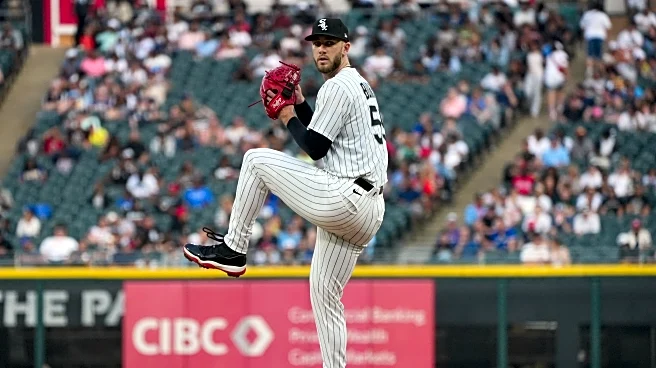
A couple of weeks ago, I introduced a new mini-series in which I examined a few players on the edge of the roster. These are guys who could fundamentally change the trajectory of this franchise if, improbably, they reach their full ceilings and become reliable, productive contributors to a good team. First, I profiled Brooks Baldwin and what his quiet surge in the second half of last year might mean. Next up is Jonathan Cannon, who remains on the outside looking in for a rotation spot after failing
to solidify his future there last summer.
It’s as simple as this: Cannon’s pitch mix was and remains fascinating. It moves all over the place, and when things are going right, it’s the kind of stuff that makes you wonder how a hitter ever finds a barrel.
Through his first few outings in Arizona, he’s still tinkering with that mix. It appears he’s added yet another type of breaking ball to his arsenal, testing a new slider that could slot in neatly as a bridge between his cutter and his sweeper.
Just as a reminder, here’s what Cannon can already do on the occasion where he has everything going for him. His very first MLB win was a near-complete game gem against a Houston Astros team.
Cannon has a major problem, though, one that FanGraphs prospect writer Eric Longenhagen identified back before the 2024 season and remains true to this day: platoon splits. His sinker-sweeper combination can be hell for righties when he’s locating them, but his command isn’t good enough to prevent him from leaving the sinker up in the zone to lefties, where it’s gotten absolutely pummeled. With a relatively low arm slot and long-armed delivery, lefties are simply going to see fastballs better, and Cannon’s cutter hasn’t been significantly more effective, even though he favors them over the sinker to southpaws. Strangely, his most effective fastball, the four-seamer, is the one he’s used the least. This chart of his arm angle and pitch movement from 2025 clarifies things a little.

When it comes to fastball movement, if the pitch is fully in line with the pitcher’s arm angle, as Cannon’s almost is, it’s a lot easier for the hitter to track because the ball follows the path that the eye is expecting based on the arm angle and release point. A good sinker is going to drop substantially below the pitcher’s arm slot, and a solid four-seamer is going to have rise that’s significantly up and to the left of the arm. With that in mind, the difference in effectiveness between his sinker and less-used four-seamer makes more sense. We’ll see if this new slider, and perhaps an uptick in four-seam usage, can give him more of a chance against opposite-handed hitters. His sweeper is already deadly to right-handed hitters, and the changeup he’s introduced since his prospect days has solid potential as a change-of-pace pitch to mess with hitters’ timing.

With Erick Fedde signed to a major league deal and officially now slotted into the final rotation spot, Cannon appeared bound for Charlotte. Now, though, with Mike Vasil sadly out of the picture until mid-2027 with Tommy John surgery, there’s a long relief spot in the bullpen for which Cannon makes a fascinating fit. I hadn’t considered it before, but this could be where Cannon cements himself as a roster mainstay — even if the odds once seemed slim.
However, there are arguments against it. For one, and this is pretty wild, Cannon also has a weird split where hitters have done more damage the first time through the order than the second time through. An .877 OPS his first time through the lineup, an even .800 the second in a roughly equal number of plate appearances for his two-year career. It gives me pause as to whether he’s truly suited for multi-inning, one-time-through-the-order relief.
That being said, a deeper look at the splits says that it’s almost all luck. There’s virtually no substantial change in how batters have hit the ball, but an unlucky 65% strand rate the first time through and an unsustainably high 81% strand rate the second time suggest it might not hold up long term. There’s also the fact that pitchers usually change up their pitch mix the second time they see a hitter, and it may be that the pitch mix Cannon uses then is actually more effective than what we’d consider his primary arsenal.
I’ve discovered a hole in Baseball Savant and FanGraphs in which it’s impossible to see changes in pitch usage based on time through the order, so I can’t say for sure. If it’s the case, relating to a point you’ll see in a few moments, a move to a long relief role could let him figure out exactly which of his multiple approaches really works the best.
Finally, there’s the argument that if the potential to be elite is there, it’s better to have him slightly less stretched out in the big leagues than being a normal starter in the minors. Charlotte’s rotation is absolutely loaded between Noah Schultz, Tanner McDougal, and a revived Hagen Smith. While the big league rotation of Shane Smith, Davis Martin, and Sean Burke all finished between 135 and 146 innings pitched last year and will look to jump into the 160+ range this year. But it’s unlikely that they all get there. If all three of Schultz, McDougal, and Smith get it rolling in Charlotte at the same time, the future of the Sox rotation will be as bright as a star. But it probably won’t happen, and if they can get Cannon rolling as a long reliever in the majors, he’ll be extremely valuable as a seventh or eighth starter, so to speak, given that it’s hard to see more than three of those top six pitchers breaking the 150-inning threshold.

Only working through the order once has benefits beyond the standard general penalty, as a hitter sees a pitcher for the second time. There’s the classic velocity bump from working with shorter spurts. The four-seamer has potential, and a jump from the 94 mph range to the 96 mph range would make his already-intriguing four-seamer a lot more interesting. There’s also a lesser-considered side effect to this kind of change. Part of the game-within-the-game of being a starting pitcher is that it’s an extended battle with the opposing lineup. The way a starter pitches to a hitter always accounts for the fact that, in all likelihood, the hitter has either seen the pitcher’s arsenal already or is going to see it again in a couple of innings, or with the resolute knowledge that they aren’t going to see it again.
None of this is the case for a relief pitcher, and the result is that being asked to work in shorter stints allows a pitcher to hone in on what they do best. As a reliever, there’s no reason not to show your best stuff at all times, and so it presents an opportunity for a pitcher to find out what they’re really good at, if such a thing exists.
It’s not perfect, but I like Clay Holmes as an example of what a fully optimized Cannon might look like. When he came up to the majors with the Pirates, Holmes averaged about 94 mph on a sinker-heavy fastball mix and a broad arsenal that bears a pretty solid resemblance to Cannon’s. A move to the bullpen spiked Holmes’s velocity to 96-97 mph, and he went from throwing five pitches to locking in on the three that performed best. After several years dominating as a reliever, Holmes brought back the five-pitch mix for a move back to the rotation, and this time, he knew what to do with it, running a 3.53 ERA in 165 very solid innings for the New York Mets.

This isn’t to say that Cannon is going to turn into an elite closer, but it’s an example of how a move to the bullpen might unlock his full potential. If Cannon finds a way to do that before injuries and ineffectiveness chip away at the Opening Day starting five, he might be able to bring a newfound approach with him back to a starting role somewhere down the line.
Mike Vasil will be out for a while now. Still, the harsh reality is that while he’s probably a solid MLB reliever, pretty much everything under the hood indicates he won’t be able to replicate the 100 innings of 2.50 ERA that he gave the Sox in 2025. It’s a shame because that’s the kind of contribution that can help push a competitive team from good to great, and it would likely have been far more valuable in 2028 than in 2025.
In short, Vasil 2026–28 likely wouldn’t match 2025, but an optimized Cannon could — and with enough starting experience, the team wouldn’t have to wait until 2027 to stretch him out. All in all, if Cannon is going to shave down his arsenal and lock in on finding out what he does best, I don’t think it’s going to happen as a No. 4 starter in the International League Triple-A East. I’ll take the upside I just described over the seemingly small chance he emerges as a true building block starting pitcher while having to deal with Charlotte’s offensive bandbox of a stadium.

A couple of weeks ago, I talked a little about the implications that would be if Baldwin turned out to be an everyday-caliber player, or better. Given how much the pitching has lagged behind the starting lineup in getting high-impact prospects to the majors, the emergence of Cannon as a candidate for 100-ish effective innings as a multi-inning reliever and depth starter raises the floor of the staff by a full order of magnitude. Again, I love the thought of all three of Schultz, Smith, and McDougal forcing their way to the big league rotation with Triple-A dominance, but it’s not something you can expect or plan on. If things go according to plan, 2026 will be the last season in which wins and losses won’t really matter all that much, and the opportunity to take chances and risks with developing players won’t conflict with the necessity of engaging in a playoff chase.
Personally, I’m thrilled by the idea of not having to worry about rotation and long relief depth in the long term, because it opens the door to chasing a true ace next offseason. Stop spending money on back-end starters coming back from stints in other leagues and give Freddy Peralta or Shane Bieber or a resurgent Zac Gallen or an opted-out Tatsuya Imai what they’re worth to top the rotation alongside whichever of the Charlotte rotation prodigies shines the brightest. Or push it back a year and set your sights on Logan Gilbert, Joe Ryan, Pablo López, or Mackenzie Gore.
May we live in a world in which we get to find out!