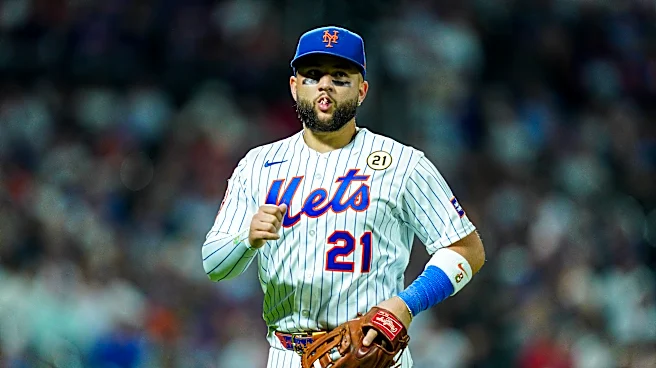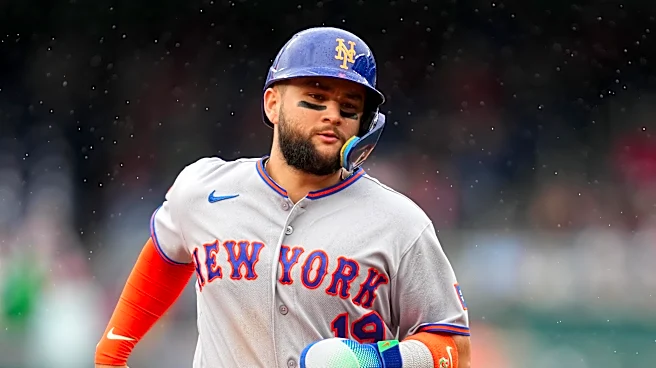


In the aftermath of the trade that sent longtime franchise stalwart Brandon Nimmo to the Texas Rangers in exchange for Marcus Semien, David Stearns publicly expressed optimism for how the three-time All Star could contribute in 2026. While acknowledging the down year that the veteran second baseman had in 2025, Stearns argued for the possibility of an offensive rebound while also noting the contributions the organization expected him to provide in the field and on the bases.
Perhaps he wasn’t entirely
lying, but he probably wasn’t being 100% truthful, either. Indeed, if you injected Stearns with truth serum, he’d probably acknowledge that the trade had much more to do with offloading Nimmo onto another team (thus securing both an open corner outfield spot and long-term salary relief), and accepting Semien in return was merely the price he had to pay for that to happen. I’m sure the team would not have been at all surprised if they looked into the future and saw that the offensive downturn that started over the previous couple years would continue—but they also probably hoped that A) he would continue to provide Gold Glove caliber defense (or at the very least well above-average, even if that aspect of his game declined as well), and B) the rest of the team would be strong enough to overcome one below-average bat in the lineup. And if all else failed, the other factor in justifying the trade may well have been that it would be easier to cut ties with Semien sometime before his contract expires at the end of the 2028 season than it would have been with a homegrown veteran like Nimmo (whose two extra years would also have provided a barrier for moving on).
We’ll get to the long-term considerations a little later. But looking solely at 2026 contributions, it’s hard to imagine how Semien’s performance could have been much worse, and he ended up becoming one of the most prominent faces for the team’s dramatic underperformance.
From the very beginning of the season, Semien looked every bit his 35 years of age—a player with declining bat speed and exit velocities whose degrading skills simply are not coming back. The 74 wRC+ that he put up for the whole year was the worst of any of his season of his major league career, and a further decline from the previous year when he was still a below average offensive player, but at least only marginally so (90 wRC+ in 2025). One of the things that stood out about Semien’s poor performance was how consistent it was—as in, he was pretty much bad all year without any notable hot stretches to speak of. Looking at his monthly splits, his best month with the bat came in August when he put up a measly 88 wRC+, meaning he was well below-average all the way from April to September. Even in his poor 2025 season, he at least had stretches where he resembled the player he once was. But no such glimpses could be seen in 2026.
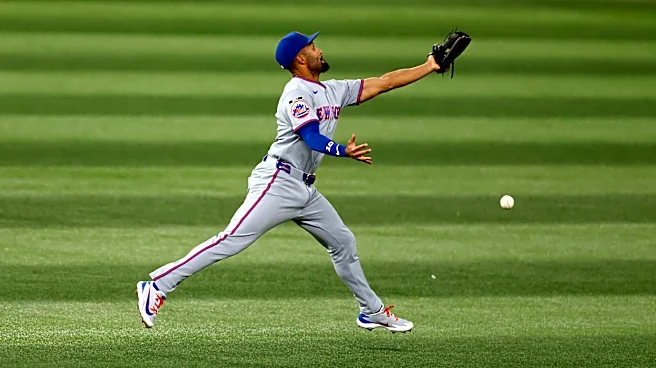
And that included his once sterling defense as well. Semien won his second career Gold Glove in 2025, despite the advanced stats saying his defensive downturn had already begun. Well, that downturn turned into an outright cratering in 2026. The advanced defensive stats paint an ugly picture for how precipitous his decline was, and it seems the primary reason for that was a significant loss in range:
 Baseball Savant" />
That certainly matches by what the eye test told us, as there were plenty of ground balls that the Semien of a couple years ago probably reaches without much difficulty which instead trickled past him. And this is probably the one thing that did actually catch the Mets off-guard internally in their internal evaluation of the player they traded for. A continued gradual defensive decline was always inevitable, and that still left open the possibility that he could be at least a neutral player if he continued to be just slightly below average with the bat. But taking such a significant step backwards with the glove along with his continued offensive decline meant that it was pretty much impossible for Semien to provide any kind of value to the team. But hey, look on the bright side: his -0.5 fWAR wasn’t even enough to make him the least valuable position player on the team, as Mark Vientos and Jorge Polanco both somehow beat him in that department. Your 2026 New York Mets, ladies and gentlemen.
What did perhaps make the Marcus Semien experience more frustrating than that of guys like Vientos and Polanco was that—as is often the case with players of his ilk—his veteran status meant that he continued to be in the lineup pretty much every single day, even after it became very clear that his performance did not warrant it. Even with a three-week IL stint thrown into the mix, he still ended up with 547 total plate appearances on the season—the third highest amongst Mets players. Granted, maybe the team would not have been inclined to continue giving him that much playing time down the stretch if they were still in the hunt for a playoff spot. Still, while one bad player can’t be assigned all the blame for a team’s underperformance, Semien was at least one of the prime reasons for why the Mets weren’t in the postseason race late in the season to begin with.
If there’s one silver lining to look at in this trade, it’s this: its effect of opening up a spot in the outfield did in fact prove to be valuable. Over in Texas, Nimmo didn’t have a terrible year, per se, but it certainly wasn’t a great one, as he ended up being just a slightly above-average player while continuing to decline with the glove. He certainly did not look like a player you would want to have signed for four more years. And back in Queens, the Mets saw their outfield buoyed by the youthful additions of Carson Benge and A.J. Ewing, and even having the ability to move Juan Soto to left field helped to improve the overall team defense. So despite Semien’s dramatic underperformance, there did prove to be some short-term benefits from making the trade, in addition to the potential long-term ones.
And now we return to the other underlying argument in favor of the trade: the unspoken notion that the Mets would be able to either release him or relegate him to the bench prior to the end of his contract if his performance warranted such a move. It is certainly worth noting that Stearns declined to commit to Semien being the starting second baseman on the 2027 team. And it’s not difficult to understand why. It’s hard to imagine that the Mets couldn’t upgrade at the position fairly easily—whether that be by exploring the free agent or trade market or giving runway for one of the team’s young infield prospects (such as Jefferson Rojas or Émilien Pitre) to win the job early in the season, much like they did for Benge.
The only question then would be what the team would subsequently do with Semien. Would they indeed demote him to a bench role? Would a veteran player who has expressed a strong desire to play every day be willing to spend the next two years in that role? The Mets could also see if they can find a trade partner for him, though such a move would almost certainly require them to pay the majority of the money on his remaining contract. If they are not able to do that, would they be willing to simply cut him and eat the entirety of the $46 million still owed to him? Steve Cohen has done it before with Robinson Canó; would he be willing to do it again?
If none of these potential outcomes play out and Semien ends up getting the lion’s share of the starts at second base next year, then the argument for trading Nimmo away will suddenly become a little bit less favorable. But if they do end up being able to either get him off the roster or relegate him to a more minor role, it is likely that, in spite of everything, the Mets would still do the trade all over again, even knowing how poorly Semien would play. The reasons for it remain sound enough. Nevertheless, the long-term benefits still won’t quite remove the bad taste in the average Mets fan’s mouth for having to endure watching such a disappointing performance on such a disappointing team in 2026. Semien will be remembered for having an excellent career when he eventually hangs up his cleats, but whether his time with the Mets ends now or in another year or two, it seems inevitable that his New York tenure will not be looked upon fondly.