




Imagine a world where we all had collective amnesia, specifically about the NBA Draft.
Weird world, right? How did that happen? It doesn’t matter. Life is the same as before, only nobody knows where any NBA player got drafted. Please note that this is not a pitch for a Sci-Fi movie.
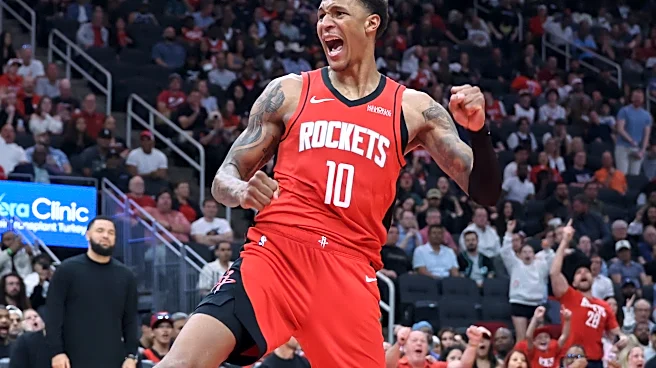
Consider Jabari Smith Jr. That guy is pretty good, right? He’s not a superstar, but at roughly $24 million per season, anyone would be happy to roster a 6’11” wing who can shoot the three, protect the rim from the weakside,
and survive in space defensively. Smith Jr. is pretty good:
He’s just not third-overall pick good.
By now, that’s a moot point – he’s not third-overall pick paid, either. Still, fans want more. Smith Jr. himself seems to want more.
Can he give more?
Rockets’ Jabari Smith Jr. has something to build on
Let it be said that Smith Jr. responded to his contract extension by having the best season of his career.
In 2025-26, he averaged 15.8 points per game while shooting 36.3% from deep, both career highs (although the latter is a tie). As with virtually every NBA player ever, much of Smith Jr.’s value is tethered to his three-point shooting. Smith Jr. shot exactly 36.3% from deep in his sophomore year as well, but last year he shot a career-high volume (6.3 per game vs 5.0).
Otherwise, little changed about Smith Jr.’s shot profile. In 2025-26, 50.1% of his field goals came from beyond the arc, compared to 48.9% last year. His percentage of attempts in every area was comparable to the previous year. Smith Jr. simply increased his overall field goal attempts.
Some fans would like to see Ime Udoka run more sets that find Smith Jr. in the midrange. He did hit a solid 52.4% of his attempts between three and ten feet this year, although the 42.4% he hit between ten and 16 left something to be desired. Still, Smith Jr. is reliable in that ten-foot area.
It’s somewhat a case of eating your vegetables before you can have your dessert. There’s a world where Smith Jr. middies become a larger staple of (to extend the metaphor) the Rockets’ offensive diet, but it’s more pressing that he continues to build on his three-point shooting.
He’s a…let’s say less than prolific ball-handler. Smith Jr. can get to his spots by virtue of his height, and he’s increased his physicality when looking to create his own shot. Still, life would be easier if defenses were more concerned with his three-pointer.
There’s also the omnipresent reality of the Rockets’ spacing. Alperen Sengun and Amen Thompson need the paint. Kevin Durant loves the midrange and is much more effective there. The team’s (presumed) 2026-27 roster won’t be set up to explore Smith Jr.’s midrange mastery.
Perhaps it’s something to explore down the road. For now, the key to success for Smith Jr. in 2026-27 remains behind the three-point line. If he can increase his efficiency on comparable volume, or increase his volume with limited efficiency regression, he’ll earn his keep again.
One more note: I’d like to see Udoka explore lineups with Smith Jr. at the 5 more frequently. I’ve long abandoned my pipe dream of him as a full-time five. Still, he spent 32% of his time there as a sophomore (the same year that he matched that 36.3% from deep, which may be a statistical blip, but big men have a harder time closing out…) and a career-low 10% last season.
Smith Jr. is one of the very best 6’10” and up shooters in the NBA. There’s Karl-Anthony Towns, his own teammate Kevin Durant, and…that’s where I start drawing blanks. Naz Reid is comparable. Kristaps Porzingis is a candidate. Still, Smith Jr. is right there. That combination of height and shooting accuracy gives him value:
Even if it’s a bit less than you wanted from a third overall pick.