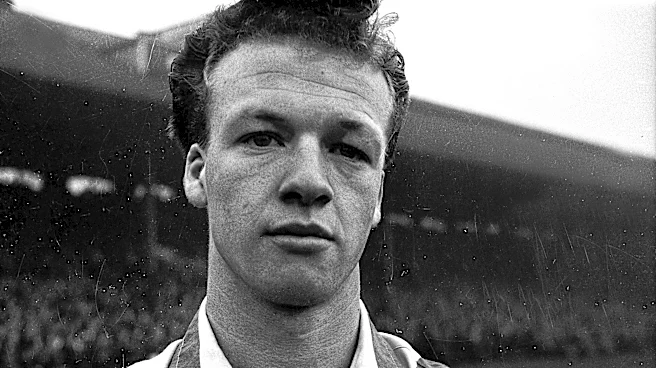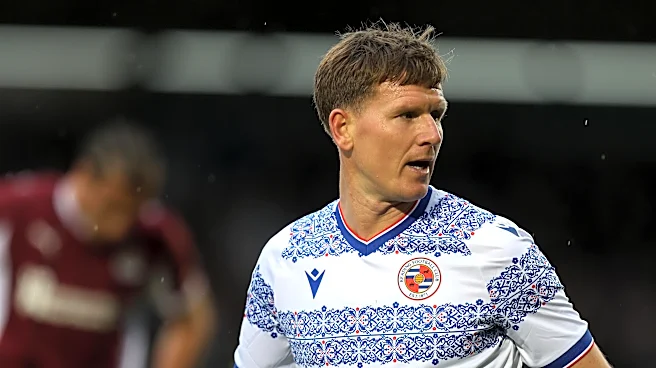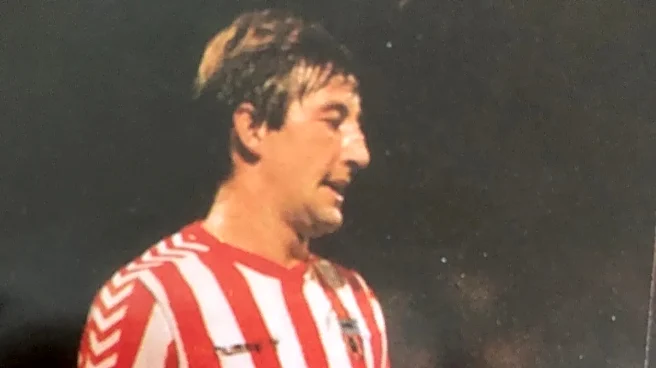




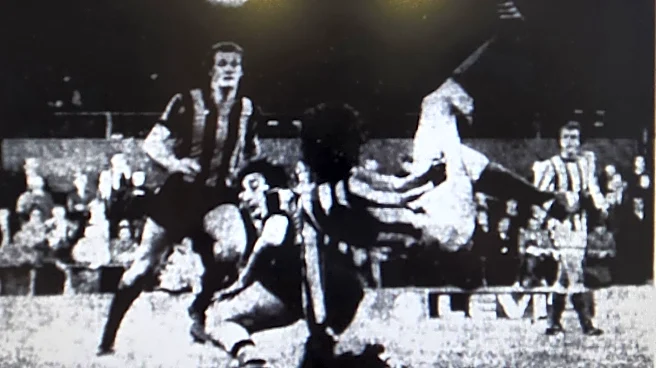
Billy Whitehurst will be sixty-seven years old on this day.
I first became aware of William Whitehurst in the early eighties as a Hull City player, where he netted forty-seven goals in one hundred and ninety-three league matches for the Tigers between 1980 and 1985. He helped Hull to back-to-back promotions from the Fourth Division to the Second Division. Many Hull fans hold Billy in high esteem.
In December 1985 he commanded a big fee for Hull of £232,000 and joined our nearest and dearest (the Visitors)
at St James’ Park.
I saw him play for Newcastle a couple of times during this period and would say that he seemed a little out of his depth in the top tier. He had physical presence and aerial ability and most certainly could not be accused of a lack of effort. It would be fair to say that, watching him from the terraces, he was no shrinking violet.
However, sharing the same pitch as the likes of Paul Gascoigne, Peter Beardsley, Glen Roeder and our own Jeff Clarke, Billy’s limitations stood out and he became a bit of a target for the renowned ‘Visitors boo-boys’.
An incident in a cup tie against Bradford City saw him confront fans who were jeering him after he was substituted. His obscene gesture to them as he left the field was the final straw for manager Willie McFaul. After twenty-eight league appearances and seven goals, he was sold in October 1986 to fellow First Division club Oxford United (League Cup holders).
He appeared in forty league games, scoring four goals between 1986 and February 1988, when he was sold to Reading for £120,000.
His time in the top tier at Newcastle and Oxford was not a huge success, so dropping down to the Third Division with Reading, who were putting together a handy team and a promising promotion run, at least on paper looked like a good idea.

Ian Branfoot was the Reading manager at this time and he probably saw in Whitehurst an ingredient that was missing from his team, possibly the final piece of the jigsaw.
Unfortunately, Billy’s off-field exploits were often as “colourful” as his robust play on the pitch. With stories of carousing and bare-knuckle boxing (where he could supplement his wages with up to £1,000 per fight), Branfoot took a dim view of some of these exploits.
After Billy was fined £200 and banned for drink-driving, the Reading boss had had enough and accepted somewhere between £90,000 and £100,000 from Denis Smith at Sunderland in September 1988. His eight-month stay with the Royals saw him score a credible eight goals in seventeen league games.
Smith had just led Sunderland out of the Third Division and, having lost a good forward in Keith Bertschin (to Walsall), wanted a target man to play up front with Marco Gabbiadini.
I reckon I saw twelve of Whitehurst’s eighteen games for Sunderland in 1988 and would say that it never quite looked like it was going to work with Billy and Marco up front.
In many respects, I felt Eric Gates was a better foil for Gabbiadini, though Whitehurst, once again, never lacked for effort.
Something that always impressed me about Denis Smith as our manager was his generally attacking style of play. I had seen him play for Stoke quite a few times over the years and he was a rugged, no-nonsense defender – someone to have in the trenches with you.
As a manager, he liked to get his team playing an attractive, fast-passing game and he sought players who could bring this to the team.

Eric Gates was a conundrum at the time. His form was patchy despite having formed an effective partnership with Marco in the previous campaign. He had also stalled over an extension to his contract and Smith had let it be known he would consider offers for the thirty-three-year-old.
Denis wanted a big target man and Billy looked like that player. He certainly brought a bit of toughness on the pitch to the squad and I particularly recall his performance in the Leeds game at Roker Park, where he was probably at his rampaging best and scored one of our two goals (Gabbiadini got the other) in the victory.
The game before that had been against Oldham at Roker Park. His display in this 3 – 2 victory was not a thing of beauty, but it was very effective as he rampaged around the pitch looking for contact wherever he could find it.
Oldham were managed by Joe Royle and had some solid citizens in their team that night (Andy Ritchie, Roger Palmer, Earl Barrett, Denis Irwin and Willie Donachie, to name five). Joe Royle complained to the press after the game that Sunderland were the most physical team they had played in a long while and lamented the five injured players in his dressing room.
Honestly, I would have to agree with Joe on that night’s evidence. Whitehurst was irrepressibly physical, bordering on violent in that game, and it appeared that this attitude was pervading some of his colleagues.
I thought Gordon Armstrong and John MacPhail sailed pretty close to the wind (both were booked). Steve Doyle too (who was always competitive on the pitch but quite clever with it). He and Marco put themselves about in a fashion that seemed to have an extra edge.
It had been a long time since I had heard my team accused of being over-physical!
During this period, Gabbiadini and Whitehurst played together sixteen times. Billy scored three goals and Marco scored seven, while five games were won, five were lost and eight were drawn during Billy’s eighteen games with the club.
With talk of Billy’s off-field exploits circulating, an incident in training resulted in young keeper Barry Richardson being laid up with a broken ankle. This prevented Denis Smith from transferring Tim Carter to Bristol City and raising some funds for his transfer kitty.
The Billy and Marco pairing had been given a chance. Smith may have decided it had not worked, or maybe he was presented with an opportunity he could not refuse. My guess is it was probably a bit of both.
Billy played his last game for Sunderland against Blackburn Rovers in the Simod Cup on 22nd December in a 2 – 1 defeat at Ewood Park.

In what must be regarded as a fine bit of business for the club, Smith brokered a deal for goalkeeper Tony Norman from Hull. £450,000 plus Billy Whitehurst and Ian Hesford was the cost.
Few people who watched Tony Norman play for Sunderland would argue that this was not a great deal for the club. When you add John Kay, John MacPhail, Colin Pascoe and, of course, Marco Gabbiadini to that list of players brought to the club by Smith, it is an impressive-looking list indeed.
With Billy gone, Gabbiadini and Gates re-established their partnership, with Colin Pascoe also chipping in up front with goals that season.
As for Billy Whitehurst, he continued his footballing travels. He scored five goals for Hull in thirty-six league games between December 1988 and February 1990.
One of these games brought him back to Roker Park, where he and Hesford put in typically characteristic performances. Billy was in bullish fettle for eighty-two minutes, with John MacPhail and he enjoying a physical afternoon’s combat.
Whitehurst missed the last eight minutes after being sent off for a high tackle on MacPhail as Sunderland won the game 2 – 0.
As an aside, this game was Thomas Hauser’s debut and probably saw the best goal Marco ever scored for us!
In a surprise move in February 1990, Billy joined Sheffield United (and Vinnie Jones) to aid their promotion push, which proved successful. He made twenty-two appearances for the Blades in the top tier, scoring twice, before getting on his bike again and spending time at Stoke City, Doncaster and Crewe.
He ended his playing career with brief spells in Hungary, Hong Kong and Northern Ireland with Glentoran before a persistent knee injury forced his retirement.
Billy Whitehurst was not a great success at Sunderland, but he was memorable. His robust, physical style was something of a throwback and his off-field antics were never dull.
His role in bringing Tony Norman to Sunderland adds another layer to the memories of this battler.
Happy Birthday, Billy, bonny lad. I hope you have a good one.