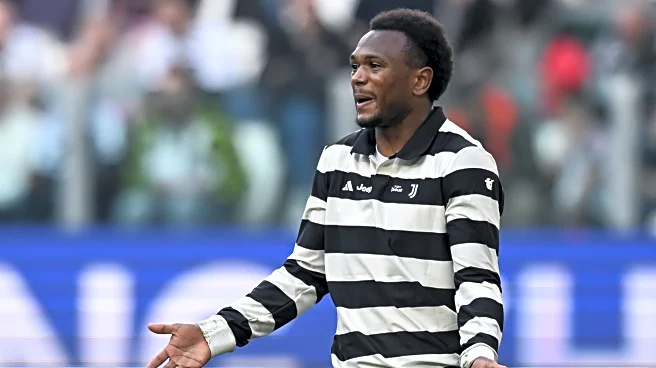


Deep in the heart of Turin’s Gran Madre district, there is a 1,000-square meter villa which boasts a 300-m² garden, a spa with a sauna, steam room, and indoor pool, six bedrooms and six bathrooms. Secluded from prying eyes, the four-story villa offers breathtaking views of the city and has served as the home of a number of a number of former Juventus stars like Cristiano Ronaldo, Paul Pogba, Nicolás González and Zinedine Zidane. And today, it is the home of Loïs Openda, his wife, and their two children.
But Openda shouldn’t get too comfy in his new digs: after a disastrous six months in Italian football, there’s every reason to believe that Openda will be on his way out in the near future. Just what exactly has happened to Openda in Turin? Let’s take a look.
Born on Feb. 16, 2000, Ikoma-Loïs Openda grew up in Liège, Belgium, but decided to make the move to Club Brugge in 2015, where he rose through the youth ranks and eventually broke into the first team. Desperate for regular minutes, Openda then took his talents to the Netherlands and spent two years with Vitesse Arnhem, scoring 37 goals and 11 assists in 88 appearances and guiding them to the 2020 KNVB Cup Final.
Rather than return to Brugge, Openda was sold to French outfit Lens in 2022, where he excelled in Les Sang et Or’s attack with 21 goals and 4 assists in 42 appearances. After spurring Lens to the verge of the Ligue 1 title, Openda was then sold to Bundesliga outfit RB Leipzig, where he racked up 28 goals and 7 assists in 45 appearances in 2023/24.
The joint-fourth top scorer in Ligue 1 the previous year, Openda’s 24 Bundesliga goals put him third in the Torjägerkanone race behind Harry Kane and Serhou Guirassy, earning praise from the likes of Niccolò Pierozzi and establishing himself as one of the top young forwards in football. And even with his numbers dropping to 13 goals and 11 assists in 45 appearances in 2024/25, he nevertheless did enough to earn a €3.3 million loan move to Juventus, with a €40.6 millio obligation that will be triggered as Juve are all but guaranteed a top-half finish.
At the time, Openda was running low on confidence, having scored just three goals in the new year for Leipzig, and having watched as an array of European giants pursued his strike partner Benjamin Šeško. Openda, meanwhile, failed to find the back of the net in his first three matches for Leipzig before departing for Juve, who had only agreed to pursue Openda after their summer-long pursuit of Randal Kolo Muani fell flat.
Larry David once opined, “A good compromise is when both parties are dissatisfied,” and that’s certainly proven the case with Openda’s move to Juventus. After gradually building his value in the Netherlands, France, and Germany, Openda has failed to add onto his progression in Italy due to a number of factors, from the lack of a preseason in Continassa to chopping and changing managers to struggling to adapt from the faster-paced Bundesliga to a more defensive-minded, methodical league like Serie A.
Initially, Igor Tudor sought to alternate Openda with fellow summer arrival Jonathan David and Dušan Vlahović at the center forward position in something far more akin to a Major League Baseball pitcher rotation than anything resembling a striker competition. After coming off the bench vs. Inter, Openda made his full debut in the following match vs. Borussia Dortmund, balancing substitute cameos and starting appearances under Tudor.
However, it wasn’t until Nov. 25 that he was able to open his scoring account in Juve’s comeback win over Bodø/Glimt — a goal that is looking more and more impressive with every single week. When Vlahović sustained a severe injury to the musculotendinous junction of his left adductor muscle just four days later, all signs pointed to Openda taking advantage and cementing a starting spot in attack.
Instead, he’s started just four matches ever since and scored just once in a 1-0 win vs. Roma on December 20. Even with the abject form of David, who could also be set for an early exit after a dismal debut season in Italy, Openda hasn’t come close to delivering the scintillating performances that saw him light it up in two of the five best leagues in world football.
Even on Feb. 17, when Luciano Spalletti was missing each of his three center forwards in David, Vlahović and Arkadiusz Milik, he preferred to start Weston McKennie up top and only brought Openda on for the final 11 minutes in the 5-2 shellacking in the first leg of the Champions League play-off round at Galatasaray. Spalletti then started Openda up top in the following match vs. Como, where he struggled to impose himself across his 65th minutes, registering just three shots, missing one big chance, losing possession eight times, and being caught offsides twice in a 2-0 defeat.
With Vlahović nearing a return to injury, there’s reason to believe that the Como game will end up being Openda’s final start for Juve. He was brought on in the 109th minute vs. Galatasaray but nevertheless failed to make his presence felt, losing his sole ground duel and taking just three touches (two unsuccessful and leading to a loss of possession) as Gala secured their spot in the knockout round for the first time in 12 years. Openda then came on for the final minutes of their 3-3 draw at Roma before being left on the bench in a 4-0 win vs. Pisa.
Whereas Openda was able to tear apart Ligue 1 and Bundesliga defenses thanks to his rapid acceleration and change of direction in counter-attacking scenarios, he’s having less opportunities to do so thanks to Spalletti’s shift towards a more possession-heavy style of play as well as the league’s stingier defenses. Similarly to the likes of Ricardo Neto, Openda is a player who thrives with space to exploit. Take that space away, and he’s a fish out of water.
Previously accustomed to playing alongside a more physical center forward like Yussuf Poulsen or Šeško in a front two at Leipzig, Openda has been forced to operate as a lone striker in Italy. Instead of being able to run in behind and chase down through balls, he’s having to hold the ball up front of the goal against more physically imposing defenders, which has led to both a decrease in attacking efficiency as well as an increase in possession losses.
It’s undeniable that center forward is the biggest priority facing Juventus right now, and even if they manage to renew Vlahović‘s deal before he departs on a free transfer, they still find themselves in need of at least one more striker with neither Openda nor David nor Milik featuring in their long-term plans. However, with gross annual wages of €7.4 million running until 2030, finding a buyer to take Openda could prove easier said than done.
At 26 years of age, Openda should be entering the finest years of his career as he prepares to participate in his second FIFA World Cup. Instead, he finds himself on the outside looking in as Spalletti grows more and more skeptical of the Belgian striker’s abilities, and it seems that a summer departure is already on the cards. Fenerbahçe manager Domenico Tedesco is reportedly keen on a reunion, having previously coached him at Leipzig, although an impressive showing in North America this summer could very well land him additional suitors.
While they’ll undoubtedly be eager to recoup their investment, it seems far more likely that Juve have weakened their leverage by handing Openda an excessive wage. Instead, it seems that Juventus will be forced to repeat the same formula that they’ve done with the likes of Arthur Melo, Douglas Luiz, Marko Pjaca, Daniele Rugani, Douglas Costa and Gonzalo Higuain: loaning Openda out multiple times before selling him for a cut-rate fee or nothing at all.