


Four days after rallying from 11 down at the half to win at Maryland, Virginia came home to John Paul Jones Arena on Tuesday night as the No. 4 team in the country, its highest AP ranking since December 2022. Waiting for the Cavaliers was an Old Dominion team that was no pushover on paper. The Monarchs came in 5-0, their best start since 1998-99, under third-year coach Mike Jones. They had held opponents to 58.4 points a game and led the Sun Belt in rebounding margin. This was the first meeting of
the two programs since December 2012, when ODU won 63-61 in Richmond. DraftKings opened and closed Virginia as a 26.5-point favorite, a number it did not cover.
In front of a Tuesday-night crowd of 11,742, Virginia never made it dramatic. The Cavaliers led 40-28 at the half despite going 6-of-21 from three and pushed the lead as high as 23 in the second half. For all of Old Dominion’s prowess on the boards for a mid-major, Virginia outrebounded the Monarchs 41-33, including 16-10 on the offensive glass, and turned it over just six times.
Virginia moves to 6-0, and Old Dominion falls to 5-1. Virginia now leads the all-time series 10-5.
Here are my six takeaways.
Another workmanlike win, and Thijs De Ridder is on fire from deep
This was not a pretty game, especially early. Virginia missed several shots at the rim in the opening minutes, went to the line and came away empty and, at one point in the first half, was 4-of-14 from three and 1-of-4 from the line. It leaned on its size and physicality on the glass to help set things up. Virginia had five offensive rebounds before Old Dominion had one, and that was the main reason it pulled away in the first half.
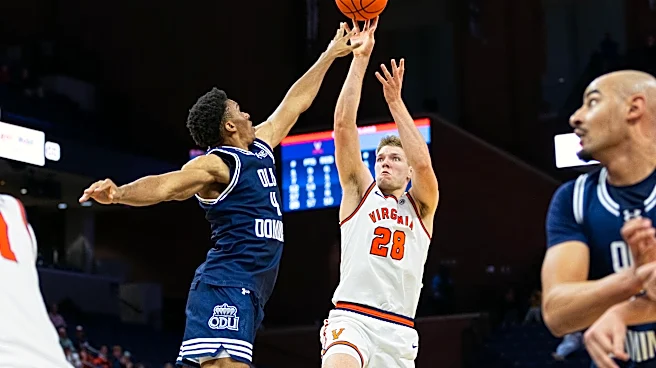
When most of the team was running cold during the first half, De Ridder carried the offense. He finished with 20 points on 5-of-9 shooting, 4-of-7 from three, and 10 rebounds for a double-double. His improved presence on the glass, with all 10 rebounds on the defensive end, is critical given Virginia’s thin frontcourt. In my preseason profile, I had flagged the defensive glass as one of the things to watch with Ugonna Onyenso gone, and on Tuesday De Ridder cleaned it up.
Even more impressive is his shooting, which has been lights out so far. His four threes tied his career high, set in the NCAA Tournament loss to Tennessee in March, and he is now 14-of-24 from three through six games, 58.3 percent. While obviously unsustainable, this is an incredible percentage and something that would make even great shooters like Jacari White jealous. He hit a spot-up three early, a pick-and-pop off a Chance Mallory screen, a three off a Mallory drive and tip-out in the second half, and a called play late that he buried. In his preseason profile, I noted that he shot just 29.8 percent from three in ACC play last season. It is a small, nonconference sample, but right now he is a player defenses cannot leave open for three, and you can already see that changing how teams have to guard him. In this game, he used the pump fake multiple times to get defenders off their feet and then attacked the basket to finish or draw the foul.
He also did his work inside, posting up and drawing reach-in fouls and bullying his way into the lane late. If there was a blemish, it was the free-throw line, where he went 6-of-10.
Going back to the team as a whole, this was not a game anyone will remember in March. But against a team that came in undefeated, Virginia handled business and never let this one get too close for comfort.
Even against a mid-major opponent, Virginia played its starters big minutes
With 4:24 left and Virginia up 18, only nine players had seen the floor, and one of them was Jurian Dixon, who had played just one minute. Meanwhile, Johann Grünloh had played 30 of a possible 35 minutes at that point. Ryan Odom did not make the call to empty the bench until just 1:36 remained.
Virginia’s starters played 146 of 200 minutes. Grünloh finished with 33, De Ridder and Mallory with 31 and Sam Lewis with 26. Behind them, Elijah Gertrude played 21, Martin Carrere 14 and Kalu Anya nine. That is essentially the eight-man rotation that we have seen develop over the last few games.
To be fair to Odom, I understand the incentives. Old Dominion is a solid mid-major that came in confident at 5-0. Moreover, Virginia’s lead was only 12 at halftime, and in a sport where analytic metrics matter so much, he likely wanted to build the margin, or at least cover the line, before he put in the backups. On the flip side, Odom did go deep in the Bucknell blowout, when no starter played more than 21 minutes, likely because it was Virginia’s third game in five days.
But this is now the third time in four games that the starters have carried a heavy load: 156 minutes against Arkansas, 157 at Maryland and 146 on Tuesday. In particular, Grünloh has been an absolute workhorse. He has played 37 and 33 minutes in his last two games after playing on an injured ankle earlier this month. I am concerned that Odom might run his guys into the ground if he continues to use such a thin rotation all year, especially given how much the full-court press demands.
Late in the second half, Grünloh gave up a basket over the top and looked tired, and he went 1-of-6 at the line. Jan Vide, Christian Harmon, Silas Barksdale and Favour Ibe played only in the final minute and a half.
I understand that Odom trusts his guys, and the result speaks for itself. But Virginia plays Loyola Maryland on Friday, then two games in three days in the Bahamas. Analytics aside, an 18-point lead with four minutes left Tuesday was a chance to save some legs, and Odom passed on it.
The free-throw shooting needs to improve
Virginia went 18-of-30 at the line, 60 percent. Old Dominion went 18-of-21. Free-throw shooting was a big talking point after the Maryland game, and the problem showed up again.
Grünloh went 1-of-6, including two misses after drawing a foul on a lob from Gertrude. De Ridder went 6-of-10. Mallory rattled out the front end of a one-and-one. The starters went 12-of-23, while the bench went 6-of-7.
The trend is what concerns me. Virginia shot 47-of-60 (78.3 percent) at the line in its first three games. In its last three, against Bucknell, Maryland and Old Dominion, it is 44-of-73 (60.3 percent). For the season, it is now at 68.4 percent, below last season’s 72.8 percent.
The first thing I considered was whether the workload was a factor. Possibly. Virginia went 10-of-15 at the line in the first half Tuesday and 8-of-15 in the second, and the full-court press demands a lot of the legs. But the Bucknell game, when no starter played more than 21 minutes, was a 9-of-16 night, so fatigue is likely not the whole explanation. While it has not hurt Virginia yet, it will surely haunt the Cavaliers in their bigger nonconference games if they cannot fix it soon.
The steals have come back to earth, but Virginia was disciplined with the ball
Through four games, Virginia averaged 13.3 steals and had at least 10 in every game. Steals had become a major piece of its identity and a source of its scoring. But it has had five in each of the last two. Old Dominion did not commit its first turnover until well into the first half and had only eight for the game. That says a lot about the Monarchs, whose point guard Khoi Thurmon came in with a 3.33 assist-to-turnover ratio. The press still produced some of its best moments, including Mallory’s steal on an inbound pass and behind-the-back feed to Lewis for a layup, and Lewis’ steal on another inbound.
Turnovers, especially for Lewis, had been a problem in recent weeks, but Virginia seems to have fixed some of the issues. It turned it over just six times, its fewest this season. After a season-high 17 turnovers at Maryland, that is a big step. Lewis, who had seven turnovers Friday, had one. Mallory had one to go with six assists, and Virginia finished with 16 assists to six turnovers.
If the steals are going to come down against better ball-handling teams, this is the trade Virginia needs to make. It won the turnover battle 8-6 and the points-off-turnovers battle 13-8 without a big steal night.
Elijah Gertrude set a new career high
Gertrude scored 14 points on 5-of-6 shooting, 3-of-3 from three, in 21 minutes. His previous career high in a game that counted was 13, against NC Central in December 2023. His three made threes tied his career high, set against Northeastern this month.
He was the spark off the bench again. He hit a three a few minutes after checking in. Later, he found De Ridder for a three that rimmed out, then followed his own pass, grabbed the rebound and finished through contact for an and-one. He had nine points in 10 first-half minutes. In the second half, he knocked down a contested jumper and then made something out of nothing for a layup that gave him the career high. He added two steals, including one on an inbound pass.
It was not perfect. He can still be a bit jumpy and excited at times. That led to three fouls, including a blocking foul. He was also blocked on a drive. But for a player who was 3-of-29 from three before this season, a 3-of-3 night is another sign that the shooting is real, and he has firmly established himself as the sixth man.
Virginia found its three-point shot again
After attempting just 10 threes at Maryland, Virginia shot 13-of-34 from three Tuesday. The game flipped that script. At Maryland, Virginia scored 58 points in the paint. On Tuesday, it had 28, and 70 percent of its first-half shots were threes.
It started slowly. Virginia went 6-of-21 from three in the first half, including two end-of-shot-clock heaves from Lewis. The first was an airball. The second, heavily contested, went in to send Virginia into halftime up 12. Grünloh missed open looks from the corner, and Lewis did not score until late in the half.
Then it turned it on. Virginia went 7-of-13 from three in the second half. De Ridder and Adekunle hit two each, Lewis pulled up over a contest, Gertrude hit his third of the night and Carrere added one late.
The shot selection was not always good, especially in the first half, when Virginia settled against a defense that came in holding opponents to 35.7 percent shooting. But Virginia is continuing to show it can beat opponents in a multitude of ways.
Bonus: A mid-game turnaround for Nolan Adekunle
After a pair of nice games, Adekunle went scoreless at Maryland in 19 minutes, and through the first half Tuesday he was 0-of-3 with no points. He airballed a layup early in the second half that immediately caused Odom to send Gertrude to the scorer’s table, and then he bricked a heat-check three that sent Adekunle to the bench.
Odom could be seen having a stern conversation with him as he left the floor. When he got back in the game it was like a switch had been flipped. He beat his defender off the dribble and drove all the way for a layup, pump-faked and relocated for a three, drove baseline to draw a blocking foul and buried a corner three off good ball movement. He finished with eight points, all in the second half on 3-of-5 shooting, plus four rebounds, three assists and no turnovers. He also made a hustle play to keep a possession for Virginia. Given his role, he is not expected to be a primary scorer, but his ability to respond to what Odom told him and play with that level of intensity is critical for a deep March run.
Bonus: Another rough night for the ACC
It was a bad week for the conference. No. 5 Duke lost 99-78 at home to No. 10 Illinois on Tuesday, its first home loss by more than 20 points since 1989, as Andrej Stojakovic scored 46. The loss also ended the nation’s longest home winning streak at 35 games. On Sunday, then-No. 10 Louisville blew an 18-point lead and lost 98-78 at Memphis. Elsewhere on Tuesday, Notre Dame lost 86-78 to No. 1 Florida in Las Vegas. Georgia Tech trailed Norfolk State by 12 at halftime before pulling away, SMU needed a second-half comeback to beat Oral Roberts by four, and Wake Forest held off Monmouth by five. Pitt’s 20-point win over Villanova was the lone bright spot.
Some Virginia fans will enjoy seeing Duke and Louisville stumble. I get it. But a weaker ACC hurts Virginia, too. A top NCAA Tournament seed is built on quality wins, and if the league’s contenders keep losing in November, Virginia’s conference schedule will offer fewer of them come February. That puts more weight on the nonconference games. However, with No. 20 Arkansas dropping its second game, to Indiana on Tuesday, and Kentucky looking extremely suspect to start the year, Virginia is unlikely to get as much analytic credit for its nonconference schedule as it expected in the preseason.
What’s next
Virginia hosts Loyola Maryland on Friday at 7 p.m. on ACC Network, its last game before the Battle 4 Atlantis. In the Bahamas, Virginia opens against Marquette on Nov. 25 at noon on ESPN and plays Xavier on Nov. 27.
Loyola Maryland should be another chance to get the bench real minutes. Whether Odom takes it may say a lot about how he plans to manage this rotation through December.