


The Carolina Panthers have officially made the playoffs for the 2025 season, their first trip since 2017. They are in the second year of a new coaching and general manager regime, which got me thinking about another Panthers group that had a similar story, namely the 2003 squad. So let’s take a closer look at some similarities.
Construction
Let’s start at the top with the owner of the franchise. In 2003, Jerry Richardson was in his ninth season as owner of the Panthers, the team that he founded. This season, David
Tepper is in his eighth season as owner of the Panthers, an eerily similar number. Moving down the corporate ladder, both teams employed general managers who had previous positions within the organization who built a playoff team in just their second season in the position. 2003’s team had Marty Hurney, previously the Director of Player Operations in 1998, took over the General Manager position in 2002. Dan Morgan, who played linebacker for the Panthers for seven seasons, was hired as the general manager in 2024. The first order of business for both gentlemen was hiring a new head coach for their floundering franchise that had 15 loss seasons the year before their hiring (2001 saw the Panthers go 1-15, the 2023 team went 2-15).
Both Hurney and Morgan decided to take a chance on first time head coaches with very similar experience as an NFL assistant or consultant (John Fox was an NFL assistant/consultant for 13 years, Dave Canales for 14 years). It gets weirder: John Fox was a defensive minded head coach and hired an experienced offensive coordinator (Dan Henning) and a young defensive mind who had never been a coordinator before (Mark Trgovac). Dave Canales is an offensive minded head coach, and he hired an experienced defensive coordinator (Ejiro Evero) and a young offensive mind who had never been a coordinator before (Brad Idzik).
Statistics
The biggest difference statistically for the two iterations of Panthers teams was the win/loss record. The 2003 team finished 11-5 while the 2025 squad is 8-9. Both teams won the division, hosting a team they already played in the regular season who was highly favored to win in Charlotte (in 2003 the Panthers hosted the Cowboys in the Wild Card Round, and the 2025 Panthers are hosting the Rams). In fairness, the 2003 Panthers had a much lower strength of schedule. Points wise, the 2003 team looks much better overall, sporting 20.3 points for and 19 points against per game while the 2025 team scored 18.3 points while allowing 22.4 points per game. The points per game for the 2003 team was boosted by the five total defensive/special teams touchdowns compared to just the two for the 2025 team.
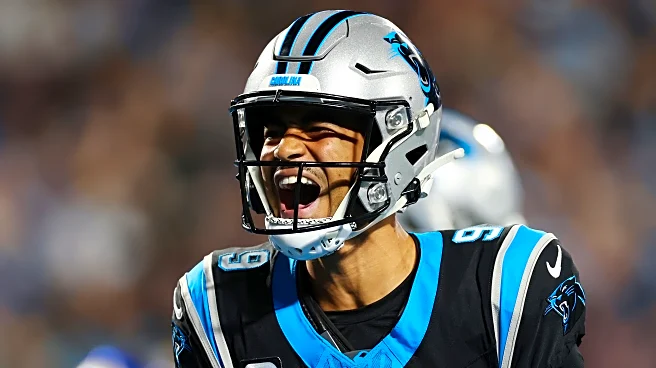
Looking at individual stats, Jake Delhomme was the quarterback for most of the 2003 season. He finished the year with 3,219 passing yards, 19 touchdowns, and 16 interceptions. Bryce Young in 2025 finished with 3,011 yards passing, 23 touchdowns, and 11 interceptions. The big stats for both these quarterbacks in their respective seasons were Fourth Quarter Comebacks and Game Winning Drives. Delhomme had five 4QCs and seven GWDs in 2003, and Bryce had four 4QCs and six GWDs this season (had they completed the comeback against Tampa, the numbers would have been identical). Jake also had 15 fumbles in 2003 compared to seven for Bryce this season.
On the ground, the primary 2003 Panthers backs (Stephen Davis and DeShaun Foster) combined for over 1,800 yards and the 2025 duo (Chuba Hubbard and Rico Dowdle) combined for almost 1,600 (though adding in Bryce’s 200 yards rushing makes the numbers much closer). From a receiving standpoint, the 2025 version was much more of a one man show with Tetairoa McMillan more than doubling the next highest receiver’s yards total. 2003’s team had Steve Smith and Muhsin Muhammad with over 800 yards receiving. Had Jalen Coker been healthy all season, he likely would have also cleared that mark, though.
Special Teams was more special for the 2003 team in large part because of the aforementioned touchdowns. The 2003 squad had one punt return and one kickoff return go to the house while 2025’s team had zero. 2025’s Ryan Fitzgerald had a better season overall than 2003’s John Kasay in terms of field goal percentage. Fitzgerald also wasn’t much worse on extra points despite the ball being moved back further than where Kasay was kicking from. Sam Martin had fewer punts in 2025 than Tood Saurbrun in 2003, eclipsing those 2003 numbers in yards per punt while having more punts inside the 20 and fewer touchbacks.
The biggest difference defensively was 2003’s ability to make the splash plays on a consistent basis. That unit, led by Julius Peppers and company, managed 16 interceptions, forced 13 fumbles, and had 39 sacks. Those numbers for the 2025 unit were 15, nine, and 30, respectively despite playing one more game. It’s the high leverage plays that make the biggest difference in the 11-5 Super Bowl Panthers of 2003 and this year’s 8-9 version, at least on defense. The dominant 2003 unit allowed opponents to convert on third down just 34.7%. This year, that number is 47.1%. Fourth downs share a similar story: 2003’s fourth down conversion allowed rate was 31.3% and 2025’s defense allows a conversion 63.6% of the time.
How Can The Panthers Replicate 2003?
The biggest area the 2025 Panthers can improve in order to make a run similar to the 2003 team is high leverage plays. Offensively, they are ranked lower in third down conversions than they were in 2003. More conversions on third down means longer drives, which usually leads to more points and a more rested defense. If the defense is more rested, they might be better on third and fourth downs as well. If they can tighten up (literally, from a coverage standpoint in many instances) on the money downs and get off the field sooner, the offense could get more chances to put some points of their own on the board. Looking at a per drive basis, the 2025 offense was better than 2003 in time of possession per drive (31 seconds more), plays per drive (almost a full play more), yards per drive (four more), and points per drive (0.34 points more). Long story short, if the Panthers want to make another Super Bowl run and keep the Ohio State Championship/Jaguars to open the season/Jennifer Lopez getting divorced streak alive, they need to get off the field on defense and stay on the field on offense. Easy, right?