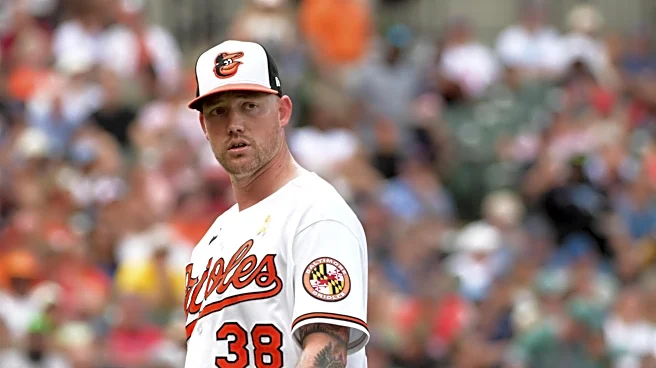


If you had been told back in March that the 2026 Orioles season would include Kyle Bradish making 29 starts for the Orioles and receiving a five-year contract extension during the season, you would probably be picturing something exciting happening. Things did not quite work out that way. There were ups and downs for Bradish’s first full season back after his Tommy John surgery, and by the time his season ended slightly early due to a sports hernia, Bradish was just about exactly average.
You may
have set your hopes higher. I think the Orioles certainly did. It’s not like these were the first starts Bradish made after his surgery. He got in six games at the end of the 2025 season and every indication there was that he would be picking up where he left off before having to get Tommy John. Batters couldn’t hit him very well. He had an excellent strikeout rate, was controlling the walks and home runs at acceptable rates. It wasn’t crazy to believe that Bradish would be able to return to top-of-the-rotation form.
The Orioles were counting on being able to get a quality 1-2-3 out of Bradish, Shane Baz, and Trevor Rogers. Other writers will be covering those other two guys on different days. As far as Bradish, by the time his season came to an end, that just wasn’t what he was. The strike rate was down substantially, the walk rate increased, the home run rate had a bit of a jump.
It all added up to Bradish posting a 4.12 ERA for the season – an ERA+ of 99, or 1% below league average for a pitcher. Peripheral stats such as FIP, the ERA-analogue stat that tries to subtract defense from the equation, had Bradish at a 4.35. The Orioles, I believe, wanted more than this. They needed more.
To be sure, it is good that Bradish ended up among the 65 MLB pitchers who threw at least 150 innings this year. By not missing many starts until the end of the season, that avoided exposure to depth options like Cade Povich, and by averaging more than five innings per start for the season, Bradish also (mostly) avoided contributing to seeing guys like Keegan Akin or Yaramil Hiraldo pitching in the fourth or fifth inning.
These are not trivial problems to avoid, and yet… of that list of 65 MLB pitchers who tossed 150 innings, Bradish came in 47th. It could have been worse. It’s just that it needed to be better. The Orioles did not commit to the next five years of Bradish at $18 million per season for a 4.12 ERA.
The signs were there from as soon as Bradish’s first start that he wasn’t going to be picking up right where he left off last season. Walking three batters while failing to get through five innings against the Twins back on March 28 turned out to be more like the typical 2026 Bradish start than any of us would prefer. He took the loss because the offense only scored one run in the game. Of course, that fact was also more like the typical 2026 Orioles offense than any of us would prefer.
Seven starts into his season, Bradish was sitting on a 5.03 ERA and he had walked 21 batters in only 34 innings. That’s a tough way to win, and naturally he wasn’t winning. His record was 1-4, and the O’s were just 2-5 in those starts. By season’s end, Bradish himself had a 7-14 record, and the Orioles were 13-16 in games that he started. With apologies for beating this same drum yet again: The team needed more than that to be successful this year. Mike Elias bet part of this season’s chances of success on getting more than that, and he just didn’t.
It wasn’t just Elias betting on Bradish in a big picture way. This also included times where the manager, Craig Albernaz, decided that he was going to count on Bradish to get one more batter rather than bringing in a reliever. One such time, particularly memorable to me because I was baking in the sun in Cincinnati watching it play out in person, Albernaz let Bradish, already past 100 pitches in the eighth inning, stay in for one more batter. That batter hit an RBI double, expanding the O’s deficit that day from 2-1 to 3-1. They ended up losing, 3-2.
There were stretches in there where you could believe that a fully healthy Bradish will be better than this. From May 8 on through to August 15, a stretch of 17 starts, Bradish had a 3.18 ERA. It wasn’t exactly as good as his pre-surgery outings, not quite as many strikeouts and not quite as few walks but still: That would have done the trick, if he was that over the full season.
The Orioles are being their usual cagey selves over when exactly Bradish suffered the sports hernia; the results look like maybe his five starts were disrupted by that. That added close to half a run to his season ERA. We’d probably feel a bit different about Bradish’s season if he closed out at 3.65, which is what he had after his August 15 start. That would be a fine baseline to bring into next season, with hopes of improvement on that.
Instead, like so many other things to do with the 2026 Orioles, we must simply hope for better without there being a ton to hang that belief on. Maybe the most important aspect of this hand-waving has nothing to do with how Bradish pitches at all and everything to do with whether the front office and coaching staff assemble at minimum a competent defense behind him. Bradish was one of the more heavily-victimized pitchers by bad defense: He was on the mound for 12 of the team’s 88 unearned runs. This doesn’t even count plays that weren’t scored as errors but an MLB player should have made.
I don’t want to act like the defense is too much of an excuse, though. Bradish has a rough-looking Statcast page, and none of that stuff cares about his defense. That’s so much blue. In this, blue is bad. What it looks a whole lot like on here is that Bradish’s curveball and slider were not up to the form he has showed previously. That seems like the avenue for improvement. The fastball isn’t the problem: He’s working with the same pre-surgery velocity and close to the same pre-surgery movement. Whether he can improve those other pitches, I just don’t know.
It is going to be even more important for the outlook of the 2027 Orioles that Bradish, heading into his age 30 season, pitch better next year. Trevor Rogers is almost certainly going to depart as a free agent, and the chances of Elias bringing a pitcher of the caliber of what Rogers showed in 2025 and from June onward in 2026 are slim. The top of the rotation will be counting even more heavily on Bradish and Baz doing good-to-great things that they did not do over the full 2026 season, as well as Brandon Young repeating his surprise 2026.