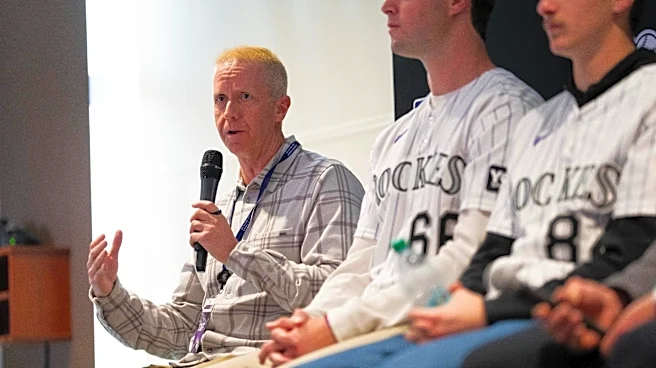


On Saturday, Chris Forbes, the Colorado Rockies senior director of player development, answered questions for Purple Row. He explained organizational changes he’s seen over the course of the last year, players to watch for in the Rockies system, and how he’ll handle a lockout — if there is one.
Below are a few takeaways from that conversation, which has been lightly edited for clarity.
On what last winter was like
Last year we had a big lift in a hiring cycle, one of the bigger ones I’ve ever gone through. It wasn’t just like
we were making that shift in the pitching, so we really needed to find the right guys. We really dove in there.
But when Paul (DePodesta) got hired, it was him and I. Now we’re talking about (Warren Schaeffer). Now we’re talking about Alon (Leichman). Now we’re doing these calls, and then we got (Josh Byrnes) on. Then it was Paul and I and JB, and then they settled on Schaeff coming back. Then there was the four of us doing the interviews for the big league staff.

Once we kind of got that in place with (Matt) Daniels and the three new pitching guys up there, it was important to get Owen Cuffe and Geoff Brown and some of the pitching guys down.
Then we started having to fill in the minor-league guys. We let go of five guys last year. I had three other guys like (Scott) Oberg who couldn’t come back, Tony (Wolters) who couldn’t come back, and a guy named Dave Keller, who ultimately stepped away, too.
And then I had three additional guys promoted to big league staffs, and Dino and you know Doug Bernier was our field coordinator last year, and Jordan Pacheco.
So now the hiring goes into “Okay, we’ve really got to focus here.” Then we hired Brett Pill. So now we’re involving Brett Pill in interviewing, like, Pacheco. And then Brett Pill in interviewing a guy that we hired in Triple-A, who’s been fantastic, Matt Schneider. It just went to Google-esque buckets of interviews.
We hired our last guy in April, Gary Templeton Jr. He’s in Fresno. He didn’t get any spring training because you’re trying to do interviews during camp.
Last year was pretty chaotic. I’m looking forward to 2026 being over.
You don’t know how it was going to go.
We needed to make changes. We just didn’t know who we were going to bring in at the time. We were involved in a bigger group with the GM interviews, too, which I think was just Walker (Monfort) and Dick (Montfort) setting up a scenario where we could kind of get to know and ask questions.
So it was pretty busy.
On what changed with the new front office
It actually hasn’t changed much at all as far as the day-to-day stuff.
It’s changed — you navigate how the communication is going to go. What’s my first phone call? On the days where you’re talking with Tommy Tanous, or am I talking to Paul? — just kind of the updates on that. Truly, he’s probably been able to expound some of the stuff we wanted to do.
There’s quite a bit more openness and curiosity. These type of programs where you’re able to challenge kids in a certain way and grow them a certain way and make sure they get individual skill stuff and all of it. So it’s actually probably opened up more because they’re curious guys. I think it’s been pretty positive in that aspect of it.
But it’s kind of the same gig. So the same-late night phone calls or controlled chaos.
On what his week looks like
Mondays are my favorite day because nobody’s playing, except for, typically, the Arizona Complex League team.
I touch base with Dan Meyer, our pitching coordinator, every day. You just double check. What did we see last night? Does he need a day? Just trying to be hyper-aware of who needs (what). Can we unplug it for a couple weeks? Like sending (a player) down to Owen Cuffe here in the performance lab, and being very aware of the innings and how many pitches he threw, and how the leverage innings or the high-intensity innings and how that went.
And then, whether it’s coordinators, depending on where they’re at, or managers.

I travel probably three weeks a month. So in and out of Denver, to the affiliates, just kind of make a rotation.
Certain guys, maybe you prioritize that you’d like to see. Sometimes it’s just touch points with the staff and touch points with players.
And then I think the worst nights I have are the latest nights are when, say, I’m in Hartford we’re done. We’re back in the hotel — because you get to the field at like 12:30 or 1:00, and there’s the game, and then we debrief to the game, post-game stuff. And if the team is playing West, like West Coast, then you’re just kind of waiting that out just in case something happened, or we need to get somebody on a flight.
So during the season, it’s pretty chaotic. The phone rings a lot.
On his impressions of this year’s draft class
I think what was intriguing was kind of the talking through and listening to the strategy that they were putting in place for the draft, and talking about guys, like what they do and how they can do it, and what we needed to work on right away.
“Okay, if we get this guy immediately during mini camp, let’s start putting this in play.”
That was kind of intriguing. We used to have what was called a “30-day Rule” that I had to abide by, and for 30 days, you’re just getting to know the player. Well, now you’re getting another player, but we can actually start making some hay. And I think that was probably the most intriguing thing.
So early on, you look at each one of these guys and certain growth opportunities for them: the work ethic, the personality. I’m starting to see some personality with some of these guys, and that’s been fun. They’re starting to come out.
Like mini camp, they’re all quiet, and I’m not a quiet guy. And then you start to get them out here in the day to day, and obviously we were able to get some guys up to Fresno. Got Lorenzo Carrier up to Spokane, but getting them now back down in the scenario with, really, a finer focus on 45 guys that we have and what they do and how they mix in with us. I think that’s key, too.
So it’s been pretty intriguing because there’s guys like like Logan Reddeman (No. 9 PuRP) through his bullpen today. You’re not going to get (him) on a game mound, but you just see, “Okay, he does this, this, and this.”
You start to get in on the maturity piece, and is he a guy that we can put right into Spokane next year? How do you split up the two priority catchers, which we have both, and they’ve got these massive bucket of strengths, and then the areas that we’re working on them with.
So it’s exciting.
And then, we’re going to get a kid named Tyler Bell (No. 4 PuRP) back. I think that’s gonna be an exciting part.

But there seems to be a lot of depth in what they did in the draft. Some of the pitching, we’re getting to know a little bit more on where to refine, and they’re going in their first off season, which is always kind of a nervous time. Some some college guys can go a little too quick out of the gate, but I think we’ve set up that trust in the communication piece that it’s going to be really regimented between you know Daniels and Dan Meyer and Cuffe and a lot of check-ins with our affiliate guys.
On the possibility of a lockout
I think we’re we’re A, B, and C.
There’s Plan A: status quo. Here’s Plan B if this happens. Here’s Plan C if this happens.
Because you just don’t know. I preach to our players about staying present all the time, and I’ve said that to the staff. “Don’t don’t assume it’s gonna lock out.” I’m not gonna read through all the posturing that these guys do. That’s just not my role. It’s just a “Say what you mean” kind of thing.
And I think you just plan it out the best you can. How does spring training look we go first, if they go later, etc? I don’t know how it’s going to look.
On players to watch for
I think Tyler Bell is really intriguing.
There’s certain guys that are no secret, and that’s where Roldy Brito (No. 3 PuRP). I think because of the year when he went out and what we were dealing with a little inflammation in the knee.
I don’t think Wilder Dalis (No. 10 PuRP) got near enough. He’s a good baseball player. So you’ve got some Latin guys like that.

You got some new guys. You’re going to get Ethan (Holliday) (No. 1 PuRP). You’re going get Antoine Jean (No. 46 PuRP) back — we lost in the second inning with his first start. You’re going to get guys like Daniel Jackson (No. 12 PuRP) out for the first full season, and I love the way he plays already because it’s like a catcher with speed, and it’s almost like a running-back aggressiveness.
And there’s guys that I think have to fit. I always kind of talk about the expectation piece of “How do you weigh (a player)?”
Like somebody asked me about Roc Riggio (No. 13 PuRP), and I said, “I think Roc’s an intriguing player.” As a manager, you want guys like Roc, but you can’t have Roc playing every day. You can’t have Ryan Ritter playing every day. That’s not what first division clubs—they’ve got those guys playing every day. But then you’ve got a guy of that type of pedigree or instinctualness on the baseball field that he can come in and help the team. Or if somebody’s down for two days, you don’t feel like you’re missing that much of a beat.
The year that Jackson Cox (No. 11 PuRP) had, still really under that minor-league rehab umbrella for a while, and then coming up to getting the year in Spokane, and still a young kid.
Jack Mahoney (No. 15 PuRP), we dealt with a couple things with Jack where he had just a little inflammation, and we took the opportunity, “Okay, we’re gonna unplug you. We’re gonna get you down a lab and do some pitch design with Cuffe.” And man, how he navigated the Eastern League after that was just phenomenal.
Those are some guys to be excited about, but the pitching really took a hit.
—
The center fielder for the ACL team, Cristian Arguelles (No. 5 PuRP). I mean, he’s everything that you want out of a young prospect. Because there’s also this persona. I used to say when I back years ago when I was scouting, where you would get there, and you watch guys get off the bus. You see that guy, you’re like, “Ooh, I hope that’s a guy.” That’s how he is. There’s something about him for 18 or 19 years old. He’s obviously very much a guy to be excited about.
Closing thoughts
Chris Forbes is always a terrific interview: He knows the Rockies farm system like few people do, and he understands baseball.
I was struck by the fact that he was a key part of the hiring process when Walker and Dick Monfort were determining the front office staff, and I didn’t really put together how much very fast work went into the Rockies hiring in the offseason.
Also, I am glad I don’t have his job. It’s hard enough for us here in the Mountain Time Zone to keep up with West Coast games. I can’t imagine doing that from Hartford.
And I appreciated the players he told us to watch for. We’ll have more on them in the coming days.
Forbes also discussed the Rockies approach to the Arizona Fall League, so look for that in a future story.
Let us know what you think in the comments!
Join the conversation!
Sign up for a user account and get:
- Fewer ads
- Create community posts
- Comment on articles, community posts
- Rec comments, community posts
- New, improved notifications system!
Download the SB Nation app on iOS or Android.
Please keep in mind ourPurple Row Community Guidelines when you’re commenting. Thanks!