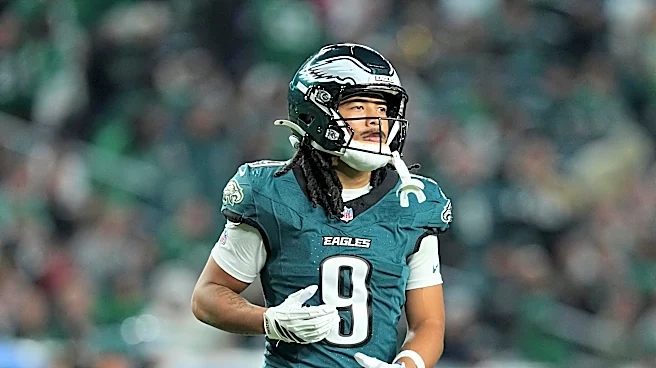



I wanted to use the bye week to get a better idea of what the Eagles have in Makai Lemon. So I went back through every target from the first nine games, hoping to see how his rookie season was developing. By the end, I was probably more frustrated with the offense than I was when I started. Evaluating a first-round receiver when almost everything thrown his way is a hitch, a quick out, or an underneath crosser is incredibly difficult. At times, this felt like an Eagles’ offense disaster compilation,
with Lemon unfortunately involved.
His production has improved. After 18 catches for 127 yards through six games, he caught 19 passes for 185 yards and a touchdown over the next three. However, the bigger question for me is how much more he can offer. The Eagles have given us a pretty clear picture of the role they want him to play right now. They have given us far less evidence of what he could become. All statistics in this article are courtesy of Fantasy Points Data Suite.
I liked Lemon as a prospect because he looked like a good football player with a fairly high floor. I still see that. I also questioned his explosiveness and whether he could become a really good receiver. Halfway through his rookie season, too many of those questions remain unanswered because his usage has been so boring.
If you want to see the video with analysis of all targets, it’s available on my Patreon here! Have a little spoiler of my favorite route of his…
Strengths
Footwork and deception in short spaces
Lemon’s best trait as a route runner is how quickly he can change direction and sell his routes using his whole body. A receiver can have quick feet, but good defensive backs aren’t simply staring at his feet. The shoulders and torso have to help sell the route. Lemon has several examples where a subtle body fake gets the defender leaning before he plants and breaks away. His movement in tight spaces looks very natural. He can threaten one direction and get into another without making the whole process look labored.
The fourth-down slant against the Cowboys might be my favorite example of his season. He hesitates briefly on the release before selling the vertical stem, getting the cornerback into a position where he has to respect the possibility of Lemon continuing downfield. Then Lemon breaks inside. The separation comes from making the defender react to a believable threat before changing direction. It is a really clean win.
I particularly liked that play when comparing it with an earlier route against Travis Hunter vs. the Jaguars. On that rep, Lemon takes a hard outside step, but he doesn’t close enough to make Hunter feel threatened vertically. Against the Cowboys, Lemon does a much better job of making the release and stem look like the beginning of a vertical route. The opponents are different, so it isn’t a perfect comparison, but his improved route-selling is encouraging.
The Giants game provides another lovely example of route detail. Lemon angles his stem slightly, suggesting he might continue inside, then works upfield and gets the defensive back to turn. Once the defender’s eyes move away, Lemon uses that blind spot to create separation as he breaks back toward the football. He adds a little physical contact to help himself, then gets his feet organized and catches away from his body. That is proper receiver play.
Awareness against zone coverage
Lemon understands how to find space against zone. Settling between defenders sounds straightforward until you watch receivers who keep running themselves into coverage. There is a difference between occupying an open patch of grass and adjusting a route as the defenders move. Lemon already shows some of that understanding.
One of my favorite examples comes against the Jaguars. He initially threatens to cross the field, recognizes the linebacker dropping into the space around him, and adjusts back away from that defender. Simply stopping would make him easier to close on. Continuing across would take him toward coverage. Lemon finds a way to remain available, and Jalen Hurts delivers the ball where he can extend and catch it. He creates a usable throwing window, then gives the quarterback room to place the ball slightly outside his frame.
Another example later in the target reel shows him working toward an out route but recognizing he is already free. He doesn’t need to keep racing toward the sideline and potentially bring himself closer to the outside defender. He can throttle down, turn, and present a target. Those little decisions are valuable, especially in an offense that has made completing passes look painfully difficult at times.
He is averaging 1.20 yards per route run against zone compared with 0.49 against man. At this stage, I feel more confident in his ability to recognize and use space than in his ability to consistently defeat every type of individual matchup.
Catching away from his frame
Watching all the targets together made this strength really obvious. Lemon repeatedly extends his hands away from his body and catches the football cleanly. He can reach behind himself, get down to a low throw, or turn and secure the ball while moving.
There is a catch vs. the Titans that is a good example. The ball arrives behind him, and he has to adjust before taking contact. Against the Panthers, he sells an inside route before breaking out against a defender with outside leverage. The coverage makes that a difficult route to win, and the throw doesn’t make his life especially easy either. He still finishes the catch.
The two drops against the Giants need a mention, and I will get to them. But I came away from this exercise feeling positive about his hands overall. There are too many catches away from his frame, including through contact, for me to suddenly decide that catching the football is a weakness because of the final game before the bye.
Toughness and awareness through contact
Lemon takes some absolute shots in this target reel. He keeps making himself available over the middle anyway. I don’t see a receiver whose routes become hesitant because he knows a safety or linebacker is coming downhill. The Cowboys game, in particular, asks a lot of him physically, and he keeps competing through it.
What I like is that his toughness includes some awareness of how to protect himself. His touchdown vs. the Cowboys is a good example. Lemon knows the hit is coming. He secures the ball and turns his body so that he can absorb contact without charging straight into it. A smaller receiver needs to make those adjustments. Being willing to take a hit is valuable; understanding how to finish the catch while reducing unnecessary punishment is even more useful over a season.
He also shows situational awareness. On one fourth-down conversion, he gets the separation, catches the ball, and gets down with the first down secured. There is no need to fight for an extra yard and risk the possession. Elsewhere, he turns upfield and lowers his shoulder when there are yards available.
His blocking against the Rams and Cowboys also stood out this season. He is willing to contribute when the ball goes elsewhere.
Weaknesses
A limited role that makes the ceiling difficult to judge
This is the biggest issue with the evaluation, and a lot of it belongs to the offense. Hitches account for 29.5% of Lemon’s charted routes, putting him in the 98th percentile among qualified receivers for hitch usage. Nearly three out of every ten routes! His average depth of target is 6.69 yards. He is running routes on 86% of the Eagles’ dropbacks, so this isn’t simply a rookie waiting for playing time. He is out there regularly, operating within a role that gives us a very narrow view of his ability.
There is nothing wrong with running a hitch. Lemon can catch one, absorb contact, and keep the offense moving. But so much of this film involves turning back toward the quarterback against zone, catching the ball, and getting hit immediately. Some quick outs come on second-and-20 or third-and-13, where the defender can concede the completion and tackle underneath. Those plays provide limited evidence of how Lemon can stress a defense. You expect an NFL receiver to complete some of those assignments.
The slot usage needs some nuance, too. He runs about 65% of his charted routes from the slot, so calling him exclusively a slot receiver would be inaccurate. In these condensed formations, even the meaning of an outside alignment can become a little blurry. However, if he needs to remain inside to be effective and his receiving role stays confined to short routes, that limits the offense’s flexibility. It also makes me question the value of using a first-round pick on that particular role. A useful underneath receiver can have a good career. I want the Eagles to find out whether Lemon can give them more than that.
The target reel included one (!) vertical route. One! Obviously, I only watched his targets for this, and vertical routes that aren’t targeted still matter, and watching targets alone doesn’t tell us how often he was open elsewhere. But a clear-out assignment also doesn’t give us the same evidence as a play designed to put the ball in his hands downfield. I want to see how he handles those opportunities when the quarterback is actually looking for him. His college film included slot fades, posts, and corners. Give him some of those chances in the NFL. He might fail. At least we would learn something. They aren’t even trying.
Unproven vertical speed and technique
I am asking for more vertical opportunities, but I have no idea if he will suddenly become an excellent deep receiver. His short-area quickness is clear. Whether he has another gear once he gets downfield is much less certain. The movement that helps him win a quick slant doesn’t automatically translate into running away from an NFL cornerback downfield.
The downfield opportunity against the Commanders captures both the promise and the concern. I love the release. His feet are quick, he uses his upper body to work through the contact, and he gets on top of the cornerback. That ability to stack the defender puts him in position to compete for the pass. After that, though, I don’t see an obvious extra burst that allows him to pull away. He appears to be near full speed already, with the defender still close enough to contest.
He also looks back for the ball early. Continuing to run before revealing its arrival makes life harder for the cornerback. Here, Lemon’s eyes give the defender a cue to locate it. That is a technical detail worth developing, particularly for a player who may need to maximize small advantages rather than rely on speed to create a huge gap.
Even in college, he wasn’t always separating comfortably on vertical routes. He made some difficult catches anyway. I think he could retain some of that contested-catch value despite his size, because he competes for the football and can adjust outside his frame. But the NFL evidence is too limited to make a strong claim. I need more than one shot to decide how much of that game translates.
Modest creation after the catch
Lemon is averaging 2.89 yards after the catch per reception, and I don’t currently see this as the area that will transform his value. He can avoid contact in tight spaces and bounce off a tackle.
However, he doesn’t look like a receiver who will routinely make multiple defenders miss or accelerate away after a simple throw. The early attempts to manufacture touches around the line of scrimmage didn’t seem especially well suited to him. Thankfully, those screen targets became less prominent as the season progressed. I would rather get him moving into space on an in-breaking route than keep asking him to create something from a stationary reception with defenders closing.
The design plays a role here, too. Catching a hitch with someone on your back gives you less chance to create than catching in stride with room ahead. I wouldn’t treat the YAC figure as a pure measure of his individual ability. Still, the film hasn’t shown enough open-field explosiveness for me to assume better usage will turn him into a major YAC threat.
Finishing the opportunities he gets
The Giants drops were bad, especially the one on the final drive. That was poor. I just don’t think the right conclusion is that Lemon has poor hands. The wider target reel shows too much evidence of good catching technique. Joe Milton’s velocity is also part of the adjustment receivers face, although that doesn’t excuse the drops against the Giants.
Final Thoughts
I still like Lemon as a football player. I think he has a pretty high floor. His footwork is good, he understands space against zone, and he repeatedly catches passes outside his frame while taking contact. There is enough here to believe he can become a useful, dependable part of the offense moving forward.
My concern is how much of the first-round investment the Eagles are actually exploring. Some of that is unfair to Lemon. A player doesn’t choose where he is drafted, and a productive slot receiver has value. But draft position affects the expectations, and watching this many short targets makes me want considerably more from the role. You cannot spend a first-round pick on a receiver and use him in such a limited way.
Maybe the Eagles see limitations in practice that explain their approach. Maybe the protection and quarterback situation make expanding the passing game difficult. I don’t know. I do know that this season has reached the point where evaluating young players should matter enormously. I want to see Lemon targeted on a slot fade, given chances on posts and corners, and asked to develop the vertical technique that currently needs work. He doesn’t have to win every rep for those opportunities to be worthwhile.
Right now, I have a much clearer opinion of his floor than his ceiling. The Eagles have shown us that he can contribute in a limited role. In the second half, they need to give him some vertical opportunities for us to see what he can become.