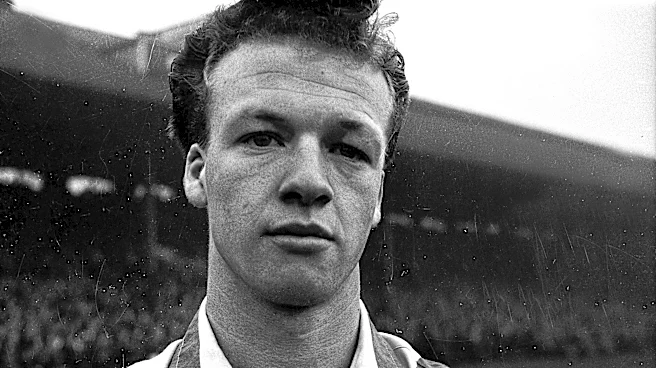



On this day in 2022, Billy Bingham died. He broke into the professional ranks at Glentoran in Northern Ireland in 1948, before moving to Sunderland in 1950 – where he spent eight years of his career, the longest spell at any of the five clubs he played for.
He turned out for the Lads from 1950 – 1958, playing 227 games and scoring 47 goals, including appearances in the FA Cup semi-finals of 1955 and 1956. He would go on to play for Luton Town, Everton and Port Vale, spending two seasons at each before
retiring in 1965 due to a broken leg.
He was signed for Sunderland for the then princely sum of £10,000 and was, interestingly, informed of the move by a football writer at the time – our very own Charlie Buchan, who shook his hand and said, “Congratulations, you’ve been transferred to Sunderland.”

In addition to signing for the Black Cats, he also continued his shipbuilding apprenticeship in the docks on the River Wear. He was fast, with great ball control. I suppose you could say an ‘orthodox’ winger and a fine crosser of the ball. Small and slight in stature, he made his way into Bill Murray’s team during the 1950/51 season.
His international record is most impressive. Whilst at Roker Park, he didn’t miss a single Northern Ireland game, which included five starts in the 1958 World Cup Finals. Up to the turn of the century, he was only joined by Stan Anderson as a Sunderland player who had appeared in a World Cup Finals tournament.
That figure has massively increased, of course, with Sunderland contributing eleven players to this year’s World Cup – only bettered by five other Premier League clubs. It is a reflection of how the game is far more of an international affair now, with vastly greater sums of money involved.
Unlike most players, however, his early exit from playing was only the beginning of the name he forged for himself in football. He is far more widely recognised as an excellent manager and coach.
His first foray into management came at Southport in 1966, before he moved on to Plymouth Argyle. He then returned to his native Northern Ireland with Linfield, before becoming Greece national coach in 1971. He also managed Everton for four years, PAOK (Salonica) and Mansfield Town during the 1978/79 season.
But it was his second spell as manager of his beloved Northern Ireland where he will be most famously remembered. He had already enjoyed a brief spell in charge of his country’s team in 1967, although he reportedly did not find the role taxing enough. He was appointed for a second spell in 1980, during which Northern Ireland won the Home International Championship – only the second time they had achieved such a feat in 96 years.
I used to love watching the British Championship on telly. An annual competition between the four home nations, it provided some of the very few live games one could watch at that time.
Bingham then led his nation to the 1982 World Cup after qualifying with victories over Sweden, Portugal and Israel. In the tournament itself, despite having a small squad and relatively few recognised stars (apart from perhaps Pat Jennings, Norman Whiteside and Martin O’Neill), they stunned hosts Spain with a 1 – 0 victory.
Followed by draws with Honduras and Yugoslavia, they topped their group with only two goals, both scored by Gerry Armstrong. They exited in the second round after a draw with Austria and a 4 – 1 defeat to France.
He led Northern Ireland to victory in the last-ever British Championship in 1984. Declining attendances, a tightening international calendar and rising crowd violence during the late 1970s and early 1980s all contributed to the competition’s death knell.
Bingham proved that 1982 was no fluke, as he took Northern Ireland to the 1986 FIFA World Cup after qualifying ahead of Finland, Romania and Turkey. However, their journey would not last as long this time, having been drawn in the same group as Brazil and Spain.

Largely due to the retirements of the aforementioned Jennings, Whiteside and O’Neill, Billy was deprived of some of his best players, and Northern Ireland failed to reach the World Cup Finals in both 1990 and 1994.
He stepped down in November 1993. The final game of the 1994 qualifying campaign was against the Republic of Ireland, managed by Jack Charlton. Despite already missing out on qualification themselves, Northern Ireland set out to spoil the Republic’s chances.
Jimmy Quinn’s strike was cancelled out by a late Irish equaliser. There were angry scenes at the end of the game and an ugly exchange between Bingham and Charlton.
Billy was awarded an MBE for his services to football in 1981. He was diagnosed with dementia in 2006 and sadly died in a care home in Southport on 9th June 2022, aged 90. Rest in Peace.