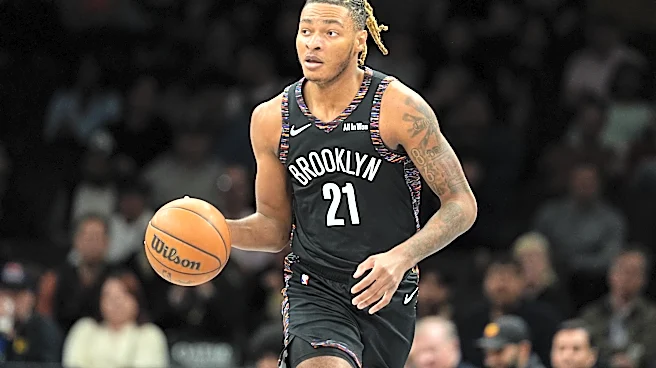






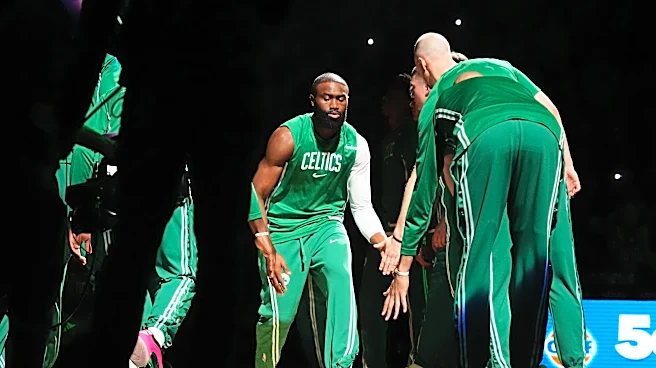
In his lone season at the University of Alabama, Noah Clowney shot 28.3% from deep on 7.2 attempts per 100 possessions. Through three NBA seasons (135 appearances), Clowney is shooting 33.2% on 10.7 3-pointers per 100 possessions. In 2025-26, Clowney played more NBA minutes than in his first two seasons combined, shooting 32.9% from deep on just under 11 attempts per 100 possessions.
You’d expect increased efficiency from a teenager with sudden access to NBA-level shooting instruction, but Clowney
also takes a ton of threes, a skill by itself. Though he is 6’10”, Clowney doesn’t have the quickest release, bulked up before this past season, has to work through frequent slumps, and is entirely reliant on his teammates to set him up with catch-and-shoot opportunities. And he still gets ‘em up.
I think this Clowney quote from December is mostly alluding to that skill, a skill that, not coincidentally, Jordi Fernández often praises: “I think my problem was at a time where I would be too worried about how I looked from the outside. I don’t really care no more, because I had to realize the only people whose opinion I really care about and how I’m playing is my teammates and coaching staff that have seen me the whole summer.”
That perspective from the 21-year-old is easy to understand. There are plenty of 2-of-8 nights, who hopefully doesn’t see his mentions on social media, full of irate fans demanding he stops hoisting them up. But he has to keep shooting. Through two seasons as the Nets’ head coach, Fernández’s biggest pet peeve seems to be when players turn down open looks.
So clearly, Clowney has gotten better as a 3-point shooter since Brooklyn drafted him in June 2023. Not every young player can make the statistical shooting leap Egor Dëmin made from NCAA -> NBA, but Clowney’s improvement is commendable. Is it enough?
Noah Clowney is no longer a mysterious prospect. Two years ago, he was exceptionally young, wiry, and possessed a few tools that didn’t add up to a clear player archetype. After spending most of his rookie season with Long Island, he played a few games for Brooklyn at the end of an otherwise miserable 2023-24 season and had bunch of fun flashes, including a game with seven blocks!
The mystery is no longer. After some trial-and-error while surveying the wider NBA landscape, Brooklyn has landed on a preferred role for Clowney. He is a wing, expected to launch catch-and-shoot threes and accept a variety of defensive assignments, aided by a 7’2” wingspan that now exceeds the norm for his position.
I feel rotten typing such a cliché, but outside shooting truly is his swing skill, and low 30s percentages aren’t good enough. Per Synergy Sports, about 43% of his usage comes from spot-up situations, which includes opportunities where he drives to the basket. That’s an 88th percentile mark league-wide. Nearly 58% of his total field-goal attempts are catch-and-shoot jumpers, an 82nd percentile mark.
Clowney made noticeable strength + physicality improvements over last summer. He drew plenty of free-throws and had a couple wow moments on drives this season…
Still, Clowney is not going to be a dribble-handoff hub, nor a rim-rolling big. He also doesn’t have the handle to initiate much offense by himself. And that’s okay — not every 6’10” player, even in 2026, has to be a ball-handler…
But what does he excel at?. He’s made a couple nice drive-and-kick passes, but there’s not a ton of playmaking potential to write home about. He is a below-average offensive rebounder, grabbing 4.1% of available misses in his career and 3.2% this season. Per Stathead, 86 players at least 6’9” tall played at least 800 minutes this season; Clowney ranked 79th in offensive rebounding.
Can that be blamed partly on Brooklyn’s scheme, over-emphasizing transition defense? Is it because Clowney is always stationed at the 3-point line (though many teams crash hard from the corners and wings)? One league decision-maker views it as a motor issue, calling him “so soft defensively” before adding, “I just hate his casual demeanor. No intensity to him. Even though I like his game.”
I don’t really buy that. It’s more of a frame issue. Again, the 21-year-old only put on any real muscle before this 2025-26 season, and he has a high center-of-gravity without much burst to begin with. That being said, if Noah is the third-biggest Net on the court, he’s a fine defensive rebounder. This is fairly arbitrary, but judging by Cleaning The Glass’ positional designations, he would have been a 90th percentile defensive rebounder among “wings” this season, in the 60th percentile among “forwards,” and in the 25th percentile among “bigs.”
It helps explain Brooklyn’s evolving philosophy under Jordi Fernández. Recall that Clowney only entered the starting lineup in November once Cam Thomas, of all players, went down with injury. Fernández then assigned Clowney plenty of tough perimeter matchups; in one three-game stretch, his primary assignments were Kevin Porter Jr., then LaMelo Ball, then Josh Giddey. If nothing else, Brooklyn has done a great job of stress-testing Clowney’s abilities since drafting him.
It could be the many ankle injuries he suffered last season, it could be the extra muscle he added, but I found Noah to be a bit less explosive this season, both laterally and vertically. You see it on this closeout vs. KAT…
Despite shot-blocking wizardry in a small rookie sample, Clowney has been an unremarkable defender since then. He has a big help-side block every couple games, but it’s tough to say he’s a difference-maker either down low or on the perimeter, even if he is passable in most regular-season games.
In his third NBA season — his first with a full workload — Brooklyn greatly benefitted from Clowney’s insertion into the lineup. Per Cleaning the Glass, the Nets were 3.5 points per 100 possessions better with Clowney on the court, largely due to better 3-point shooting, better defensive rebounding, and fouling less. Some luck? Proof of concept that Clowney is a real, if unorthodox, wing prospect? It’s not nothing.
Which brings us back to the shooting. He’s made improvements, but there has to be another leap in there. By the end of the season, far more opponents were daring Clowney to shoot, particularly on above-the-break attempts.
“I shot pretty well from the corners, above the break not as much,” said Clowney at his exit interview. “It was some other stats that I found interesting, but for the most part, it boiled down to my shot selection. When I shot good shots, a lot of the time they went in. But a lot of times I make one, I might shoot something crazy, because I feel like I’m going.”
I worry that the effectiveness of his drives is going to dip if defenders respect him less, but clearly, Brooklyn’s line between good and bad 3-point shots is thin. This quote signals to me that Fernández & co. want Clowney to keep driving hard, even if defenders sag off. The third-year pro shot under 60% at the rim this season, like last season, but that doesn’t tell half of the story.
Clowney posted a .355 free-throw rate (meaning he took .355 free-throws for every field-goal attempt) in 2025-26 a preposterous rate for someone with his offensive duties…
Said Clowney: “I worked on it, and I kind of did it a whole lot more, so I was bound to get better at it. With that being said, I drew fouls, I was good at that, but when they didn’t foul me, sometimes I struggled to finish. Sometimes I get caught on one foot … things like that, I can get better at.”
The native South Carolinian has always been honest about his game. Here’s how he describes his season as a whole: “I progressed this year, maybe not as much as I wanted to, but I got better at some different things, and I got more experience. So I take that for what it is. You know, I got to gel more with the group that’s probably going to be around for a while.”
Outside of the five first-round picks, he was the youngest player on the youngest team in the NBA. But it’s already time to talk extension for Clowney; the deadline is just before next season tips off. It’s worth noting that the Nets did not extend sign former first-round picks Day’Ron Sharpe and Ziaire Williams to rookie extensions in the summer/fall of 2024, but signed both of them to two-year deals (with a team option) the following summer. Could Clowney be in for a similar fate?
It’s still a bit early for those talks, but the lanky wing is an interesting case. For a #21 overall pick, he’s progressed nicely through three years … but enough?
The Nets want to win some games next season without gutting their long-term assets. If another front office likes Clowney, I wouldn’t hesitate to include him in a trade for a player that helps Brooklyn reach relevancy in 2026-27. But assuming he’s back in the borough, it’ll be a prove-it season for Clowney. If Jordi Fernández doesn’t trust him to help the Nets compete, there’s far less incentive to play him 27 minutes per game, as he did this season.
In other words, Noah Clowney is already at an inflection point in his career. Time flies, doesn’t it?